West Bank violence now a cause for concern


102nd vigil attracts strong attendance

November 2025

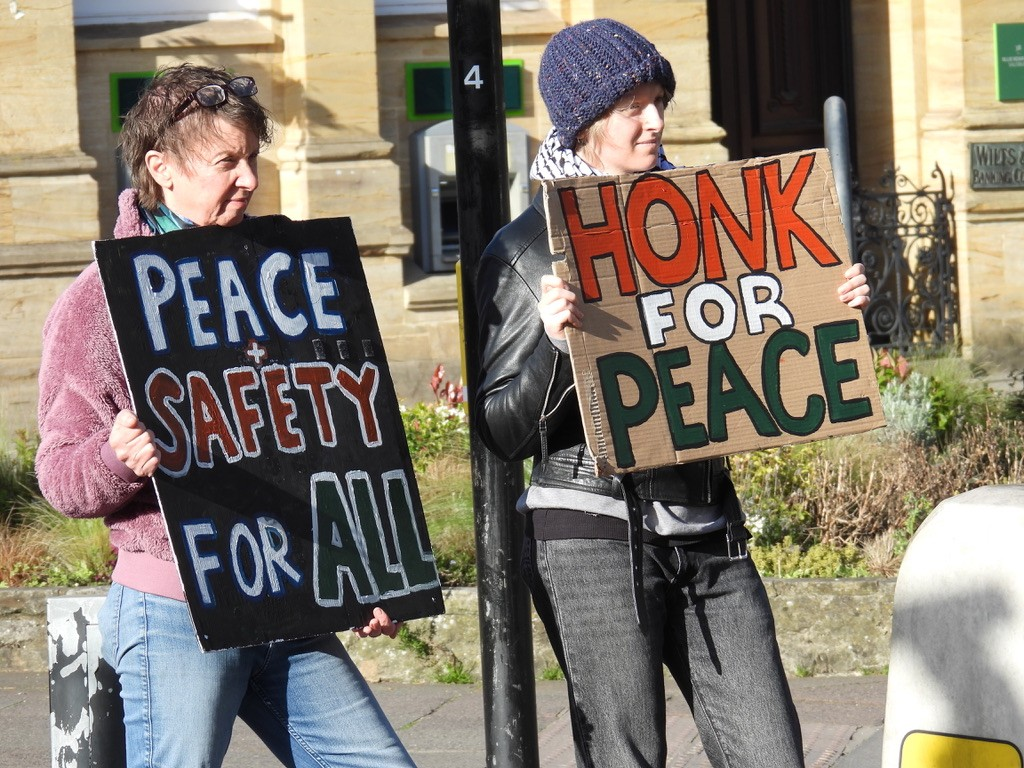
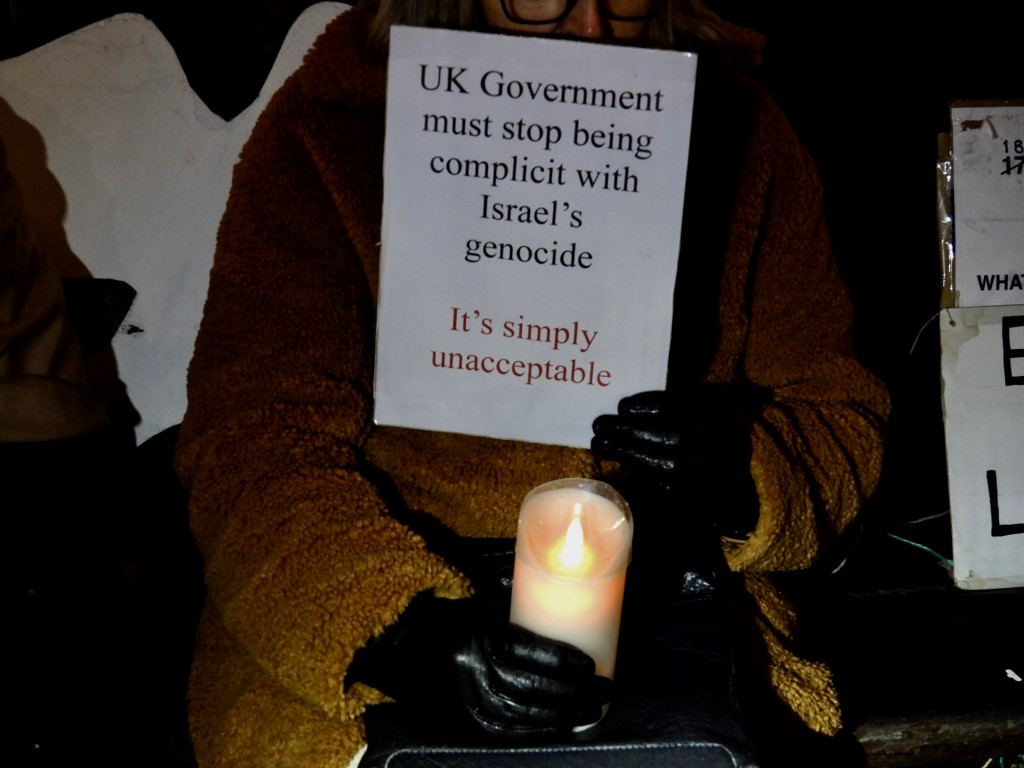
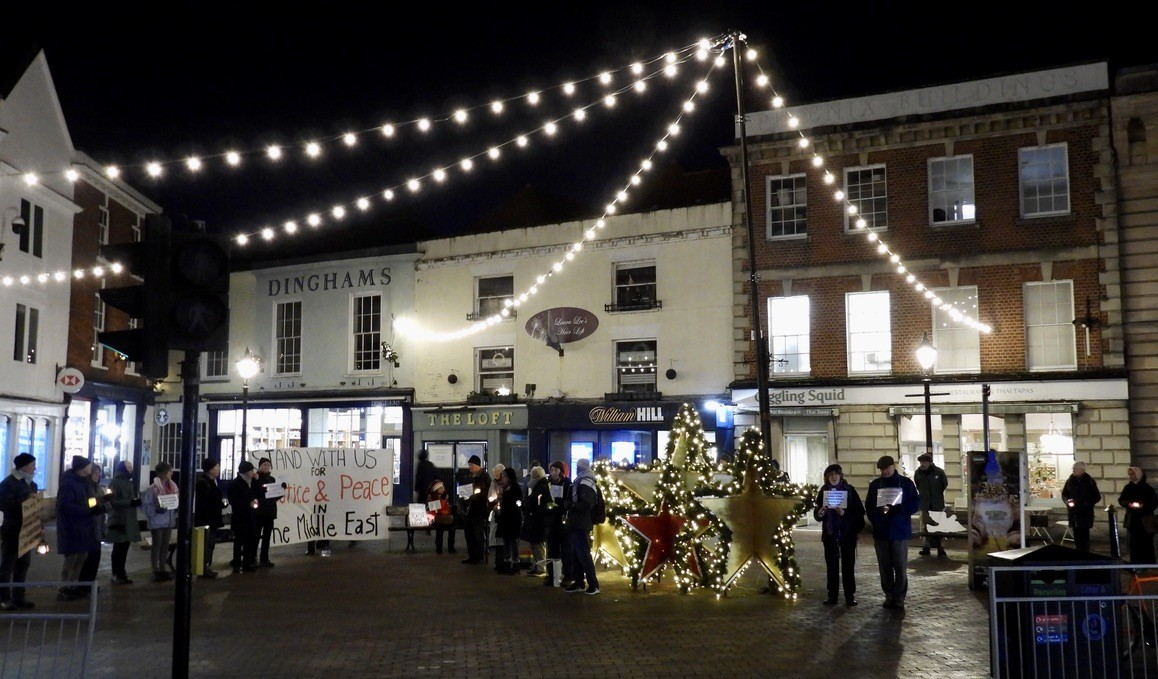
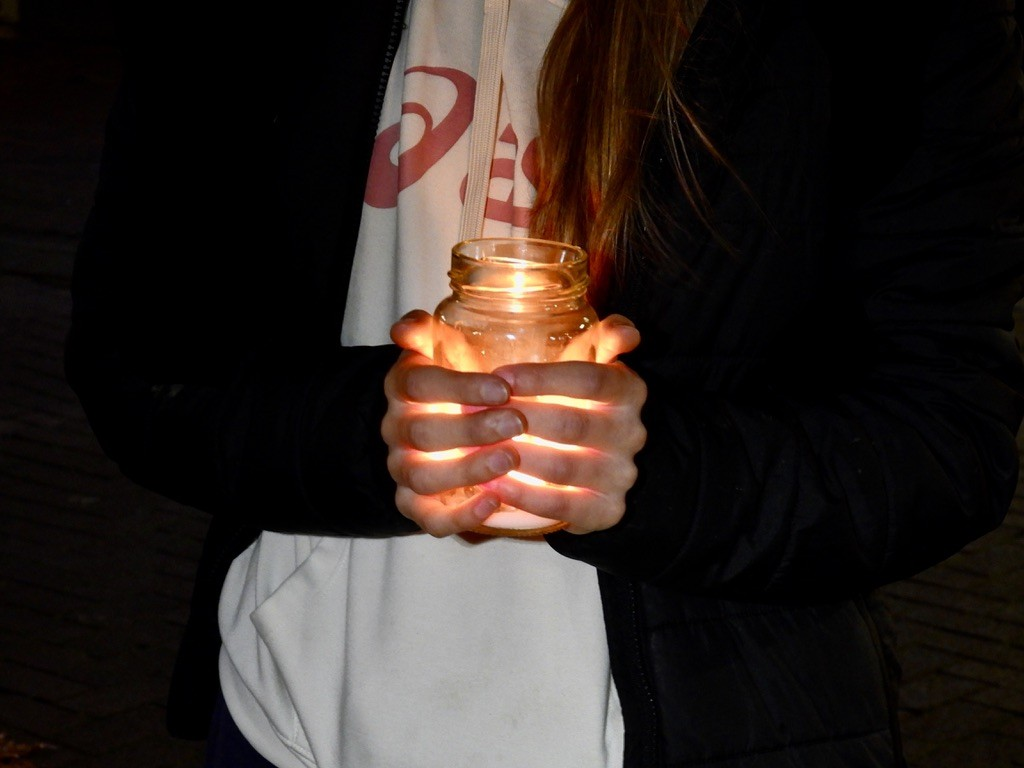
It almost doesn’t seem possible that for 102 weeks a group of people turn out of a Saturday evening to hold a silent vigil against the violence and death in the middle east most particularly in Gaza. Over 40 did so this Saturday (15th November) even with a number of the ‘stalwarts’ away for various reasons but their places taken by new people. A video can be viewed here.

Media attention has shifted away from Gaza for the moment and more attention is being paid to the violence in the West Bank. This has increased to frightening levels and news programmes showed settler gangs roaming Arab and Palestinian villages, destroying cars and houses at will. A BBC report showed an attack on a Bedouin village and business. There is little sign of police or IDF protection and previous footage shows them just standing by whilst the violence continued. Bizarrely, any Palestinian who protested would themselves be arrested. The attack on a dairy shows the same kind of tactic used in Gaza where the basic facilities of life – water, electricity, hospitals and food supplies – were consistently attacked and destroyed. President Herzog has said that this violence must end.

It is important to emphasise that many Israelis are appalled at this increased level of violence and intimidation. We are now into the season where olive are harvested and this has become a flashpoint in the West Bank in recent years as extremist Israeli settlers regularly threaten and physically harm Palestinian harvesters. This year, “the situation on the ground is out of control,” Anton Goodman of Rabbis for Human Rights said on a Haaretz Podcast.

“We have never seen anything like this,” Goodman emphasized, noting that in the past, “We’ve seen settler attacks, and we’ve seen unnecessary army aggression and restrictions, but we’ve never seen such a peak moment of violence affecting so many communities.”

By not clamping down on the gangs and standing by while the violence is carried out, Israel has created a problem for itself. Emboldened and supported by the hard liners, it is difficult now to rein in their activities.

Sources: BBC, AP, Haaretz

Video and image from the vigil courtesy of Peter Gloyns.

Next vigil on Saturday 22 November at 17:00 by the Library.

Previous posts:

November 2025 Human Rights Newsletter Highlights


November 2025

We are pleased to attach the minutes and newsletter for November thanks to group member Lesley for compiling them. They contain reports from other group members and are of general interest to followers of human rights issues. There is a report on immigration for example a topic which continues to make political waves in the UK. It makes the point that whereas the main focus of political ire and furious editorials and commentary is the number of arrivals on boats, the actual number is relatively tiny in proportion to the total number of immigrants.

There is also a report on human rights issues in the UK a matter of increasing concern. Both the Conservative and Labour governments do not like protests and have – or are planning to – introduce more and more legislation to hamper, ban or severely restrict protests and demonstrations.

There is a list of forthcoming activities which would provide an opportunity for anyone interested in joining to make themselves known.

Recent posts:

Other Amnesty groups are free to use content.

Not over yet in Gaza


Around 35 attended the 101st vigil in Salisbury and the recognition by passers by was higher than usual.

November 2025

News about Gaza has dropped down the agenda in recent weeks with concerns about prisoners mistakenly being let out of gaol tending to occupy the news agenda. Endless speculation about the budget is also taking up space and the terrible events in Sudan rightly receiving attention. The ceasefire in Gaza and the imminent arrival of the peace force (if Washington is to be believed) has dropped off the agenda. No war, no news.

This could prove to be a big mistake. Pressure is growing on the Israeli government to allow foreign journalists into Gaza especially as one reason given was their safety. Many journalists have died, around 245, the largest death toll in a conflict. The Palestinian Journalists Syndicate has accused the IDF of deliberately targeting journalists who have struggled against great odds to get their stories out. No sign yet that Israel will agree although they did allow limited access to reporters, including the BBC, last week and a brief report was broadcast. The visit was tightly controlled, reporters were not allowed to speak to any Palestinians, and an IDF officer was allowed to speak without being questioned or challenged. Nevertheless, the scenes of total devastation were horrific.

We survived the war, we may not survive the ceasefireSara Awad, a Palestinian journalist in Gaza recently

Will the ceasefire lead to a lasting peace? It is unlikely. Firstly, the territory is still being bombed. There are differing reports about the death toll since the 10 October with Haaretz reporting 38 and Al Jazeera 238. The video above says 245. There is no likelihood of a Palestinian state. West Bank violence continues unabated. Some reports suggest little has changed in terms of food supplies into Gaza.

It is one of the reasons we are continuing with our vigils: to take our eye off the ball at this stage would be a mistake. Much as our government would like protests to stop and the police are busy arresting protestors, awareness of the genocide in the area is greater than ever. This is denied by Israel and an argument against this can be read here. The complicity of our government in the carnage is a story yet to be told and will be the subject of future posts.

A video of the 101st vigil is available thanks to Peter Gloyns for producing it is such quick time. We shall be back next week on 15th. Other information on the Salisbury CND site.

Previous posts:

Is International Law Losing Its Authority?


Does International Law mean anything any more?

October 2025

Last week, the International Court of Justice (the principal judicial organ of the United Nations), in an advisory opinion, declared Israel to be in breach international law in preventing aid from being sent to Gasza. And this week, Danny Kruger MP, on behalf of Reform UK, declared that the requirement in the UK’s ministerial code to acknowledge international law in their decision-making would be dropped by any future Reform UK government. On the first point, the Israeli government of course denied the charges and the second is unlikely to happen, but they raise the question “How far is international law able to be enforced?”

Readers may recall, at the time of the Brexit negotiations, a particularly awkward point was resolved by evidently breaking international law. The then minister, one Brandon Lewis, claimed that it only broke international law “in a specific and limited way”, for which he received much ridicule, but is such a response arguable or merely dismissive?

International law is a vague concept, in that much of it is not regulated. Those aspects that are enshrined in treaties are binding (but only among signatory states), while some are no more than statements of principle (think migration). The case of Benjamin Netanyahu and the International Criminal Court reveals some of the problems – countries that have signed up to the Court are obliged to arrest him if he come under their jurisdiction, but he can move at will among non-signatory countries, and some signatories may consider it too much of a hot potato to intercept him. In his trips to Washington for example, he has to fly an inefficient route to avoid needing to overfly an unfriendly state.

So, is the law becoming meaningless? The current United States administration is set on removing and authority from the United Nations, which has largely been the means by which the laws have been enforced, and the collegiality that once existed on e.g. climate change, has largely gone. Even the EU has its own laws constantly flouted by member states (which are punished, but don’t care). But appeals are still made to the UN and other international arbitrators, in the absence of any better option.

Clearly, our expectations of governments’ probity have been too high. The ICJ’s judgements are binding, but they have no powers of enforcement and are dependent on the Security Council for any action (and the Council is subject to veto by any of the 5 permanent members).

Indifference

One might conclude that international law is like human rights law; important to have it, but, in the end, any state choosing to ignore its precepts will probably get away with it. What has changed maybe has been that states used to argue the their actions were within the law, whereas now they are indifferent as to how they are judged. It might be worth establishing a regime of specific sanctions for specific offences, which could be more plausibly mandatory. But, as Hobbes said, “Covenants without the sword are but words.”

AH


Danny Kruger is the MP for East Wiltshire who recently defected to Reform from the Conservatives.

Recent posts:

World Day Against the Death Penalty


10th October was the World Day calling for an end to this barbaric penalty

October 2025

The 25th World Day was last Friday and there is a post by the International Bar Association Human Rights Institution with further details. The IBAHRI Co-Chair Mark Stephens CBE commented: ‘The death penalty is a legal relic that belongs in the dustbin of history. It is cruel, inhuman, and degrading – not justice, but a failure of it. The IBAHRI condemns its use in all circumstances. We applaud those nations that have had the moral courage to abolish it and urge those still clinging to this barbarism to follow suit. The global tide is turning – abolition is not just inevitable, it is imperative.’

Amnesty is focusing in its latest campaign against the use of the penalty as a tool of repression. Trends recorded so far in 2025 indicate that executions have significantly increased in some countries, when compared to figures registered in recent years. Among these rises, some governments have shown renewed determination to use this cruel punishment as a tool of repression and control. This has frequently happened in the context of flawed narratives intended to create a false impression of security through a display of heavy-handed responses from the state, and to score political points. These narratives have also fostered a flagrant disregard for safeguards and restrictions under international
human rights law and standards that have been established to protect people facing execution from being arbitrarily deprived of their lives.

Held every year on 10 October, the World Day against the Death Penalty is organised by the World Coalition Against the Death Penalty (WCADP), of which the IBAHRI is a member.

Our group has campaigned for years for an end to the penalty. It is not a deterrent against crime, mistakes cannot be corrected if new evidence comes to light and the effects on those who have to carry it out is seldom taken into account. We publish a report every month and the latest is available here. We shall be following up the Amnesty campaign in later posts.

Recent posts:

Latest vigil: No 96


Vigil took place at a difficult moment

October 2025

The vigil took place two days after the killing of two Jewish men and the injury of three others at the Heaton Park Hebrew Congregation Synagogue at Crumpsell, Greater Manchester. The terrorist act was carried out by Jihad Al-Shamie. The attack shocked the nation and the Prime Minister had to fly back from a security conference in Copenhagen to attend a COBRA* meeting. It has brought to light the degree of anti-Semitism that Jews are experiencing with many receiving threats and abuse. It later emerged that one of the dead was shot by a police marksman when a bullet went through the door of the synagogue. Synagogues have to have considerable security to protect people attending. The levels of abuse have increased since the October 7th attack in Israel.

Here is a video of the vigil.

The attack sparked a debate concerning events such as this vigil and the national demonstration planned in London in support of Palestine and an end to the war in Gaza. There were many who argued that such events should be postponed in view of the Manchester killing. Others argued that the war continues in Gaza and over 50 more were killed on the day of the Manchester attack.

The other key event was a proposed peace plan agreed between Presidents Trump and Netanyahu following the latter’s trip to Washington last week. The plan has 20 points but it was not discussed with any Palestinian present. Hamas are reported to be considering the plan and indirect talks are planned on Sunday 5th in Cairo to discuss it. The plan made no mention of a Palestinian state.

Haaretz reports the death toll in Gaza has reached 67,000. More have died of starvation. Over 30 attended the vigil.

A COBRA meeting is a gathering of senior government officials and other key figures to discuss and respond to a national emergency.  These meetings are convened when there is a situation that requires immediate and coordinated action from multiple government departments and agencies. It stands for Cabinet Office Briefing Room A and refers to the location where the meetings are held.

Ninety third vigil


Over 40 attended our latest vigil

September 2025

We still meet on Saturday outside the Library in the centre of Salisbury to promote the idea of peace in the Middle East. The carnage continues. The death toll stands at an estimated 64,871 of which over 19,000 are children. It is thought that 422 have died of starvation. There is no viable peace negotiation currently underway.

Israel recently attacked a building in Qatar saying it was occupied by Hamas individuals who carried out the 9 October massacre. The attack is contrary to international law and the Qataris are furious. Israel informed the US before the attack as they have a major base in that country. The attack seems to indicate a boldness by the Israelis supported as they are by the US.

One attendee at the vigil was wearing this shirt to emphasise that the conflict has its roots in 1948 Nakba where around 750,000 – 1 million Arabs and Palestinians were displaced or lost their lives in the campaign by the IDF to displace them. Current media attention is on the 7 October massacre by Hamas and not on the events in 1948.

A video of the vigil can be viewed here thanks to Peter Gloyns for producing it.

No sign of the local MP, Mr John Glen nor any mention of the vigil in his weekly Salisbury Journal column. He is reported to be a member of Conservative Friends of Israel.

Minutes and newsletter


Minutes for our September meeting

September 2025

We are pleased to attach our minutes and newsletter for this month which has reports by members on the death penalty, the vexed issue of immigration and our increasing concerns about the erosion of rights in the UK. There are also details of forthcoming meetings and activities (so far planned). Thanks to group member Lesley for preparing these.

Global Refugee Crisis: Key Statistics and Insights


Latest report on the refugee and asylum situation

September 2025

This month has been overshadowed by arguments around flags.  Leaving aside the question of accommodation for asylum seekers, I wanted to provide a summary of the worldwide situation.

123 million refugees worldwide

At the end of 2024 there were estimated to be 123.2 million “refugees”, of whom 42.7 million have refugee status, 73.5 million are internally displaced within their own country and 8.4 million are seeking asylum. (4.4 million are officially stateless).  That amounts to 1 in 67 of the world’s population in flight. The largest numbers by country were from Syria (see more below) 13 million, Sudan 12 million, and Ukraine 10 million.  Interestingly, the numbers returning home during the year were 20,000 Syrians, 73,000 Ukrainians but only 3,700 Sudanese (hardly surprising).  Of 8 million Congolese in exile, only 122 returned home during the year.

On the return question, the UK’s deal to return one for one asylum seekers to France has started and the UK government is seeking a similar arrangement with Germany.  Since the aim is to reduce the backlog of pending applications, it is worth noting that the appeals backlog is currently around 70,000 (90,000 last year).  The main reason for the failure to reduce the numbers dramatically is the decline in the acceptance rate.  Whereas in 2023/4, 58% of applications were accepted in 2024/5 this was down to 48%, resulting in more appeals and more processing time.  Also the quality of the assessments has been criticised as leading to more overturning of decisions.  Among Afghan asylum seekers 96% were granted leave last year and only 40% this year (though only 8 families were actually returned in 2024/5).  This pattern is general – of 96,910 refusals between 2020 and 2024, only 24,508 people were actually returned.

New Home Secretary

With a new Home Secretary we must expect more legislation on small boats.  The number of people crossing this year is, of course, up on last year’s figure by 27%, mostly due to prolonged fine weather.

The reshuffle has meant that Home Office ministers Angela Eagle and Seema Malhotra have been moved to other departments, signalling probable change in policy under the new minister.

Section 80B of the Nationality Immigration and Asylum Act 2002 has been amended to take account of Brexit and the lapse of the old Dublin rules about seeking asylum in the first safe country arrived at. The rules on “inadmissibility” have been tightened to make it possible for any perceived connection to a third county grounds for deporting applicants to that (“safe”) country.

Still in the UK, the previous Home Secretary temporarily suspended applications for family reunion.  It remains to be seen if the right will be restored.

The Council of Europe has issued a report warning member countries against outsourcing application processing to third countries.

The MOD has admitted 49 data breaches in the handling of Afghan applications; this will have a very damaging effect on giving information about Afghans who served the pro-Western government to the current leadership. Following the leak, the then government set up the Afghanistan Response Route secretly to aid 7,000 Afghans to come here.  It was ended in June without any detail of its success or otherwise.

Outside of Europe the USA has now done deals to deport “illegal” immigrants to Rwanda, South Sudan, Eswatini and Uganda.  The latter country has 2 million refugees from the DRC within its borders. President Trump has suspended the US Refugee Admissions Program – President Biden set it up with a cap on the number of arrivals of 125,000.  Trump has decided on allowing 40,000 immigrants, of whom he wants 30,000 to be Afrikaners from South Africa.

…But finally, some good news.  Following the overthrow of Assad, the UNHCR report that 2 million Syrians have returned home, 600,000 of them from abroad.

AH

‘What did you do in the war Daddy*?’


Analysis of the voting record of the three Members of Parliament in the Salisbury area

August 2025

Salisbury has three MPs whose constituents live in the Salisbury area and it is timely to ask how they have performed in Parliament concerning the conflict in Gaza. We compare this with the invasion of Ukraine by Russia which is broadly taking place at the same time.

Although there is no job description for an MP, a key role is to represent their constituents in parliament and to the government of the day. Their constituents will have a plurality of views so straightforward representation is almost certainly impossible. A further problem is to ask who are they representing? This refers to the many lobby groups and organisations who spend millions on their activities trying to persuade MPs to their views and ideas. A key one relevant to this post is the role of the Conservative Friends of Israel thought to be the largest lobby group in parliament and with around a third of a million pounds, very well funded. The MP for Salisbury, appears to be a member of this group.

Methodology

We looked at the website They Work for You and used the following search terms [Gaza] [Israel] [Palestine] and for comparison [Ukraine]. All were accessed on 25 August 2025. We also did a search using Startpage (a search engine) using the same terms. We also referred to the website MP War Crimes. This site has analysed a wide range of sources and has concluded that all three MPs are ‘anti-Palestine’.

Results

John Glen (Salisbury).

Only three interventions none of them concerned about the violence. One asking about the refusal of Israeli authorities to allow MPs to enter the area. A question with a focus on Christians in the area and access to Christian holy sites such as the Mount of Olives and Bethlehem. Recently, he complained about an alleged statement by a Irish Republican at Glastonbury saying ‘the only good Tory is a dead Tory’ and ‘Up Hamas!’ and ‘Up Hezbollah!’.

On Ukraine by contrast he made over 30 interventions going back to June 2018.

Danny Kruger (East Wiltshire which comes down to the boundary of the City)

One. On the 29 October 2024 he asked a lengthy question making a collection of doubtful statements concerning Unwra and Hamas. This included the allegation that Hamas was ‘hiding their soldiers in hospitals’ and that they were ‘deeply integrated into Unwra’. Israel has never provided evidence of the former and on the latter, UN investigation showed that 7 operatives out of its thousands of staff might have been involved in the October massacre. This is the only one we could find and the intervention showed strong evidence of Kruger accepting Israeli claims without caveats.

On Ukraine he has made nine interventions.

Sir Desmond Swayne (New Forest West) south of the City

The only one who seems to have asked any questions and ten which we could find with a strong emphasis on West Bank violence. Like Mr Glen, there is a focus on Anglicans some of whom were taken by IDF soldiers from an Anglican hospital and whose whereabouts are unknown. He made a number of interventions about the West Bank prior to October 7th and it seems to be a continuing interest of his on this subject. Only a small number about Gaza however.

On Ukraine, he made a similar number of interventions – ten – going back to 29 June 2016.

Conclusions

The only local MP who exhibits some kind of balance is Sir Desmond Swayne who has asked a series of questions and made speeches on a range of issues both about Gaza, the West Bank and Ukraine. The same cannot be said for either John Glen or Danny Kruger. Indeed, historians in years to come, going through Hansard reading their speeches and questions, would wonder if Gaza or violence on the West Bank had ever occurred. Like reading a Jane Austen novel where you are unaware Britain was at war. Both seem to have a focus on the plight of Christians which is a proper concern and one that is often forgotten in Western media. But wider concerns about other faiths does not seem to be on their radar. As we have reported elsewhere on this site, people in and around Salisbury have now mounted 90 vigils in Salisbury, not one of which Mr Glen has ever attended or referred to in his weekly column in the local paper. He has been voluble on Ukraine but almost silent on Gaza.

We conclude that neither MP is representing, on this evidence, the views of a large number of their Constituents. It is possible that Mr Glen’s membership of Conservative Friends of Israel maybe a contributing factor. None are in government at present. It is important from a human rights perspective because there is mounting evidence of genocide and the use of starvation is a war crime. The known death toll is 62,000.

*Title of a 1966 film comedy

Recent posts:

Blog at WordPress.com.

Up ↑