Regional meeting


Amnesty International South-West Regional Conference in Exeter 11 May 2019

These are some notes of the recent regional conference made by Salisbury group member Fiona. They are not an official record.

The keynote speaker was Emel Kurma, a Human Rights defender from Turkey, currently hosted by the University of York’s Protective Fellowship Scheme. She outlined for us how a Citizens’ Assembly works. Inspired by the Helsinki Final Act, these are low-profile bodies (no smart headquarters or logos) that aim to stimulate social and political discussion towards a peaceful and inclusive society, valuing democratic and environmental principles. The best response to a state’s limitation of individual freedom is to strengthen civil society at all levels, allowing ethical thinking to penetrate even closed structures. For example a liberal academic offered an opportunity to go to a conference abroad might instead hand it to a member of a state institution in order to broaden that individual’s understanding of human rights as practised beyond their country’s borders.

Emel Kurma is a brave individual and her stoical acceptance of probable interrogation and possible imprisonment on her return to Turkey is both shocking and inspiring.

Israel Palestine 

Two other reports (also by women) focused on Palestine and Eastern Europe respectively.
Penny Wilcox has for several years worked with the intriguingly-titled Ecumenical Accompaniment Programme in Israel and the Occupied Territories.  Again in an unobtrusive fashion, they accompany vulnerable Palestinians at checkpoints (adults going to work, children to school, traders etc.) and, simply by acting as protective witnesses, aim to reduce the levels of conflict or anxiety so often experienced by this oppressed population.  This approach is also practised by various Israeli humanitarian groups who wish to offer support to trapped and threatened Palestinian communities.  Even simply to witness and record the bulldozing of ‘illegal” Palestinian structures (cow byres, olive trees) is an act of silent protest and solidarity.  One of the many ironies of this absurd and tragic occupation is that when sometimes belligerent Israeli settlers have gone into Palestinian villages to cause trouble, the Israeli army itself has been called in to defend the Palestinians residents.

The third report came from Central Europe co-ordinator Ulricke Schmidt, who traced worrying trends in the rise of racism and anti-Semitism in Hungary and, to a lesser degree, in Poland.

Hungary

In Hungary the usual targets are the Roma, but the influx of refugees has now made them the focus of anger.  This in spite of the warm reception originally given to those fleeing war, who were perceived as ‘passing through’ Hungary and in manageable numbers.  However attitudes have hardened and Ulriche quoted an acquaintance who got 6 months imprisonment for giving a lift to a refugee while NGOs risk being criminalised for helping them.  Additionally, resentment against global capitalism has contributed to a revival of anti-Semitism.  Huge posters crudely stereo-type George Soros as ‘an enemy of the people’ with his ‘army of leftist terrorists’.

Ulricke defines some of the underlying causes of xenophobia as relating to globalisation – seen as benefiting the few – and to a drift to the cities which has left a frustrated and impoverished rural population to grasp at the promises of the Right to restore Hungary’s romanticised past (sounds familiar, does it not?).

Poland 

Poland reflects some of these trends, but fortunately to a lesser degree. Some liberal teachers have been disciplined and protesters have had their personal data published.  But Poland has had a more recent history of resistance to authoritarian rule.  When an outright ban was placed on abortion thousands of women marched in protest to overturn it.  When a recent Independence Day march was joined by racist demonstrators, fourteen brave women entered the throng and unfurled a Stop Fascism banner.  They were beaten by some marchers, and subsequently charged and fined by the courts for ‘disrupting a lawful demonstration.’  But a recently published video has now prompted an Appeal Court investigation into the attack..

The European Union has triggered Article 7 against Hungary for imperilling European values and has also expressed concern that the judiciary in Poland is being politicised.  On a more positive note, 26 EU countries have recently seen powerful demonstrations against fascism, racism and anti-Semitism.

Death penalty

The Death Penalty workshop confirmed that our group is very well informed on relevant data thanks to the regular updates from group member Lesley. The new network now has two and a half thousand members.  An interesting recent survey estimated that it was actually more expensive to execute a prisoner than to simply keep them in prison.  The campaign is currently now focusing on Singapore and Iran, the latter for its practice of deferring punishment until a sentenced juvenile is old enough to receive the death penalty.  On a positive note – more and more countries are abolishing the death penalty – 106 in total by the end of 2018.

Many thanks to the regional representative Chris Ramsay for organising this meeting.

Death penalty report


The most recent death penalty report on the use of the death penalty around the world is now available thanks to group member Lesley for compiling it.

Report (Word)

Monthly meeting


The next monthly meeting is on May 9th at Victoria Road as usual starting at 7:30.  Supporters are very welcome to attend.

Southampton event


Sing for Freedom

Our colleagues in Southampton are holding and event in June and have asked us to promote it locally which we are happy to do.  It is a folk concert and is in Freemantle on June 24th starting at 7:30.  Tickets are £6 on the door.  Further details on the poster link below:

Southampton event

Real Neat Blog Award


37 beheaded in execution spree in Saudi


Shocking news of a beheading spree in Saudi Arabia.  Allegations of a crucifixion

It has been widely reported that Saudi Arabia executed 37 individuals on Tuesday 23 April 2019 in what was the biggest mass execution since 2016.  The executions have been widely condemned around the world and mark an alarming increase in the use of the death penalty by the regime.  Any hope that the rise to power of Mohammad bin Salman (pictured) marked a more liberal regime seem well and truly to be finished.

The UK government is usually quite reticent in these matters claiming to make its views known behind the scenes.  However, in this instance, diplomatic language seems to be set to one side following an urgent statement in the House of Commons:

The Foreign Office minister Sir Alan Duncan, answering an urgent question in the Commons, spurned the usual diplomatic niceties, saying the mass executions were “a deeply backward step which we deplore”. He added it was “deplorable and totally unacceptable” that at least one of those executed had been a minor at the time of the arrest.
He highlighted reports that one of those executed was displayed on a cross, saying that anyone in the House, just two days after Easter, would find “more repulsive than anything we could picture.  Parliament site [accessed 24 April 2019]

In response, Sir Vince Cable said:

We are in urgent need of a reappraisal of our relationship with Saudi Arabia given that the continued medieval barbarism of the regime does not constitute the basis for a friendly alliance, and indeed makes it an enemy of our values and our human rights.  Ibid

The executions follow sham trials and according to Amnesty International, involve confessions achieved through the use of torture.  The families of those executed were not told of the executions in advance.  It has been reported that one head was displayed on a pole and that one man was crucified.

Juvenile

One individual, Abdulkareem al-Hawaj was arrested at the age of 16 and the execution of people under the age of 18 at the time of their arrest is against international law.

So far this year, Saudi has executed 104 people and if the current rate continues, will exceed last year’s total of 149 for the whole year.

Saudi Arabia is a major customer for our arms industry and our weapons are among those being used in the devastating war currently being waged in Yemen

Sources:  Parliament site; CNN; Guardian


Future events


Forthcoming events by the Salisbury group

These are some of the events we have planned or are being planned by the local group.  One of these would be a good moment for you to make contact if you were thinking of joining us.

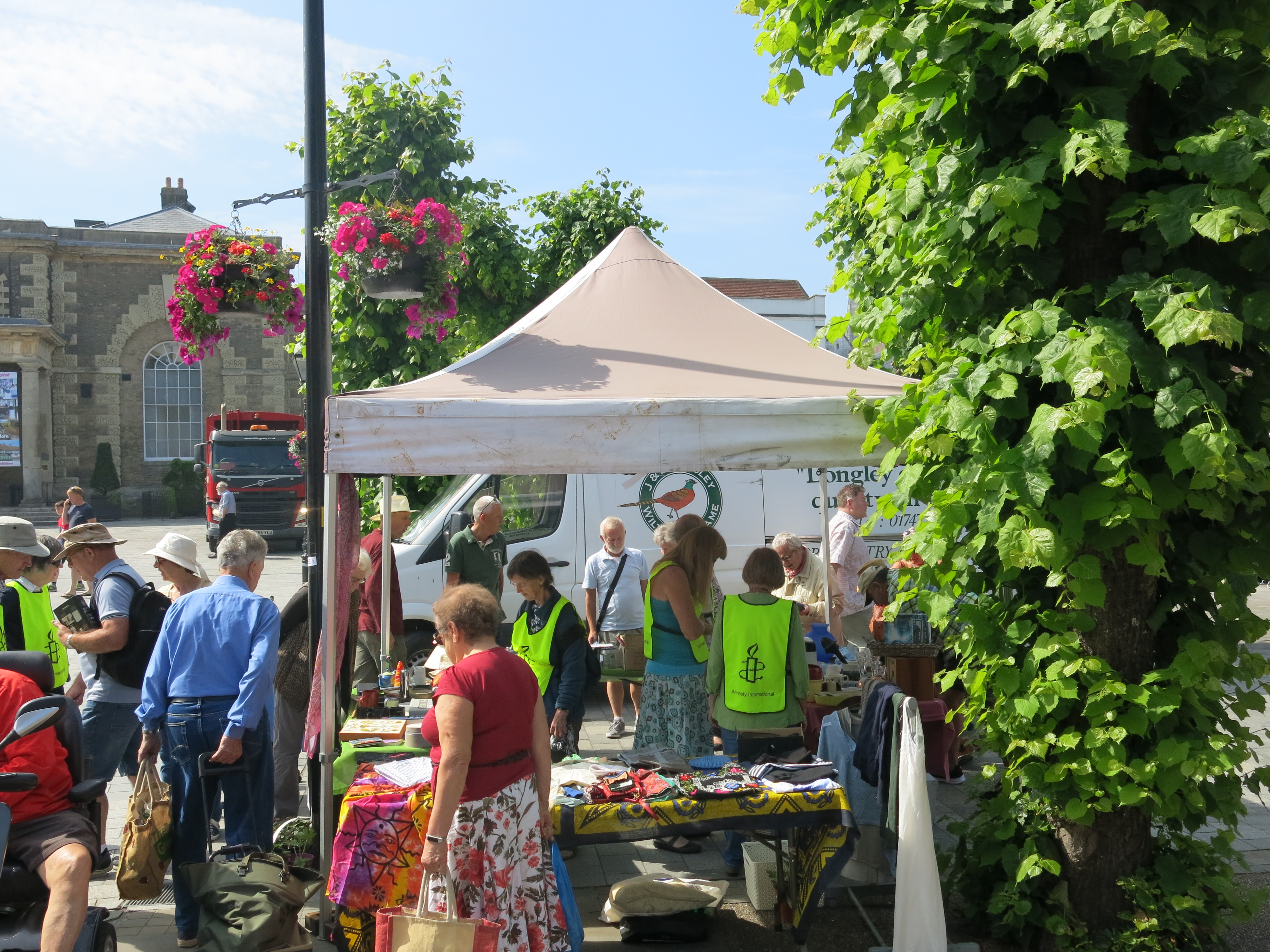
  • Market stall.  This will take place in the Market Square on 8 June 2019 and starts early.  We would be grateful if supporters could bring anything along for sale.  Wanted; china and bric-a-brac, jewellery, good books (not battered paper backs, sorry!), pickles and jams, plants and clothes.  CDs and DVDs are also popular (but not videos).  No 240v electrical goods for safety reasons.  Get in touch if you want anything collected.
  • Refugee week.  Details to follow and is during 17th – 23rd June.  Our last refugee action was on local TV.
  • Talk by Paul Mason.  We are delighted that the journalist and author Paul Mason who will be speaking about his soon to be published book Clear Bright Future: a Radical Defence of the Human Being.  This will take place on 24th June at 7:30 at the Salisbury Methodist Church and is free.  We will be asking for a parting collection to help cover our costs.  Copies of his book will be available to purchase.
  • Coffee morning.  This is on 7 September in the morning as you might expect and is at St Thomas’s church just off the square.  Further details nearer the time.
  • Other events will include a film in November, the World Day Against the Death Penalty and possibly an Evensong at the Cathedral.

You might want to add these dates to your diary.

15 April 2019

Meeting minutes


Minutes of the group meeting held on 11 April 2019 are attached thanks to group member Lesley for compiling them.  We discussed North Korea, the death penalty report, future events including a film night, a market stall and a talk by the author and journalist Paul Mason in June.  There are also some statistics of our social marketing showing quite a busy month.

If you are interested in joining the local group and live in the south Wiltshire area then coming along to one of our events is the best thing to do and you will find a list at the end of the minutes.

April minutes (Word)


Refugee video


Video of the Salisbury group’s refugee action

A few weeks ago, the Salisbury group mounted a short demonstration in support of a better understanding of the plight of refugees.  Refugees and asylum seekers get a bad press in the UK and the UN criticised the article in the Sun by Katie Hopkins referring to them as ‘cockroaches’ and ‘feral humans’.  A full discussion of the role of media in the debate on refugees and asylum seekers can be found in the 2018 report by the International Organisation for Migration particularly chapter 8 p191ff.

A film of our protest with interviews of two group members, was made by the Salisbury TV station ‘That’s TV’ and this can be seen on YouTube.

We issued a factsheet to passers-by on the refugee situation around the world and our role in it.  In the interview we mentioned the resettlement programme being managed by Wiltshire Council.

Refugee factsheet (pdf)


If you live in the Salisbury, Amesbury or south Wiltshire area generally and would like to join us you would be very welcome.  The best thing is to come along to an event we are running and make yourself known.  It is free to join locally.  Keep and eye on this site, or on Facebook or Twitter if you prefer, to see details of our next event.

Monthly death penalty report


Attached is the monthly death penalty report prepared by group member Lesley.  It features Turkey, Iran, Brunei, USA and Taiwan among other countries.

March/April report (Word)

Blog at WordPress.com.

Up ↑