Withdrawal from the European Convention threatened


Government plans to withdraw from the European Convention of Human Rights

The Conservative government has long disliked the European Convention and is now proposing to put withdrawal in the next manifesto.  This will be a serious mistake and will affect the human rights of many individuals in the UK.  It will also send a message to many other countries around the world whose record on human rights leaves a lot to be desired.

Theresa May MP. Picture: ibtimes

One of the problems with discussing this issue is that it is clouded by a programme of disinformation by the tabloid press.  Being a European creation it is damned by association.  It is also, in their eyes, a serious threat because it gives people some rights concerning privacy.  Since large parts of the British press are concerned with the private lives of celebrities and profit from such stories (which to be fair have an avid readership), anything which inhibits their ability to publish such material is going to harm profits.  There has thus been a continuous series of stories which rubbish the Human Rights Act and the European Convention (ECHR).  Small wonder therefore that politicians follow this line and brave it is for those few who stand up for the Act.

Theresa May has a particular animus against it and is famous for her fatuous remark about someone not being deported because of a cat.  “I’m not making this up” she famously said: only she was.  The person involved was a Bolivian who wasn’t an illegal immigrant anyway but was a student who had overstayed his visa.  At the tribunal and later at appeal, part of the evidence for his right to stay, was his relationship with a British woman, various other domestic matters, and their ownership of a cat.

A more serious case which caused Mrs May angst whilst at the Home Office was the case of Abu Qatada.  The Home Office spent many years trying to deport him and the HRA was blamed by her and the right wing media for being unable to do so.  In simple terms, he could not be deported because either he – or the witnesses against him – would be tortured by the Jordanian authorities.  He was eventually deported following diplomatic negotiations which led to Jordan agreeing to renounce torture.  It was never really explained during all the months of dispute about the need to deport him, why he was never put on trial here.

In a speech in April last year Theresa May (then Home Secretary) set out her reasons for wishing to depart from the ECHR:

[…] The ECHR can bind the hands of Parliament, adds nothing to our prosperity, makes us less secure by preventing the deportation of dangerous foreign nationals – and does nothing to change the attitudes of governments like Russia’s when it comes to human rights. So regardless of the EU referendum, my view is this. If we want to reform human rights laws in this country, it isn’t the EU we should leave but the ECHR and the jurisdiction of its court. (26 April 2016)

Almost every part of this paragraph is nonsense but one element is ‘[it] does nothing to change the attitude of governments like Russia’s’.  We have just seen the brutal activities of Russian forces in action in Syria and prior to that, in Ukraine and Chechnya.  Human rights in Russia are at a low ebb and the murder of opposition leaders and journalists a fairly frequent occurrence.  But Russia has been subject to the ECtHR for some years and something like half their judgements are against Russia, Turkey, Romania and Ukraine.  It is, in a small way, a civilising influence.  It has had an effect on their activities.

On the other hand there has been a miniscule number of judgements against the UK – 10 in 2012 for example.  Indeed if one looks at the statistics, between 1959 and 2015 there have been 525 judgements concerning the UK of which 305 decided that there was at least one violation.  That is 305 over a period of 56 years.  From all the sturm and drang in the media you would imagine it was at least ten times greater.

The chief worry is that if we – one of the founders of the European Court – pull out it will give the Russians the perfect excuse to do so as well.  One of the lawyers acting for the survivors of the Beslan massacre in Russia said:

It would be and excuse for our government to say we don’t want it either.  Putin would point at the UK straight away.  It would be a catastrophe.  [the UK] has to understand; we all live in the same world and we all have impact on one another.  (quoted in A Magna Carta for all Humanity by Francesca Klug, Routledge, 2015, p193)

At the end of the extract from Theresa May’s speech she goes on to say ‘if we want to reform human rights laws in this country, it isn’t the  EU we should leave but the ECHR and the jurisdiction of its court.’   But what laws do we want to reform?  We still wait after more than five years for sight of the British Bill of Rights although it is still promised.

There are two aspects to the proposed withdrawal: internal and external.  Internally, it will reduce the rights of individuals in their claims against the state.  People like the Hillsborough survivors would never have succeeded in their quest for justice without article 2.  The parents of the Deepcut shooting would never have received justice without the ECHR.  On that subject, Theresa May also wants to remove the armed services from the act, a view echoed by the local MP for Devizes.

Behind all this anti-ECtHR rhetoric, are the assumptions that all EU rulings are wrong and that we have a superior and infallible legal system.  We do indeed enjoy a very good system – witness the low number of rulings against us by the European Court – but it is not perfect and judges have shown themselves to be too keen on supporting the establishment.  There is also the issue of sovereignty and a belief that it is only our parliament who should decide our laws.  The problem here is the weakness of parliament in challenging the executive.

Externally, it will send a harmful message to countries like Russia and Turkey where human rights are fragile.  It is astonishing to recall that it was a conservative, Sir Winston Churchill who was instrumental in forming the Convention.  Yet now it is the same conservatives who want to abolish it because, now and again, we fall foul of it and have to change our procedures or right a wrong.

Coming out of the European Convention would be a serious error and a backward step.  Our influence in the world would be diminished.  As a result of Brexit, we will be desperate to secure trade deals with whoever we can.  Such limited concerns as we do have for human rights will all but disappear in the rush to sign a deal.  Witness our activities in the Yemen where we are more concerned with selling £3bn of arms than we are with the results of the bombing.   In the UK, the ability of ordinary people to uphold their rights in every day situations will be diminished.


The local group hopes to campaign in favour of the Human Rights Act and related issues as when we get some details from government.  If you believe these matters are important, as we do, both for people’s rights in this country and our influence overseas, you would be welcome to join us.  Details will be here and on twitter and Facebook


Display at the Methodist’s church


Write for Rights display now on at the Methodist Church in Salisbury

We are pleased to say that the Methodist Church in Salisbury has agreed to host a display of four cases from our current ‘Write for Rights’ campaign and this display will be in place until 14th of January.  Visitors to the church will be able to read the cases and if they wish, send a card which is available from the coffee shop.  The church is open from 10 in the morning and often for much of the day.  They serve coffee (which is very good value and can be recommended!).

A YouTube video about the programme can be seen here (2 mins).

Carol singing


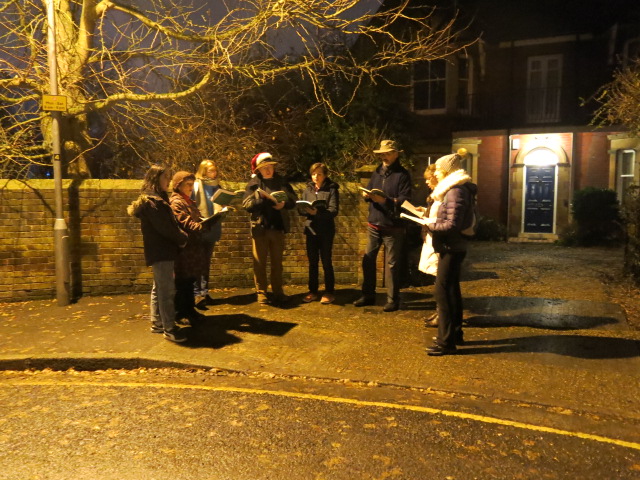
Farrant Singers sing carols in Salisbury

img_4581

Once again, the Farrant Singers entertained some of the residents in Salisbury with some beautifully sung carols on Monday 19 December.  They sang in and around Marlborough Rd; College St; Victoria Road; Albany and Belle Vue Rds.  Afterwards we enjoyed soup and cheese generously provided by Michael and Chantal washed down with vin chaud.

A successful evening and many residents came out to enjoy the singing.


Follow us on Twitter and Facebook – salisburyai

If you are reading this in the Salisbury area and are thinking of joining Amnesty there are several ways of doing so.  You can join Amnesty International itself for which there is a joining fee and you will receive their magazine.  Or you can just join our group which is free.  The level of your involvement is of course up to you.  Help with our campaigns in the street is always welcome or on the stall we run once a year.  You can come to the annual film we do in conjunction with the Arts Centre and stay on to help with the signing afterwards.  If you have a particular topic of interest – which might be a country you know about – then making that a focus of your activity is a possibility.  The best way is to come to one of our events which you will see here or on Twitter or Facebook (salisburyai), and make yourself known. 

Iranian youth sentenced to death again


URGENT ACTION

Salar Shadizadi has been sentenced to death for a second time and is now in solitary confinement.  He was 15 at the time he committed the crime and it is contrary to the Iran penal code to execute minors.  Please write if you can.

Urgent action (pdf)


December meeting minutes


We are pleased to attach the minutes of the December meeting thanks to group member Lesley for preparing them.

December minutes

Film – ‘Mustang’


It’s less than a week until the Arts Centre in Salisbury is showing the film Mustang set in Turkey.

Pic: weekendnotes.com

This 2015 internationally co-produced film is directed by Turkish-French film director Deniz Ergüven.  Set in a remote Turkish village it depicts the lives of five young orphaned sisters and challenges they face growing up as girls in a conservative society.  In a Turkish village, the orphaned sisters (Günes Sensoy, Tugba Sunguroglu, Elit Iscan) live under strict rule while members of their family prepare their arranged marriages.  The event that triggers the family backlash against the five sisters at the beginning of the film is based on Ergüven’s personal life.

Starts at 7:30 and doors open at 6:45.  Tickets £8 with concessions.  It has a 15+ rating.


A time to be reaching out to those in great need


The following piece was published in the Salisbury Journal (8 December 2016)

Each year thousands of people in the UK write letters or send cards in solidarity with those suffering humans rights abuses around the world as part off Amnesty’s Write for Rights campaign.

As a result, people have been freed after having been unfairly imprisoned, human rights defender who have been threatened and harassed by authorities have been able to live freely without intimidation and forced evictions have been halted.

Sending a message of support to those whose rights are being abused and also to the authorities on that person’s behalf is powerful.  Imagine drowning in thousands of letters of encouragement and solidarity – in fact, imaging the officials who will see and deliver thousands of cards to the victims and their families.  The effect on both is priceless.  It shows the authorities that that individual is not alone and that all over the world thousands of people are standing up for them.

People featured this year include:

  • Fomoseh Ivo Feh a young man in Cameroon who faces 20 years in prison for forwarding a sarcastic text message
  • a photojournalist from Egypt, named Shawkan who was beaten, arrested and then held without trial following a demonstration in Cairo
  • a British-Iranian charity worker Nazanin Zaghari-Ratcliffe who was arrested in April at Tehran
    Nazanin Zaghari-Ratcliffe. Picture: Iran Human Rights

    airport as she was about to board a return flight to London with her 22 month old daughter.

Salisbury Methodist Church is hosting a Write for Rights event from January 4th to 15th and people are invited to see the exhibition and send a message of support.  The church will be open from 10 am to noon.

We hope local readers will be able to support this initiative and come along at some time on those 2 days and sign something.


Follow us on Twitter and Facebook  @salisburyai

Death penalty report for November


December 2016

The latest death penalty report is now available thanks to group member Lesley for compiling it.  Generally gloomy with several countries around the world reverting – or threatening to revert to – the penalty.

Death penalty report (Word)

No to the death penalty

Theresa May’s visit to Bahrain


Prime minister’s trip to Bahrain gives a hint to what will happen to human rights after Brexit

Picture: Express

The prime minister, Theresa May, is on an official to Bahrain amid controversy about the poor state of human rights in the kingdom.  It is really quite difficult to grasp quite what the Prime Minister means when she says the ‘UK must not turn our back on the human rights abuses of foreign countries’ as she prepares to sign various trade deals which does precisely that.  There is a growing hint of riddle like statements from her including the meaningless ‘Brexit means Brexit’.

There now seems to be a desperate urge to secure trade deals ahead of our departure from the EU and the Gulf states are fertile ground.  She is quoted in the Guardian (5 December 2016)

There will be some people in the UK who say we shouldn’t seek stronger trade and security ties with these countries because of their record on human rights.  But we don’t uphold our values and human rights by turning our back on this issue.  We achieve far more by stepping up, engaging with these countries and working with them.

So the argument is that Bahrain has a questionable human rights record and that by working with them, and doing business, we can exert some kind of influence to encourage them to stop torturing or otherwise mistreating their people.  Since we have been trading there for some time, we would expect that the country would be slowly improving as a result of our influence.  The problem is that it isn’t.  As Human Rights Watch and Amnesty have said:

Bahrain’s 2016 “reform” agenda has consisted of an assault on core elements of civil society and jailing or deporting government critics.  Last month, Amnesty International accused UK Ministers of acting like “overexcited cheerleaders for Bahrain’s woefully inadequate reforms.”

On December 4, Human Rights Watch and others wrote to Prime Minister May to complain about the British government’s ‘abject failure to exert any positive influence’ in Bahrain.  We didn’t call on the UK to end trade or security ties, but rather to use the UK’s influence to help put a stop to an orchestrated attack on rights that has badly undermined any prospect of the reform that the UK claims to support.

What exactly “working with” Bahrain to “encourage and support” reform amounts to, remains to be seen.  But one thing is clear – human rights will not be at the center of the UK’s relationship with Bahrain.

This is especially worrying in the context of the post Brexit world.  The UK will be in a tough position trying to develop trade outside the EU.  We will not be in a position to exert any kind of influence on countries like Bahrain if we want to continue to sell them weapons.  There will be lip service of course and meaningless phrases from the prime minister and other ministers to assure us that persuasion has been applied to improve human rights.  The reality is we will have to accept what’s on offer and be thankful for it.  In the context of the Gulf states for example, we export more to them than to China, a situation unlikely to change anytime soon.

Ministers cannot quite bring themselves to say that in reality, there is little they can do and often little they want to do.  We must remember also the ‘revolving door’ through which ministers, senior civil servants and top military brass, pass to secure lucrative directorships with the very companies doing the deals in countries like Bahrain.  There is little incentive to upset the apple cart.

See also College of Policing.


Follow us on Twitter and Facebook, @salisburyai

Blog at WordPress.com.

Up ↑