Big increase in executions in Iran


This year has seen a further increase in executions in Iran

May 2025

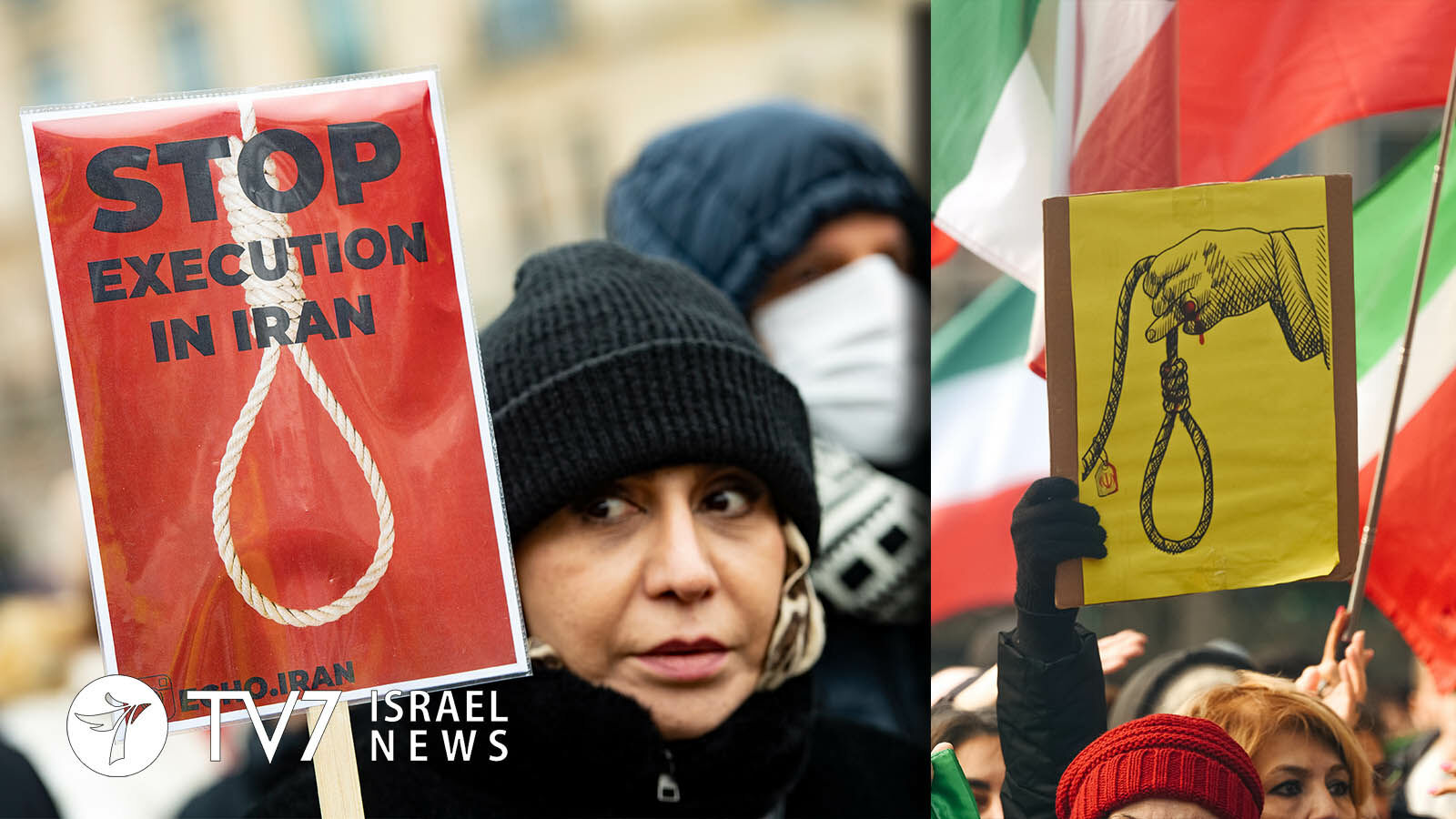
The BBC reported that in 2024, 901 people were believed to be executed in Iran representing a 6% increase over 2023 when 853 were put to death. 31 were women. The chosen method is hanging often in public. The main reasons are murder, rape and drug crimes but also the vague ‘corruption on earth’ used to describe people opposed to he theocracy. Minority groups are also hard hit.

There seems no let up with 343 put to death in the first four months of this year representing a significant increase over the same period in 2024.

Iran joins other countries like China, North Korea and Vietnam which use the penalty extensively. Details of numbers are a secret in those countries. In China it is believed to be thousands. The killing spree has been widely condemned by a range of agencies.

Sources: BBC, Death Penalty Information Center, France 24, Amnesty International.

People in the Park


Members of the group will be there on Saturday

May 2025

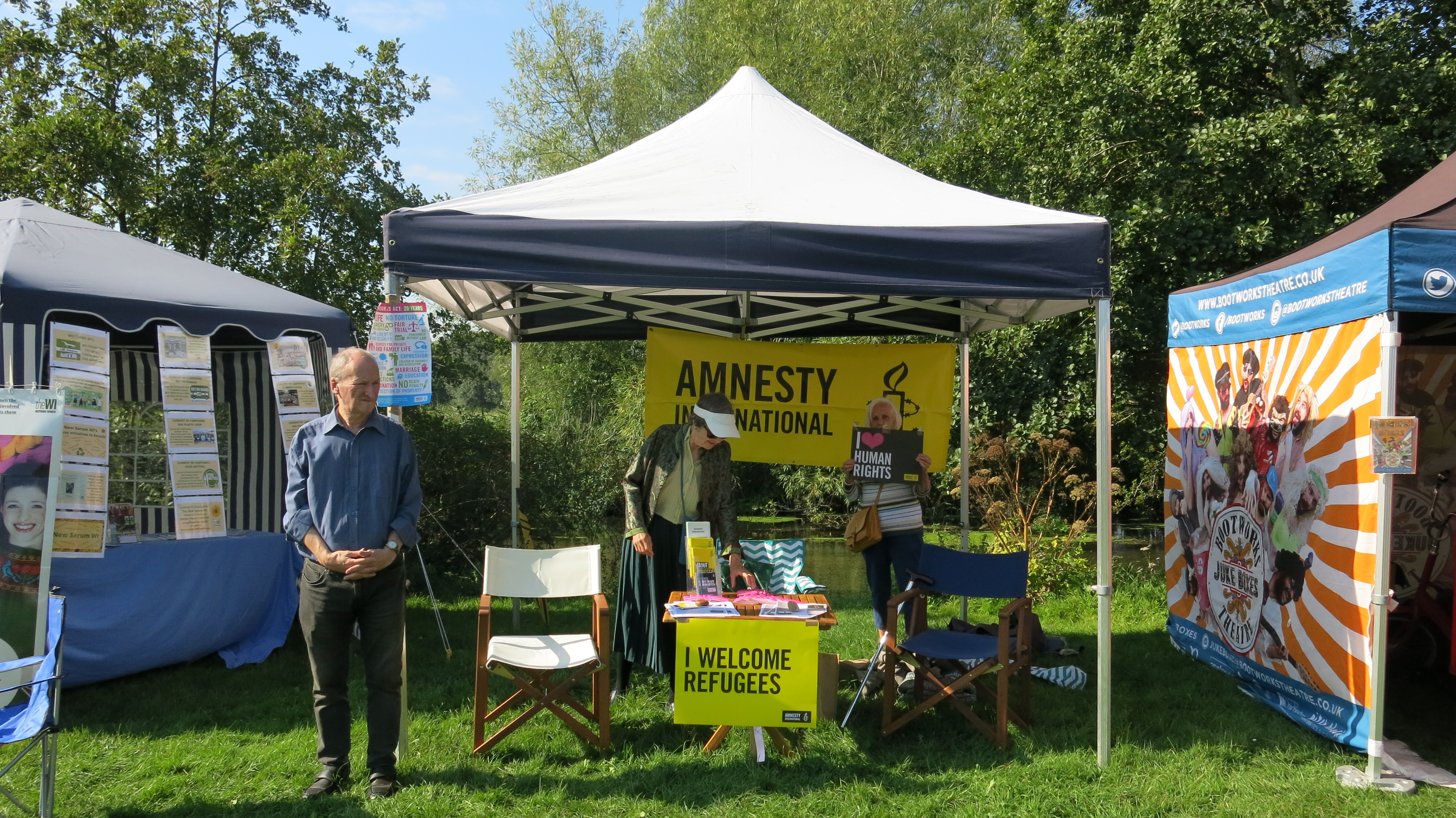
Members of the Salisbury group will be at the People in the Park event this Saturday 17th from around 10:00 and we would be delighted to see you. It would be a good opportunity to say hello if you are interested in joining us. To get an idea of what we are doing, have a glance at our last set of minutes and news. Look forward to seeing you there.

The following handout will be available.

The 75th Vigil


Strong support for the vigil continues

May 2025

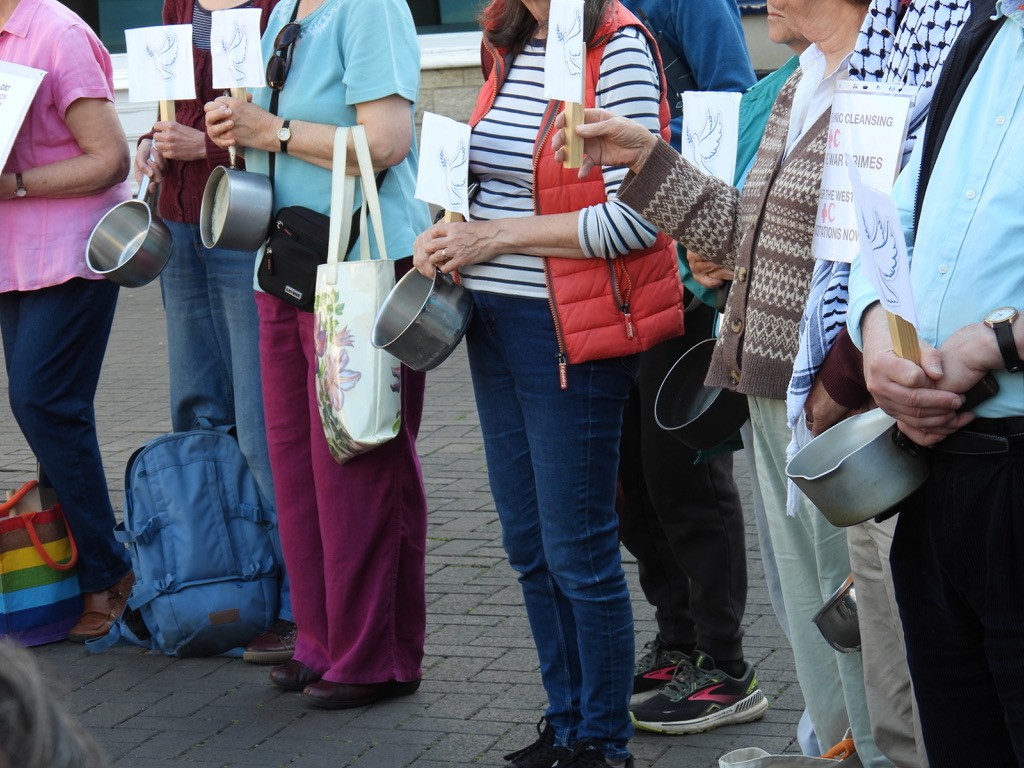
We held our 75th vigil on Saturday 10 May and there were 40 in attendance: the numbers are steady with new people each week. The crisis in Gaza goes from bad to worse with huge parts of the area annexed by Israel. Over 52,000 are dead. We repeated the ‘pot’ theme to echo the scenes of people desperate for food after 70 days of the blockade. We shall be back next Saturday 17th.

Nakba Event 15 May

Salisbury Concern for Israel Palestine are holding an event this week to remember Nakda, when thousands of Palestinians were driven from their homes and villages in 1948. Join Team Nakba and SCIP as we reflect on the Nakba of 1948 and subsequent events in Israel/Palestine. With Canon Jonathan Herbert, Iman Mahmoud, Miranda Pinch, Hilary Bond and the Dean of Salisbury (representing all the Abrahamic traditions).

Takes place in All Saints Church, Watersmeet Road, Harnham’ Salisbury, SP2 8JH

7.00pm for 7.30pm. Simple refreshments available and Zaytoun Fairtrade produce on sale​.

(Picture courtesy of Peter Gloyns)

Recent posts:

UK lawyer make questionable remarks about Gaza


The charity UK Lawyers for Israel claim the Gaza conflict might ‘help solve obesity

May 2025

Few may have heard of this charity which has a prestigious list of members and patrons. It is in the news recently (10 May) because its chief executive made some highly questionable and some might argue ill-judged remarks about the effect on the conflict in Gaza on its citizens. He was referring to a letter published on July 20th 2024 in the Lancet in which the estimate of those killed in the conflict might reach 186,000. The death toll at the time was around 37,000.

The Coop was to debate a motion from its members [No 13] to stop trading with Israel in view of the death toll in Gaza. The motion quotes the Lancet estimate. The UKLFI chief executive Jonathan Turner objected to the Coop motion saying:

“We first pointed out that the letter published in the Lancet on 20 July 2024, to which the motion evidently referred, did not claim that 186,000 Gazans had died in the current war. It did, however, claim – without foundation – that 186,000 Gaza would be likely to die eventually as a result of the war.

“So we pointed out, secondly, that this claim was based on entirely unfounded speculation, which also ignored factors that might result in lengthening the lives of Gazans, given the public health situation existing in Gaza prior to the war, including the extent of obesity. These factors include the possible reduction in the availability of confectionery and cigarettes”.

“In the context in which they were made, our statements were accurate and objective.” (our italics).

The full text can be read here. This might be seen in hindsight as a somewhat warped view of the conflict and on reflection, an apology issued to withdraw them. However, the Guardian article is referenced on their website without any sign of such an apology or retraction [accessed 11 May at 07:00].

The charity’s objectives are – [The] UKLFI Charitable Trust was set up by UK Lawyers for Israel (UKLFI Ltd), which is is an association of lawyers who support Israel and seek to ensure that the rights of Israel and Israelis are respected.

The charity has a range of reports which seek to counter the narratives which appears in the media. These reports have the appearance of research reports with copious references and footnotes. However, on closer inspection the references do not always support the claims made of them. For example, the bombing of hospitals is usually because the IDF claim they are hiding Hamas operations of various kinds. This is the justification for their destruction. Very little evidence is produced by the IDF. In the charity’s report on this there is still no evidence. Indeed one reference is of an article in Haaretz from 2009, some years before the current conflict which says ‘Intelligence officers suspect’ [the Hamas operations]. Other references do not always support the claims made. The report denying a famine in Gaza was produced in 2024 before the current blockade. Among the conclusions to one report is the plea for ‘more transparency’. This is difficult since foreign journalists are not allowed into the area and the high death toll of those who are – 178 journalist and media workers have been killed in the current hostilities.

UKLFI has a list of patrons of some note. They include Lord Dyson; Lady Cosgrove; Baroness Deech; Stephen Hocken KC; Lord Pannick; Lord Grabiner KC and Lord Howard (formerly the MP Michael Howard). Many are well connected in the British establishment.

One has to question the wisdom of an organisation replete with KCs, other notables and members of the House of Lords, making a claim of this kind. Together with the reports on its site, the purpose seems to be to deny, deny and deny despite the mounting evidence of death and destruction wrought by the IDF. They have threatened the government with legal action over its decision to withhold a limited number of arms licences [not ‘all arms licences’ as the Foreign Secretary, David Lammy twice falsely claimed in a BBC interview last week].

Over 52,000 have now died in Gaza.

Sources: Campaign to Protect Journalists, UKLFI; Guardian; Wikipedia

American readers: a KC is a King’s Counsel which is a barrister of at least 10 years standing who is appointed by the monarch as someone ‘learned in the law’.

May minutes and news


Group minutes, reports and news

May 2025

We are pleased to attach the minutes and news of the group’s activities thanks to group member Lesley for the work in preparing them. There is a list of future events at towards the end and if you are thinking of making contact, one of those would be a good opportunity. We shall be at People in the Park in Elizabeth Gardens, Salisbury on Saturday 17th from around 10:00 all day.

Recent posts …


Our recent posts all in one place

May 2025

Minutes and Newsletter


March minutes and Newsletter March 2026 We are pleased to attach this month’s minutes and Newsletter for the group thanks to group member Lesley for preparing them. We do not publish a Newsletter as such but they contain a lot of material on the death penalty around the world, the state of UK politics as…

Middle East ‘forever’ wars


Iran, Lebanon join victims in the forever war. Vigils continue March 2026 The 119th vigil took place in Salisbury with over 25 in attendance, as the war intensified in the Middle East. We are in the third week of attacks on Iran as Israel and the US are bombing large areas of the country. Israel…

Ex Iranian prisoner to tell his story


Anoosheh Ashoori will speak in Romsey March 2026 The story of Nazanin Zaghari-Ratcliffe has been widely told and she has become a household name. A BBC film was made of her ordeal and she came to Salisbury to speak. Iran is in the news at present with the bombing campaign being carried out by Israel…

Threat to Jury Trials: MPs Debate New Court Bill


Threat to trial by jury March 2026 MPs voted to allow the Courts and Tribunals Bill to proceed to the next stage after significant debate during its second reading.  This was over proposals to replace juries in England and Wales with a single judge in cases where a convicted defendant would be jailed for up…

How the New UK Bill Aims to Prevent Foreign Election Interference


New bill to tackle electoral reform March 2026 A functioning democratic system is vital for human rights.  It is about power and how it is wielded.  Increasingly, we have witnessed powerful outside interests – whether they be states or wealthy individuals – influencing the political debate.  Electoral reform is carried out infrequently partly because political…

Court Decisions Impacting Protests and Gender Rights in the UK


Significant number of things happened this month

May 2025

There were a number of interesting events on the human rights front in the UK this month including the Court of Appeal judgement discussed below. There has been a steady ‘nibbling away’ of rights by successive governments which is why we have started this series of reports of which this is the second and why the judgement is good news.

Right to Protest 

This month the Court of Appeal has upheld an earlier ruling of the High Court from May 2024 that then Home Secretary Suella Braverman did not have the power to create a new law that lowered the threshold of when the police can impose conditions on protests from anything that caused ‘serious disruption’ to anything that was deemed as causing ‘more than minor’ disruption. They said that “the term “serious” inherently connotes a high threshold … (and) cannot reasonably encompass anything that is merely ‘more than minor’”.

This was the first time a government had sought to make changes through so-called ‘Henry VIII powers’ of secondary legislation to a law which had been democratically rejected by Parliament when introduced in primary legislation.

Hundreds of protesters have been arrested under these measures since they were created, including the

climate activist Greta Thunberg (pictured: MusikExpress) who was acquitted of all charges in a hearing in February 2024.

Liberty has called for the regulations to be quashed immediately (as per the initial ruling from the High Court, whose decision to scrap them was put on hold until the conclusion of the appeal) and has called for all arrests and prosecutions under the legislation to now be urgently reviewed, alongside a comprehensive review into all protest laws that have been passed in recent years.

The Court will decide in the coming weeks if the legislation is to be quashed.

Gender Recognition Ruling

Five judges from the UK Supreme Court ruled unanimously that the legal definition of a woman in the Equality Act 2010 dealt with biological sex at birth and did not include transgender women who hold gender recognition certificates.

In a significant defeat for the Scottish government, their decision will mean that transgender women can no longer sit on public boards in places set aside for women and it will have far reaching implications for access to protected spaces and services such as the armed service, hospitals, women-only charities and changing rooms and access to sport.

Lord Hodge told the court the Equality Act (EA) was very clear that its provisions dealt with biological sex at birth, and not with a person’s acquired gender, regardless of whether they held a gender recognition certificate.  In a verbal summary of the decision, he said: “Interpreting sex as certificated sex would cut across the definitions of man and woman in the EA and thus the protected characteristic of sex in an incoherent way.”  He stressed that the ruling does not change the protection trans people are afforded under the protected characteristic of ‘gender reassignment’ under the Equality Act.  Amnesty has called the decision ‘disappointing’.

Humanist Rights

Two couples are taking the government to court over its failure to legalise humanist marriage in Wales and England, five years after a ruling that the lack of recognition was discriminatory. Humanist marriages are legal in Scotland and Northern Ireland, and elsewhere in the world including New Zealand, Canada and Australia.  In Scotland in 2022 there were 9,140 humanist wedding ceremonies compared with 8,072 based on faiths or other beliefs.

Activists Detained

Non-violent activists Roger Hallam and Dr Patrick Hart are being refused their right to a Home Detention Curfew.  Days before their scheduled release from prison in March Dr Hart was told that there was ‘no suitable accommodation’ and Hallam that the media’s interest in his case meant that he was deemed unsuitable for HDC (which actually states that non-violent prisoners can only be denied release ‘in exceptional circumstances’). New release dates are respectively June and possibly August. There will be an appeal.

The Counter Terrorism and Border Security Act of 2019

This was invoked by police at St Pancras rail station for detaining a Palestinian-British Christian academic and his 8-year-old son on their return from Paris on Good Friday. Professor Makram Khoury-Machool (pictured: BBC Arabic Service) is a Palestinian-British Christian academic who has lived in the UK since 1999 and taught in Cambridge since 2004.  He is the founder of the Cambridge Centre for Palestine Studies whose board members and patrons include Dr Rowan Williams, Baroness Helena Kennedy, Baroness Sally Morgan, Lord Chris Smith, HE Clare Short, Baroness Warsi and Lord David Steel.  

He and his son were held over 4 hours until after midnight, were given no food while the police took his fingerprints, DNA samples, searched his personal belongings and confiscated his laptop and mobile phone using the threat of force.  Seven days later, the devices were returned but without his SIM card.  He was subjected to an intimate body search, and his son was left traumatised by the experience.  This is perhaps the first time a child as young as eight has been detained in the UK under the 2019 Act; his treatment may breach the UN Convention on the Rights of the Child to which the UK is a signatory.

Economic, Social Cultural Rights

Amnesty reports that in the UK there is no legislatively defined universal social protection floor such as the one recommended by the UN’s International Labour Organisation: this is left to the discretion of the state and is inconsistent across Great Britain and Northern Ireland.  The changes proposed by the Pathways to Work Green Paper 2025 will require new legislation allowing the secretary of state to implement proposed cuts to social security rates for disability and incapacity schemes, and removing some of the legislative protections which are in place to protect against political whims.

If implemented, Amnesty considers the extensive reforms proposed would be a deliberately discriminatory, disproportionate and retrogressive violation of human rights;  The UK’s social security system does not legally guarantee essential social security payments that ensure access to basic needs such as healthcare, housing, food and education and that social security freezes, caps, and deductions, removal of the spare room subsidy (bedroom tax) and two-child limit have deepened poverty and disproportionately harmed children, the disabled and low-income families. Despite increased social security spending, poverty rates remain unacceptably high.

Recent posts:

Death penalty report


Report for April – May

May 2025

We are pleased to attach the monthly death penalty report thanks to group member Lesley for the work in compiling it. As ever we remind our readers that China is believed to execute more of its citizens than the rest of the world combined but information is a state secret.

Refugee report: May


The treatment of asylum claimants takes centre stage

May 2025

The question of immigration and boat people continues to make political waves although survey results recently suggest it has dropped down the list of people’s concerns. ONS surveys show that the NHS and the cost of living are of most concern and were the issues which came up in last weeks elections. Only among the over 70s did immigration and such matters have high salience.

There has been much debate in recent weeks about Article 8 of the Human Rights Act, the one that concedes a right to a family life to irregular migrants under threat of deportation. Some political parties wish to remove this right, and the government say it is “under review”. The issue is whether or not this right has been exploited by people whose claim is questionable. Baroness Kennedy has taken up the issue on behalf of claimants.

Indeed, the treatment of asylum claimants after their arrival has taken centre stage lately. Some who were held at the notorious Manston camp have sued the government over the associated health issues. The unfortunate camp is now under attack over the level of drug abuse by staff working there.

The Home Office is eager to reduce the waiting time for appeals from its current 50 weeks to 24. This is not made easier by the downward trend in initial refusals. A further government action has been to declare that proven sex offenders will be denied asylum. It is not known how many applicants may fall into this category. Also on the Government’s mind (as part of the ongoing Border Security Asylum and Immigration Bill) is that lawyers should not be allowed to advise claimants unless properly qualified. The Bill will reach its Report stage in the Commons on Monday and more changes have been promised.

Profits

While much noise has been generated by the possible big profits obtained by the small boat providers, a research team from four UK universities has been looking at the profits made by companies in the border security business. Their report concludes that worldwide the business is worth $377 billion, and in the UK £3.77 billion in contracts with the government, for a wide range of activities (e.g. boat repair, sniffer dogs, marquees). The information is not easy to come by and may well be an underestimate.

The European Commission has proposed setting up a Common European System for Returns (though it is not in the 2024 Migration and Asylum Pact), with processing hubs in third countries (as Italy has tried to do with Albania, but hit legal obstacles). Perhaps surprisingly, the UNHCR has endorsed the idea. It is said that only 20% of people with a deportation order are effectively removed from the EU.

Elsewhere

Much is happening in Greece, notably sentences of 25 years for smuggling (most of which have landed on the pilot). Crete has had 2,500 migrants from Africa in the last year.

Syrian refugees are still in limbo as the government waits to see developments post-Assad. 100,000 are in Europe awaiting recognition as claimants, while the in-power HTS is still listed as a “terrorist organisation”.

Reports that the US sent an Iraqi asylum seeker to Rwanda seem to be supported by news that the White House is in talks with the Rwanda government about sending deportees there, probably to facilities built by the UK.

Notes from elsewhere – 12,000 central African (or Central African?) refugees want to go home from Chad and Cameroon, but there is no support structure to enable this; the UNHCR, on its 75th birthday is warning of a funding crisis; 250,000 exiles have been sent back to Afghanistan from Iran and Pakistan (96,000 forcibly) and are expected to head for Europe.

Finally, AIUK have a briefing paper on the asylum seeker backlog and how to resolve it. In their conclusion they say:

‘Backlogs have recurred in the asylum system for decades because successive administrations have pursued bad policies. They have tried to avoid responsibilities rather than take them. Their efforts at deterring and preventing people seeking asylum have broken the system and had other bad effects. This has generally been because they have set aims for the system that are impractical, even illegitimate. Asylum responsibilities cannot be avoided. They can, however, be managed badly or managed well. Fair and efficient decision-making is critical to managing well and avoiding backlogs’.

And a new Urgent Action asking people to write to the Belgian authorities about their refusal to supply accommodation or assistance to 2,500 asylum seekers.

Recommended reading: Nicola Kelly: Anywhere But Here; How Britain’s broken asylum system fails us all (Elliott & Thompson, 2025)

Andrew Hemming

Anti-protest law modified


High Court loosens restrictions on demonstrations

May 2025

No government likes protests. They demonstrate, all too visibly, that the public – or a part of them at least – is not happy with them or the status quo. Depending on the degree of despotism, demonstrations are controlled or in the worst of countries, banned altogether. China has an extremely restrictive policy backed up by a massive and all pervasive surveillance system making protests all but impossible. Gulf states are also highly restrictive.

Demonstrations are often how change happens. Britain has many examples throughout its history of protest bringing change. Wat Tyler and the plight of the poor (serfs); the Poll Tax riots in 1381 and 1970; the Prayer Book rebellion; the Iraq War protest and of course the Suffragettes. There are many more examples. They do not necessarily bring about immediate change. They do show to politicians and others the depth of feeling that people have about their cause.

The last Conservative government was no different to others in disliking protests. What upset them the most were the climate protests. Just Stop Oil and other groups such as Extinction Rebellion, engaged in a series of eye-catching protests which shone a light on the government’s failure (in their eyes) to do enough to stop fossil fuel extraction.

Suella Braverman, then the Home Secretary resented these protests and introduced the Police, Crime, Sentencing and Courts Act in 2022 in an attempt to seriously curtail them. Controversially they introduced a change in the threshold wording from ‘serious disruption’ to ‘more than minor’. This was done by using a statutory instrument not after proper debate in the House of Commons. This had the effect of almost banning all protests.

Successful challenge

Liberty and other groups successfully challenged this in the courts and the new Labour government decided to appeal. This seems to demonstrate that the dislike of protest is not a party political matter: governments just do not like challenge. Last week (May 2) the Appeal Court ruled that ‘serious’ is not ‘more than minor’ and said that the anti-protest laws were introduced unlawfully. The regulations gave police almost unlimited powers to prevent protests taking place. Many were arrested using these powers.

The protests which so upset the previous government concerned fossil fuels. The fossil fuel industry is extremely powerful and well-funded. Several of the various think tanks based in and around 55 Tufton Street are thought to be funded by them. These include: The Tax Payers Alliance; Civitas; Adam Smith Institute; Global Warming Policy Foundation; Centre for Policy Studies and the Institute of Economic Affairs. Their funding is opaque but is thought to be mainly from fossil fuel companies such as the Koch corporation in the USA among others. They have frequent access to the media being interviewed on various BBC and commercial stations without ever being asked ‘who funds you?’ Their opinions often appear in newspaper columns. They employ large numbers of lobbyists and enjoy close contact with ministers and civil servants. They claim to be influential in forming policies to suit their interests. It was admitted by Rishi Sunak when he was prime minister that the Policy Exchange – another of these think tanks funded by Exxon Mobil – had drafted the anti-protest legislation.

Protest is crucial to enable the ordinary person to make their voice heard. As with the arms industry we highlighted in a previous post, governments are dominated by commercial concerns, the need for growth and the enormous power and influence of companies and their army of lobbyists. Around £2bn per annum is spent by firms on this activity. It is welcome news that the Appeal Court has ruled against the government and its ‘draconian’ anti-protest legislation.

Blog at WordPress.com.

Up ↑