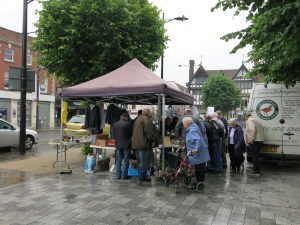
At its meeting on Thursday evening, the group decided that the profits from the stall which will take place in the market square in Salisbury tomorrow – Saturday – will go to this month’s Amnesty Urgent Action. In the event we took £234 so over £460 will go the the African state. Thanks to all those who helped on the stall and who bought things from us.
Picture of the stall in Blue Boar Row, Salisbury
This action concerns the treatment of women in Burkina Faso and in neighbouring Sierra Leone. They are subject to forced marriages often to men who are up to 50 years older than them. Some can be married as young as 10. They have no choice over these marriages nor when nor whether to get pregnant. Some have babies at such a young age that their lives can be threatened or they experience lasting medical complications including incontinence. Female Genital Mutilation is also common.
Report sent to the Salisbury Journal and was published 23 June can be read here:
The funds raised by the Salisbury group of Amnesty International at their stall last Saturday are to be sent to Burkina Faso in Africa as part of a programme to help girls and women in those countries.
The group managed to raise over £234 and this will be doubled by the Department for International Development to make £468. In Burkina Faso, whether you are a girl or a woman, you are prevented from making crucial decisions about marriage and whether or when to get pregnant. Some girls as young as 10 are married and their partners can be as much as fifty years their senior. Physical and sexual violence against women and girls is common and a particular concern is the large number of pregnancy complications and death among girls who bodies are not yet ready to bear children.
Amnesty in Burkina Faso is working with 5 of the shelters which house girls who have been subject to early forced marriage or female genital mutilation.
Andrew Hemming, the chair of the local group said “we are delighted to have contributed to this scheme and for the funds to go to such a good purpose. The doubling of the monies raised by DfID makes it extremely worthwhile.” Further details can be found on the group website
Members of the Salisbury; Mid Glos and Ringwood groups met on Sunday 17 April to view the tapestry in the Cathedral and to take part in a video being put together by the Salisbury group, further details of which can be found in the minutes. The group is grateful for the two groups taking the time to come all the way to Salisbury for this.
The minutes of the last meeting are here thanks to group member Lesley for writing them up. We discussed North Korea and the forthcoming video planned with Clare Moody; the Death Penalty report which highlights the events in Saudi, Pakistan and elsewhere; plans for the Human Rights Act, forthcoming events such as the stall in the market, and social media statistics including the success of the post about the war in Yemen and our role in arming and supporting the carnage, and several other topics. The next meeting is on 14 April.
We have just added a link to an organisation, based in the USA, which campaigns for human rights of those who work in sometimes appalling factories for a pittance to bring us cheap clothes. Called The Institute for Global Labour (sic) and Human Rights, it came to light in an article on the German retailer Lidl and its latest offering of a pair of jeans called ‘jeggings’ for the princely sum of £5.99 ($8.62). The article alleges that the factories that make them in Bangladesh do so by paying a pittance to their workforce. Source: The Observer 13 March 16
It’s sometimes easy to forget that human rights can be infringed in clothing factories as well.
Campaigning against the Death Penalty has continued to be a major focus for the Salisbury Group. Regrettably, there has been no national campaign coordinated by Amnesty International in London. We hope this might change in 2016 as we have taken part in a Survey currently being carried out by HQ confirming that we would like this important aspect of Amnesty’s work to be taken up again – particularly in the light of the recent changes in the priorities of the Foreign and Colonial Office (see later).
In the meantime, we have identified particular issues around the Death Penalty on which we have campaigned. Throughout the year we have responded to all the Urgent Actions received in respect of individuals under threat of execution – 31 in total. The majority of these have been for prisoners in Saudi Arabia, Iran and the USA. We have worked on the cases of individuals sentenced to death within Amnesty’s Campaign against torture – most notably Moses Akatugba and Saman Naseem (see later), including them in letter writing, card signings and petitions, and have also continued to campaign on behalf of Reggie Clemons (see later). In partnership with St Thomas’s Church, we held a Vigil as part of the World Day Against the Death Penalty. This was our first such venture, and it has to be said that public support was disappointing, but the Group felt it had been very worthwhile.
2015 has been a challenging year:
We saw an unprecedented rise in executions in Saudi Arabia following the accession of King Mohammad bin Salman. At least 151 had taken place by early November, and executions are now at a 20 year high. Disproportionate use is made against foreigners, particularly from poor countries, who do not understand arabic and are denied adequate translation in court. Barbaric methods of execution are employed – beheading, stoning and crucifixion. Death sentences have been passed for a range of offences, including ‘apostasy’
There has been a rise in the number of executions in Iran – at least 694 in the first half of the year
There are considerable concerns at the numbers of countries now using the death penalty to deal with real or perceived threats to State security under the guise of terrorism – Pakistan, Tunisia, Chad and Egypt as well as Saudi Arabia and Iran. Initial fears that the legislation would be used to include a wide range of ‘crimes’ other than terrorism were more than justified. A report by Reprieve states that those executed in Pakistan have included individuals sentenced to death as children and victims of police torture
Concerns have been raised at the numbers being sentenced to death and executed for alleged crimes committed when children. Countries with the worst records for this are Saudi Arabia, Iran and Pakistan. This issue has been taken up by the Salisbury Group – as mentioned above, it was the focus of our Death Penalty Vigil for this year’s World Day Against the Death Penalty. We highlighted the case of Saman Naseem, a Kurd arrested at 17, tortured and sentenced to death for being a member of a banned organisation. Reports earlier in the year of his execution proved to be unfounded, and he has now been granted a re-trial
There has also been the issue of the growth in sentences and executions for drug-related offences, particularly in Indonesia
China continues to refuse to publish details of the numbers of executions, but is believed to carry out more than the rest of the world combined. There have, however, been some encouraging signs. In January, a youth wrongly convicted of rape and executed 18 years ago received recognition of his innocence and a posthumous pardon. In May a number of Judges contributing to a Symposium on “Mistaken Cases” called for reforms which would go some way to meeting standards for a fair trial. Also in May, the sentence for a woman convicted of the killing of her abusive brother was commuted from death to life in prison
The year for the USA in respect of the death penalty has been mixed. Its use continues to decline across America – the number of death sentences handed down dropped by a third in 2015 , with only six states – Texas, Missouri, Georgia, Florida, Oklahoma and Virginia – carrying out executions. Public attitudes to the death penalty are also changing, partly because of concerns at costs incurred from keeping prisoners on death row for many years and the lengthy appeal process, but also because of an increasing recognition of the risk of unsafe convictions. Almost 3,000 cases were identified involving unreliable or false testimony given by FBI Agents using a now discredited technique of hair analysis. Following 28 years on death row, Anthony Ray Hilton was released from death row in Alabama when his innocence was confirmed through the use of ballistic tests
In 2015 Nebraska abolished the death penalty, and in Connecticut the death penalty abolished for new offenders in 2012, was abolished for the 11 inmates currently remaining on death row. There remain, however, pockets within the States where the use of the death penalty is disproportionate to the numbers within the population. Professor Frank Zimring of the University of Berkeley, California, believes the attitude of the district attorney to the death penalty to be a key factor
Here in the UK it is now 50 years since the abolition of the death penalty, and it is encouraging to note that for the first time support within the country for its use fell below 50%. The Group have, however, been concerned at changes in our Government’s approach internationally to issues around human rights, and specifically to the use of the death penalty. In June we wrote to Salisbury MP John Glen to ask why the British Government could not follow the lead of the French President, Francois Hollande, in speaking out publicly while in Saudi Arabia against the use of the death penalty. His reply cited the value of behind the scenes diplomacy, seeing this as being more productive than speaking out publicly
In August we learned that the Foreign and Commonwealth Office had dropped explicit references to abolishing the death penalty from its global human rights work. Despite the 2014 Human Rights and Democracy Report in which the Government claimed their work in this area was part of ‘sustained and long term efforts to to see an end to the death penalty world-wide’, all references to the death penalty were set to vanish from its stated priorities. In reporting on this, The Times of India made a pointed reference to the British Government’s condemnation of the hanging last year of the convicted terrorist, Ajimal Kasab. Mr Glen replied that the decision of the FCO to overhaul its approach to human rights had been made on the basis of feedback from diplomats who reported difficulties in relating our long list of human rights priorities with the issues they faced in real life. He stated that the death penalty could come under all three of the broad categories listed in the new guidelines, and this approach would enable diplomats to ‘tailor them appropriately to local circumstances’. As a group we are particularly concerned at what we see as a ‘fudged’ approach, and a serious threat to our country’s ability to be seen as promoters of human rights.
Economic prosperity was further up my list of priorities than human rights
Sir Simon McDonald, Head of the Foreign and Colonial Office in evidence to the Foreign Affairs Select Committee
This year has, however seen a number of successes in our campaigning:
We have continued to campaign actively on behalf of Moses Akatugba, the young Nigerian accused of the theft of three mobiles and sentenced to death as a juvenile. After ten years on death row, in June Moses was granted a pardon and released. Over 34,000 had signed the petition, with more than 200 by people in Salisbury at last year’s stall for World Day Against the Death Penalty. Amnesty have received a letter of thanks from Moses, describing his feelings on learning of an experiencing his release, and describing Amnesty activists as his ‘heroes’. We were able to celebrate this success at our Vigil
Following our long term campaign for Reggie Clemons in Missouri, in December we received the news we had been waiting for. After a long wait for a decision from the Court following the report of
Reggie Clemons (picture Amnesty USA)
the Special Judge, Reggie’s conviction and sentence for first degree murder were ‘vacated’. The Court had upheld his right to a fair trial, which was all that he had sought from the beginning. We now await news of a date for his re-trial.
The Salisbury Group’s Campaigning Plans for 2016
We will continue to write in response to individual Urgent Actions in respect of the death penalty
We will be continuing to campaign on behalf of Saman Naseem to ensure that he receives a fair trial
We will continue to campaign specifically on behalf of individuals sentenced for alleged crimes committed as juveniles.
We will await news of the date of Reggie Clemons’s new trial, and campaign to ensure this is fair and in accordance with internationally agreed standards.
We will await the outcome of the current AI Death Penalty Campaigning Survey, and will participate in any national campaign arising out of this.
We attach the death penalty report for this month thanks to Lesley for her work on this. The news about Reggie Clemons is most welcome after years of campaigning, with the decision to ‘vacate’ the previous judgement. It shows that persistent campaigning does work. The decision by Mongolia to end the death penalty is welcome especially when you consider the barbaric activities of their neighbour.
On the dark side, Saudi continues to execute with a promise to put 50 people to death.
The film, Timbuktu, is to be shown in the Salisbury Arts Centre this Thursday evening 3 December. The film is extremely topical both because of the horrific activities of jihadists in Paris and today’s news of a terrorist attack in Mali which is where Timbuktu is. This is the latest in our joint presentations with the Arts Centre. The film has received many favourable reviews and mostly 4 stars.
Timbuktu has entered the English language as a place which is remote and unknown yet recent events have brought the country and the town into the limelight.
There will be a short presentation by an Amnesty director before the film starts and afterwards, an opportunity for people to sign a petition or some cards.
Tickets from the Arts Centre via the link above or by phoning 01722 321744.
The April meeting minutes are here thanks to Karen. They contain a lot of useful information about the death penalty and North Korea in particular. There is a group meeting this Thursday 14th
Around 160 people attended the Cathedral this evening to hear Dominic Grieve QC MP give a brilliantly lucid lecture in support of the Human Rights Act. He traced some of the key clauses of the Magna Carta and showed how they had continuing relevance today. We hope to include a transcript of his lecture soon. His lecture followed the annual Amnesty evensong which also was very well attended with around 120 people.
The film Bastards (12A) was shown this Wednesday 25 March starting at 7.30 and the audience reaction was very positive indeed. There were many questions to the producer Deborah Perkin.
This is a fascinating and highly-acclaimed documentary about one Moroccan woman’s struggle to legitimise her daughter and the director, Deborah Perkin will be there to answer questions. The film follows an illiterate young woman who took on her own family and the Moroccan justice system for the sake of her illegitimate child. It is a gripping, moving and uplifting documentary from the cutting edge of Islam.
Deborah Perkin is the first person to film in a court in Morocco, a country which leads the world in its legal efforts to give women and children more rights under Sharia law.
In Morocco, as in all Muslim countries, sex outside marriage is illegal and women bear the brunt of society’s disapproval. But what is the fate of the children of those single mothers? They cannot attend the better schools, are turned away from infant immunisation clinics and refused government posts. Jobs, housing and a huge range of social advantages are denied them. They are despised outcasts, condemned to a life of discrimination. Bastards is the first film to tell this story from a mother’s point of view.
We shall have a petition to sign about torture in Morocco. Morocco is one of the five countries highlighted by Amnesty International in its #StopTorture campaign. We are pleased to say many people signed our petitions at the end of the showing. Thanks to the Arts Centre.







 Amnesty in Salisbury & South Wiltshire