Things have gone quiet with the plans to abolish the HRA and the promise of something before Christmas has not come to anything. There is a glimmer of hope in that Michael Gove has taken over as Justice Secretary and seems willing to modify or drop completely some of the worst excesses of his predecessor. However, the negotiations currently coming to some kind of conclusion concerning our role in Europe are likely to see a fresh assault on the act emerging soon. The watch word is ‘sovereignty’. Parliament wants to be sovereign and this is being presented as a good thing and it is implied we will be the better for it. The right wing press will delight at this and there will be many articles about ‘bringing power back to Westminster’ with the implication that this will result in better laws for us all. Salisbury MP John Glen is a keen advocate for abolition.
A parallel story over the past couple of weeks has been the tax situation of Google and other American behemoths who so manage their affairs that they pay little or only derisory levels of tax. Here, our sovereign parliament (since Brussels has little to do with tax collection) has failed. Indeed, successive chancellors have made numerous announcements about ‘cracking down’ but almost nothing seems to happen. Hardly surprising since accountants from the big four firms are actually in the Treasury ‘advising’ the chancellor on tax policy. So the idea that sovereignty is key and is some kind of magic bullet is clearly illusory and does not lead to better outcomes.
A useful guide explaining the HRA and what it does has just been published by the British Institute of Human Rights and is worth a look. There is a short video as well. No doubt we will be returning to this topic when the announcements are made.
Independent judge-led inquiry into UK complicity in torture needed
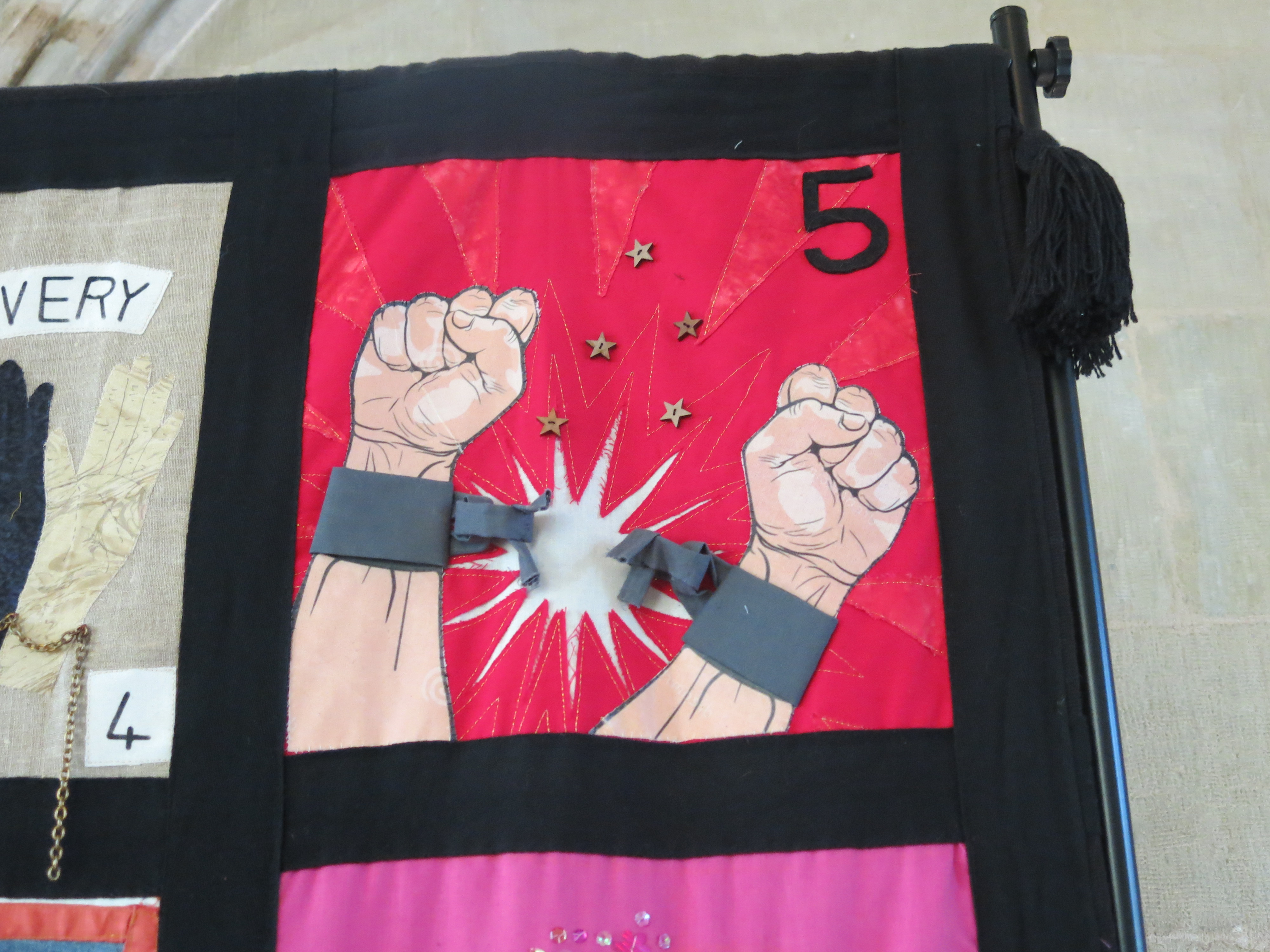
Article 5: No one should be subject to torture. Image from the tapestry
Amnesty International believes that there is credible evidence that the UK has been involved in grave human rights violations perpetrated against people held overseas by other authorities since the attacks in the USA on 11 September 2001.
The UN Convention Against Torture states that ‘no exceptional circumstances whatsoever, whether a state of war or a threat of war, internal political instability or any other public emergency, may be invoked as a justification of torture’. It also states there should be a prompt and impartial investigation wherever there is reasonable ground to believe an act of torture has been committed.
The Human Rights Act 1998 also prohibits torture under any circumstances, and that obligation implicitly requires a prompt independent investigation of credible allegations – the more so when there appears to be a ‘systemic’ problem. The existence of evidence requires the establishment of an independent, impartial and thorough judge-led inquiry, now. Credible allegations implicate the UK in torture or other ill-treatment, unlawful detentions and renditions. Over the years, Amnesty International and others have documented cases of the UK’s involvement in these abuses, including:
UK personnel were present at interrogations of detainees held unlawfully overseas in circumstances in which the UK knew, or ought to have known, that the detainees concerned had been or were at risk of being tortured and/or whose detention was unlawful and even that they participated in such interrogations
UK personnel provided information (e.g. telegrams sent by UK intelligence personnel to intelligence services of other countries) that led the USA and other countries to apprehend and detain individuals when the UK knew or ought to have known that these people would then be at risk of torture and/or unlawful detention
The UK was involved in the US-led programme of renditions and secret detentions through, for example, the use of UK territory (e.g. Diego Garcia) and/or airspace
UK personnel forwarded questions to be put to individuals detained by other countries in circumstances in which the UK knew or ought to have known that the detainees concerned had been or were at risk of being tortured and/or whose detention was unlawful
The UK systematically received information extracted from people detained overseas in circumstances in which it knew or ought to have known that the detainees concerned had been or were at risk of torture and/or whose detention was unlawful.
Testimony
A number of individuals – including former Guantánamo Bay detainees – have spoken publicly about UK involvement in their mistreatment. Shaker Aamer, who was released from Guantánamo in October 2015, after nearly 14 years without charge or trial, has said for example that a UK official was in the room when his head was beaten against a wall.
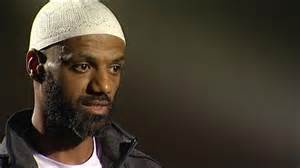
Binyam Mohamed
In 2008 the High Court confirmed that the UK, through its security service MI5, had facilitated the interrogation of Binyam Mohamed in the knowledge that his initial detention in Pakistan was unlawful. Then, during a two-year period, the UK continued to facilitate interviews conducted on behalf of the US authorities when it must have realised that Binyam Mohamed was being held unlawfully by a third country and knew or ought to have known that there was a real risk that he was being tortured.
Proper investigation needed
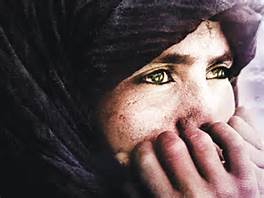
Image: Amnesty Paris
The Intelligence and Security Committee (ISC) has now been given the task of investigating allegations of UK complicity in torture, but Amnesty International, along with many other anti-torture organisations including the UN, believes that the ISC is wholly unsuited to the task in hand. The structural limitations of the ISC, particularly its lack of power and independence from government, means that any investigation the ISC conducts is unlikely to get to the truth, and cannot satisfy the UK’s human rights obligations. The ISC is not a traditional Parliamentary committee, even though it is made up of parliamentarians. Ministers ultimately decide what evidence the Committee can see, with the Prime Minister controlling what it can publish and even who can be a member. Crucially, the government retains the right to withhold information considered to be “sensitive” or on grounds of national security from the ISC. The definition of what constitutes sensitive information is extremely broad and notably includes information provided by a foreign intelligence agency which can object to further disclosure of that information. Any Secretary of State can determine material is sensitive and in the interests of national security should not be disclosed to the ISC.
Poor record
The ISC has a poor record in holding the intelligence services to account. In 2007, three years after the rendition of the Libyan families, the ISC produced a report which said that there was “no evidence that the UK Agencies were complicit in any “Extraordinary Rendition” operations.”
Historical context
In July 2010, the Prime Minister promised to establish an independent inquiry into allegations of UK involvement in torture and other human rights violations with respect to individuals detained abroad in the context of counter-terrorism operations. At the time, David Cameron specifically ruled out the possibility of the ISC carrying out the investigation, recognising that an inquiry led by a judge who is “fully independent of Parliament, party and Government” was required “to get to the bottom of the case”.
In 2011 the Detainee Inquiry was established, led by the retired judge Sir Peter Gibson. Amnesty International and a number of other organisations felt that the Detainee Inquiry fell short of the UK’s international human rights obligations and domestic obligations under the Human Rights Act to fully and independently investigate allegations of UK involvement in torture and other ill-treatment. Of most concern was that the government retained final say on what material could be disclosed to the public and that the protocol did not provide for an independent mechanism to decide on disclosure of national security material.
In January 2012 the Detainee Inquiry was suspended, after Scotland Yard announced a criminal investigation into joint UK/Libyan operations which had resulted in the rendition of Libyan opposition figures. Those investigations are ongoing.
In December 2013 the Detainee Inquiry interim report was published. It highlighted that the evidence it had received indicated that UK agents were aware of abuse of some detainees by other governments and that the UK government may have been involved in rendition. It outlined 27 separate issues that should be subjected to further investigation. Amnesty and others expected this to be followed by a proper full judge led inquiry.
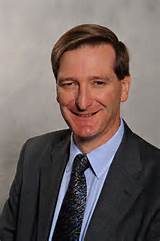
Dominic Grieve QC MP
Instead, on 19 December 2013, it was announced that the ISC had been tasked with examining allegations of UK complicity in torture and other ill-treatment of detainees held overseas, which had previously been the subject of the Detainee Inquiry. In September 2015 Dominic Grieve was appointed as the new Chair of the ISC. There is as yet no news on its work in this area.
Last year we wrote to our local MP Mr John Glen to ask his government to be more assertive with the Saudi government in view of their appalling human rights record. This was prompted by the death penalty group which was concerned by the mounting tide of executions in that country. We received a bland reply from both Mr Glen and from Mr Tobias Ellwood of the Foreign Office (FCO) saying that behind the scenes, representations were being made.
No sooner had we posted details of the letters from the two politicians, when news was received of plans to drop the requirement of ministers to obey foreign treaties. Also, explicit reference to the abolition of the death penalty was removed from government policy. We have in previous blogs pointed to the continuing sale of arms to Saudi Arabia despite their role in the war in Yemen. Then came the astonishing news that British and American service personnel were present in the control centre for Saudi military actions.
All the while, the human rights record in Saudi remains dire and the year started with the mass execution of 47 people. When Mr Ellwood was asked in Parliament to condemn the mass execution he declined to do so. Today, we learn from the Independentnewspaper that Mr Ellwood is reported in various Saudi and middle eastern newspapers as having urged Saudi Arabia to ‘do a better job at trumpeting its human rights successes’. He was addressing the Saudi Arabian National Society for Human Rights [an English version is available] in Riyadh and added that ‘British people were unaware of the notable progress being made.’ Many human rights groups have said that Mr Ellwood’s remarks are astonishing. FCO has denied that such remarks were made by him and the matter could easily be cleared up by publishing his speech.
Today, the Guardian newspaper published extracts from a leaked UN report into the airstrikes carried out by the Saudis on Yemen. The report said that:
…many of the attacks involved multiple civilian objects [and that] of the 119 sorties the panel identified 146 targeted objects. There were three alleged cases of civilians fleeing residential bombings and being chased and shot at by helicopters.
So far, 5,800 people have been killed in the conflict. On Wednesday, the leader of the opposition Mr Jeremy Corbyn asked the Prime Minister for an independent inquiry into the policy on arms exports to Saudi Arabia in view of the UN report. As the weeks have gone by, the drip, drip of revelations, the continued sale of arms to the Saudis, the presence of our military personnel in the control centre of the Saudi operations, our help in getting a Saudi to get onto the UN’s Human Rights Council, and speeches by a FCO minister, has painted a picture of complicity in a brutal conflict in Yemen and connivance in the politics of repression in Saudi itself.
From Mr Glen there has been silence. His column in the Salisbury Journal this week refers to the Maldives [YouTube] and his involvement and concern about human rights abuses there is of course to be welcomed and applauded. But when, we may ask, is he going to express concern about the much greater level of human rights violations and killings taking place in Saudi Arabia and Yemen?
Follow us on Twitter and Facebook. If you would like to join us, go to the ‘Joining’ tab at the top of the home page.
There has been a great deal of coverage in the last few days concerning legal actions against British soldiers. Mr Cameron – the British Prime Minister – wants to put an end to them. This is an edited version of the sermon given by the Reverend Lieutenant Colonel N J Mercer at the Amnesty International service held on Thursday 17 October 2013 at Salisbury Cathedral. It was first published two years ago.
Two weeks ago in our Benefice we had a week of fasting for “Stand Fast For Justice.” Stand Fast for Justice is a campaign which is currently being sponsored by the Charity Reprieve. In this week of Benefice Fasting, parishioners – aged 12 to 90 – fasted in sympathy with the prisoners at Guantanamo who are currently on hunger strike and being force fed. In particular we remembered Shaker Aamer. Shaker Aamer is British and has been cleared twice by the Guantanamo authorities for release. Once by George Bush and once by Barak Obama. Yet he remains in custody. It appears that he was nothing more than an innocent bystander, caught up in the fog of war, for which he has lost eleven years of his life.
Most alarming is his claim that he was tortured at Bagram Airbase and at Guantanamo and that MI5 have been complicit in his torture. The reason for his delay – some allege – is that if he is released he will reveal details of his treatment. The authorities want him sent back to Saudi Arabia even though he is British Resident. His family live in South London and he has a son whom he has never seen
My background
The service this evening is the Amnesty International Service which remembers, in particular, prisoners of conscience. These are individuals who are held in prison for their conscientiously held beliefs and who lose their liberty for no other reason than holding the wrong opinions or beliefs. They are wholly innocent of any crime. And it this category of wholly innocent prisoner which is my own nexus for me being asked to preach this evening.
For there is another category of wholly innocent prisoner, and that is the prisoner of war. As their title suggests, these individuals are imprisoned for no other reason that they were on the opposing side in an armed conflict. As the Geneva Conventions state, they become prisoners of war when they fall “into the power of the enemy” and for no other reason (Art 5 1949 GCIII).
Some of you may know my background, but I was the senior legal adviser in Theatre for the Iraq War in 2003. I had legal responsibility for all operations in the field, and this included the difficult issue of prisoners of war. I became embroiled with this issue which arose quite by chance whilst visiting the Prisoner of War camp in Um Qsar in March 2003. I went down to visit the camp – on a totally unrelated matter – and as I entered the facility, I glanced down a hessian corridor at the entrance. Unknowingly, I was looking at the Joint Force Interrogation Unit and to my horror, I saw about thirty – forty Iraqi prisoners, hooded and in stress positions, kneeling in the sand in 40% heat and with a generator running outside the interrogation tent
As a soldier, I knew exactly what was going on. The interrogators were trying to intimidate the prisoners. I intervened and demanded to know what was going on. The Officer Commanding replied that he didn’t take his orders from me but “direct from London”. I was told that such practises were “in accordance with UK doctrine”. Needless to say, I was unable to change the situation there and then but I reported matter to the British Commander that evening. It led to an unseemly row between lawyers the interrogators and higher Headquarters. It was only the intervention of the Red Cross which turned the tide in my favour.
The ‘5 techniques’
There was, as many have remarked, a general indifference to prisoners. Six months later however, a prisoner called Baha Mousa was beaten to death during tactical questioning. The whole episode was examined first at Court Martial and then in the Public Inquiry that followed. It was revealed that not only were prisoners hooded and in stress positions, but were also being deprived of food and sleep and were probably being subjected to what is termed “white noise”. Indeed, one prisoner had been chained to a generator whilst it was running and belching out carbon monoxide.
These so called 5 techniques were banned in 1978 after the United Kingdom was taken to the European Court of Human Rights (Ireland v UK) – yet somehow they had remained in use.
This episode was to have a profound effect on my life. Like so many pivotal moments in our lives, it set me on a journey that I neither expected nor desired. I left the Army in 2011. Not long afterwards however, a book called “Cruel Britannia” dropped through my letter box. The publishers (Portobello Books) asked me to review the book and I felt flattered as I had never been asked to review a book before. The book horrified me. It revealed a catalogue of torture by the British from the end of the Second World War and throughout the colonial campaigns of Malaya, Kenya, Cyprus and Aden. Then onto Northern Ireland and Iraq and to the episodes which are described above.
There was one particular quote I want to share with you about the treatment of Mau Mau prisoners in Kenya:
Men were whipped, clubbed, subjected to electric shocks, mauled by dogs and chained to vehicles before being dragged around. Some were castrated. The same instruments used to crush testicles were used to remove fingers. It was far from uncommon for men to be beaten to death (Cruel Britannia p 81)
The assistant chief of police in Kenya at that time (Duncan MacPherson) said that:
The conditions I found existing in some camps were worse, far worse, than anything I experienced in my four and a half years as a prisoner of the Japanese
The British myth
The British narrative is that we are a people who pride themselves on decency and fair play, except it is a myth. We have been unspeakably cruel to our prisoners in the post war period and that includes Iraq and Afghanistan.
I recently spoke at a dinner hosted by the Tablet where I met a young SAS Trooper called Ben Griffin. You may or may not have heard of him. But he was first in the Parachute Regiment and then the SAS and a thoroughly decent soldier. However, he was so appalled by the treatment of prisoners in Iraq and Afghanistan that he refused to soldier on. He said that Coalition Forces were treating prisoners as “sub-humans” and that we were “accepting illegality as the norm.” Rather than Court Martial him, he was discharged honourably from the SAS. His Commanding Officer described him as a “balanced and honest soldier who possesses the strength and character to genuinely have the courage of his convictions.”
He now lives under a High Court injunction. If he reveals what he knows about prisoners and he will go to jail. But he is not the only one whose silence has been wrought. Those former prisoners, like Shaker Aamer, who seek to bring a claim against the British Authorities, now have to do so in a secret court where they can neither have their own lawyer, see the evidence against them nor challenge the witnesses or judgement against them. This is thanks to the “Justice and Security Act” which was skilfully managed through Parliament this year.
I recently preached on the Roman Persecutions in the Early Church where the historian Tertullian – a lawyer and a priest – wrote in his Apology (197) how the Roman Authorities similarly rigged the trials of the early Christians. Now we rig the trials of prisoners and silence those who seek to speak out on their behalf.
As an Army Officer, I expected the State to behave honourably. What I stumbled upon was what one commentator described as “Britain’s dirty little secret”. What the Telegraph journalist Peter Oborne recently described as a “ghastly cloud” which overshadows this country. We have as a nation kidnapped innocent men and women and we have been complicit in their torture. Then we have covered it up; wholly innocent prisoners, be they prisoners of war or prisoners of conscience, it amounts to the same thing.
In this service, in this beautiful Cathedral, in this rural idyll of Salisbury, most are oblivious to our own sordid history. The psalmist tells us that God “hears the groans of the prisoners” (Psalm 102:20). The United Kingdom still actively supresses those groans on threat of imprisonment or injunction. This, of course, happens all over the world, but if it can happen so easily in one of the world’s oldest democracies – on our watch – just think how easily it can flourish elsewhere.
Film focusing on ‘honour violence’ to be shown in London
Honor Diaries is the first film to break the silence on ‘honor violence’ against women and girls. It features nine courageous women’s rights advocates, with connections to Muslim-majority societies, who are engaged in a dialogue about gender inequality. These women, who have witnessed firsthand the hardships women endure, are profiled in their efforts to affect change, both in their communities and beyond.
The film gives a platform to exclusively female voices and seeks to expose the paralyzing political correctness that prevents many from identifying, understanding and addressing this international human rights disaster. Freedom of movement, the right to education, forced marriage, and female genital mutilation are some of the systematic abuses explored in depth.
Spurred by the Arab Uprising, women who were once silent are starting to speak out about gender inequality and are bringing visibility to a long history of oppression. This project draws together leading women’s rights activists and provides a platform where their voices can be heard and serves as inspiration to motivate others to speak out.
The news today that Saudi Arabia has carried out a mass execution of 47 people has caused international outrage and speculation about the future of the ‘House of Saud’ itself. In our review of 2015 we noted the continuing dire human rights situation in Saudi was a backdrop for the year. In particular, we noted the closeness of our government to the regime, whatever they did on the human rights front, and how we continued to sell them arms which were used to attack Yemen. This new outrage raises the bar and the scale of international reactions may indeed have a dramatic effect on the future of the country.
This has been a busy year for the group. A prevailing theme has been the Magna Carta celebrations and we enjoyed a fruitful relationship with the Cathedral where one of the extant copies of the charter is displayed. We organised a talk in the Cathedral by Dominic Grieve – the former Attorney General – and 160 attended to hear him speak in favour of the Human Rights Act. Kate Allen, Director of Amnesty, spoke at the Sixth Form Conference also at the Cathedral. We mounted a display in the cloisters and we ended the year by displaying the tapestry, assembled by members of Amnesty groups in the south region, with two contributions from refugee groups. Another event was at the Playhouse where we hosted a discussion with Kate Allen; Prof Guy Standing and Ben Rawlence – a first for us. The Playhouse agreed to display the tapestry ahead of it moving to the Cathedral.
Films
For several years we have held a film night at the Arts Centre and this year we managed two, the first being the documentary Bastards. Set in Morocco, this moving film showed an illiterate woman’s struggles with her family and the justice system on behalf of her illegitimate son. We were delighted to welcome the director of the film, Deborah Perkin, to introduce it. After the showing, we asked people to sign cards for Ali Aarrass who was returned to Morocco from Spain, held incommunicado, denied access to a lawyer and tortured for 12 days. An enquiry into his allegations was promised but has not happened. He still seeks justice and has recently ended a prolonged hunger strike. Campaigning for Prisoners of Conscience like Ali are a core aspect of Amnesty’s work.
The second film was Timbuktu which was timely in view of the problems with terrorism and Islamic extremism. We are grateful for the continuing support of the Salisbury Arts Centre in this enterprise and to the many people stopped after the showings to sign cards.
Saudi Arabia and arms sales
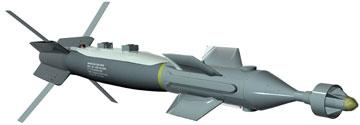
Paveway missile sold to the Saudis
Saudi Arabia formed a backdrop during the year with their continuing and increasing use of the death penalty and a host of human rights violations. In July, we wrote to our local MP, Mr John Glen, to urge his government to take a more robust line with the Saudis. We received a reply from him and a minister in the Foreign and Commonwealth Office assuring us that diplomacy was proceeding behind the scenes. We had not long received the letter when it was revealed that the FCO had just removed references to the abolition of the death penalty from its policy. It was also revealed that the requirement to adhere to international law and treaty obligations had been removed from the ministerial code. We then discovered the astonishing news that the UK government had been active in securing a seat for a Saudi man on the UN’s Human Rights Council. Together with the continuing support the government offers to sellers of arms to Saudi Arabia, this shows that claims to be interested in better human rights in countries like Saudi was a sham. It was depressing to note the new college in Salisbury being supported by a range of arms companies.
Economic prosperity was further up my list of priorities than human rights
Sir Simon Mc Donald, head of the Foreign and Colonial Office in evidence to the Foreign Affairs sub-Committee
Our all too close relationship with the Saudi government was exposed at the end of the year when the Independent revealed details of the secret security pact signed between the two governments. Human rights groups, the Independent reported, expressed alarm at the secretive nature of the deal with a regime which has been condemned for its human rights record. Kate Allen, Amnesty’s Director, called it a ‘murky deal’.
Yemen
Later in the year there was a great deal of interest in Syria and the decision to bomb ISIS. A major debate was held in Parliament with impassioned speeches on both sides. We noted that no such passion was evident in the case of Yemen where British arms supplied to Saudi are being used to bomb civilians and kill children. The government remains to keen to sell arms to whoever seemingly unconcerned where they end up. They support the annual arms fair in London and, no doubt mindful of previous revelations about the sale of torture equipment, banned a representative from Amnesty attending.
It is extraordinary that so much heat and righteous indignation is engendered by the barbaric activities carried out by ISIS, but beheadings, crucifixions, floggings and torture carried out on an increasing scale in Saudi Arabia result not in condemnation, but visits by ministers and by members of the royal family.
Good news
Moses Akatugba
But is was not all bad news. The Salisbury group, in common with others around the world, campaigned for the Nigerian man Moses Akatugba who was brutally tortured by the Nigerian police and forced to sign a confession to murder. We are pleased to note that many Salisbury people signed our petitions and cards with the result (with world wide campaigning as well) that Moses was released after 10 years on death row. This was a notable success. Over 34,000 people around the world signed petitions. Amnesty have received a letter of thanks from Moses describing his feelings on learning of his imminent release and describing Amnesty activists as his ‘heroes’.
Another success was the decision by the state authorities in Missouri to give Reggie Clemons a retrial. After a long wait for a decision from the Court following the report of the Special Judge, Reggie’s conviction and sentence for first degree murder were ‘vacated’. The Court had upheld his right to a fair trial which was all that he had sought from the beginning. This is a campaign which the local group has been pursuing actively for many years and again we are pleased to record our thanks to many hundreds of Salisbury people who signed cards and petitions.
Locally, the group undertook two Citizenship talks, one at South Wilts and one at the Shaftesbury School. These are popular with young people and well attended.
Death penalty
Campaigning against the Death Penalty has continued to be a major focus for the Salisbury Group. Regrettably, there has been no national campaign coordinated by Amnesty International in London. We hope this might change in 2016 as we have taken part in a Survey currently being carried out by HQ confirming that we would like this important aspect of Amnesty’s work to be taken up again – particularly in the light of the recent changes in the priorities of the Foreign and Colonial Office.
In the meantime, we have identified particular issues around the Death Penalty on which we have campaigned. Throughout the year we have responded to all the Urgent Actions received in respect of individuals under threat of execution – 31 in total. The majority of these have been for prisoners in Saudi Arabia, Iran and the USA. We have worked on the cases of individuals sentenced to death within Amnesty’s Campaign against torture – most notably Moses Akatugba and Saman Naseem (see below), including them in letter writing, card signings and petitions, and have also continued to campaign on behalf of Reggie Clemons (see above). In partnership with St Thomas’s Church, we held a Vigil as part of the World Day Against the Death Penalty. This was our first such venture, and it has to be said that public support was disappointing, but the Group felt it had been very worthwhile.
One of our concerns are the numbers of being sentenced to death and executed for alleged crimes committed when children. Countries with the worst records for this are Saudi Arabia, Iran and Pakistan. This issue was taken up by the Salisbury group and it was the focus of the Vigil for this year’s World Day Against the Death Penalty. We highlighted the case of Saman Naseem, a Kurd, arrested aged 17, tortured and sentenced to death for being a member of a banned organisation.
The group continues to publish a monthly death penalty report which collects information from around the world on the use of this barbaric and ineffective practice. At the bottom of this blog you will find other sites which provide information. While countries like the USA, Saudi and Iran feature frequentlyy in these reports, it has to be recognised that China executes more than the rest of the world put together but keeps the statistics a state secret.
A full report on the death penalty is on a later blog.
China
This year saw the state visit by the Chinese president to these shores. There was considerable discussion about human rights in China – or the lack of them – including the denial of free speech, the use of torture, thousands executed after brief trials and continued suppression in Tibet. It was revealed by the Chinese media that George Osborne – who is keen to replace David Cameron as Prime Minister – on his visit to China, failed to mention human rights at all to the surprise of his hosts. What was said to the president on his visit here, if anything, is unknown. Protestors in London were mysteriously kept well away by armies of Chinese. This was a clear demonstration that the current government is almost exclusively concerned with economic matters and not about human rights.
North Korea
Group campaign event, Saturday 8 November
During the year we continued to highlight where we can, the continuing state of human rights abuses in North Korea. The situation there remains dire and the role of the Chinese is crucial. People fleeing the country are frequently handed back to face a terrible future in a forced labour camp the condition of which are unimaginable. They also try and obstruct efforts by the UN. Their fear is that instability in North Korea could be the trigger for unrest in China itself. There is now greater awareness of what is going on the country and the story has moved away from border skirmishes to the appalling human rights situation: progress of sorts. Clip from the video made in 2014 available on YouTube. The message reads ‘Close the Camps’
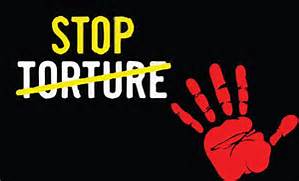
Stop torture
We have campaigned throughout the year on behalf of individuals who have been subjected to torture. This abhorrent practice is still very common around the world with an estimated 141 countries still practising it. This is despite signing various UN protocols to the contrary.
Human Rights Act
We have reported on many occasions the desire by the government to do away with, scrap or abolish the HRA. Our local MP, Mr John Glen is on record as wanting this. Part of the reason – perhaps the major part – is the continuing dislike of things European. ‘Brussels’ has become shorthand for anything bad and for interference in our affairs and the HRA is caught up in that. It doesn’t help that the majority of newspapers publish seemingly endless stories of dubious decisions which are the result – it is claimed – of the workings the act. Stories about benefits for ordinary people almost never make it onto a tabloid page.
A second reason (we have speculated) is that much press activity nowadays involves the intrusion into the private lives of celebrities and politicians using hacking, buying information from the Police and other sometimes illegal means. Article 8 of the HRA includes a right to privacy which would seriously curtail this activity. We are currently awaiting the review of the act (promised in the Autumn) and how the government proposes to change it. Perhaps we can be encouraged by the appointment of Michael Gove MP as Justice Minister, who has shown himself willing to overturn some of the worst excesses of his predecessor such as iniquitous court fees and banning books from prisons.
During the year we were pleased to welcome the formation of Rights Info which was established to counter the misinformation regularly pumped out by our media. It analyses the various cases and stories which make the news and presents the facts.
Snoopers’ charter
The investigatory powers bill is currently in the report stage. It proposes giving increased powers to the security services to intercept private messages, phone calls, Skype, emails and social media. People are rightly concerned and fearful of terrorist activity and mostly take the view that as I’ve got nothing to hide, losing a bit of liberty is a price I’m willing to pay for greater security. There is a trade off here: we give up some liberty and the right to our privacy to enable the security services to invade emails and the like in their hunt for terrorists, drug smugglers and people traffickers. But we expect our politicians to exert oversight and to ensure the security services are properly accountable. The revelations by Edward Snowden exploded that and showed that the relevant parliamentary committee had little or no idea of what was happening. We have also noted the strange dichotomy between the publics’ distrust of politicians on the one hand and trusting them when it comes to intruding into our private lives on the other.
Peter Wright’s book Spycatcher (Viking Penguin) first revealed the inside story of the MI5 which he alleged had burgled its way around London. More recent books such as Seamus Milne’s The Enemy Within (Verso) revealed the underside of the security services and their (successful) attempts to undermine the miners’ strike and Nick Davies’s Hack Attack (Chatto and Windus) which told the story of the media’s involvement with politicians, senior Metropolitan Police officers and the security services. All these books, and others, show the importance of strong independent control of what these services are up to. Unfortunately, the unholy link between some newspaper groups, politicians and the police makes achieving this very difficult.
So although we do not mind the security services penetrating terrorist cells, we might mind them listening in to solicitors discussing their client’s cases, journalists’ phone calls and bugging human rights groups, all things they have been shown to do. Liberty is a precious thing and we need to be ever vigilant that their activities are closely monitored and are appropriate. With the politicians we have today we cannot be sure of this. One of the few exceptions is David Davis MP (seen here third from left at the Sixth Form Conference at the Cathedral, next to Kate Allen) who has regularly highlighted the dangers of this bill and of the creeping nature of intrusion being planned by the Home Office.
Conclusions
This has been a busy year for us with many achievements. However, we look forward to next year with some forboding. The desire to promote economic interests almost at any cost and the near abandonment of overseas human rights issues is a worry. We want to go on selling arms to highly unstable regimes like the Saudis, seemingly with no concern with how or where they use them. Claims of ‘quiet diplomacy’ are a sham when you are promoting one of their number onto the UN’s Human Rights Council. At home, the combination of the ‘snoopers’ charter,’ a desire to end or abolish the Human Rights Act and to curtail the Freedom of Information Act are all steps in the wrong direction.
This has been an exceptionally busy year, as the report notes. We have succeeded in holding major headlining events, around the Magna Carta celebrations, while still carrying on our usual campaigning, and keeping awareness of Amnesty high in the city, all with a relatively small activist base. Our visits to schools have been valuable in this respect too, and thanks are due to all who have helped over the last year to keep us in the public eye and assisted in the success of the achievements noted here. I would conclude by wishing our readers an supporters a happy New Year, and hopes for freedom for those we are supporting.
Andrew Hemming, Chair of the Salisbury group
We continue to be heartened by the warm support we get at signings from people in the Salisbury area. The support of the Cathedral in this Magna Carta anniversary year has also been particularly valued.
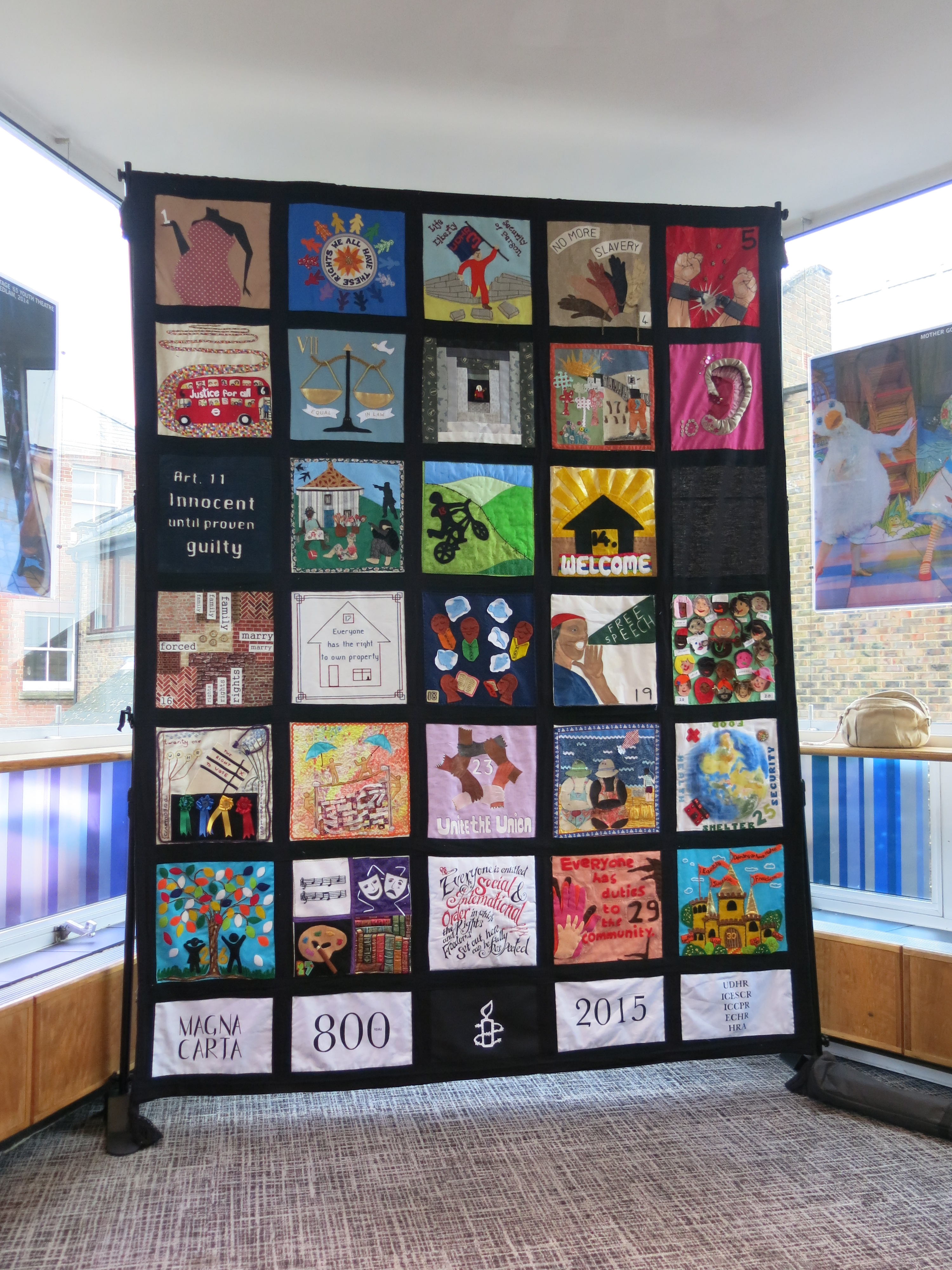
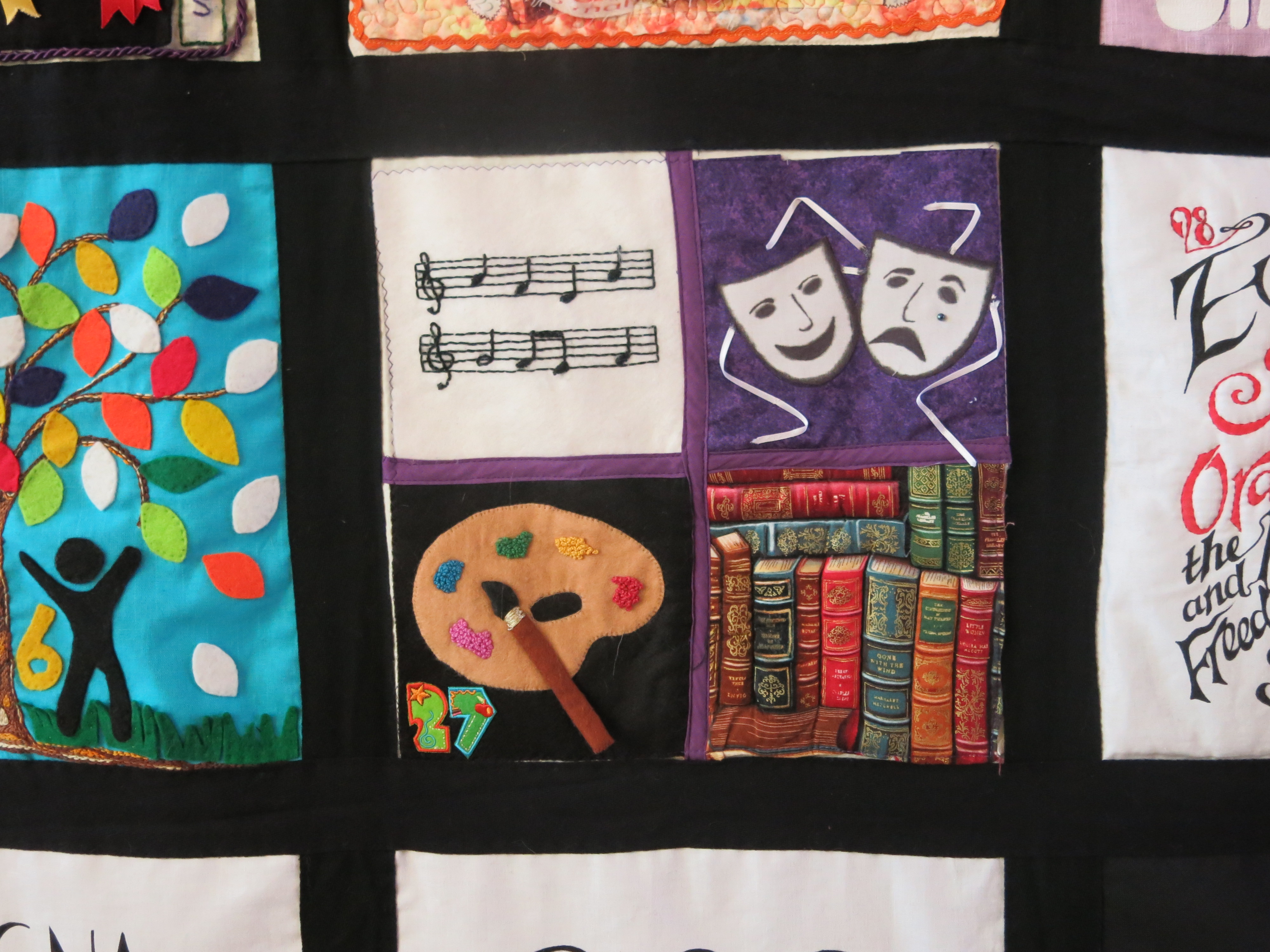
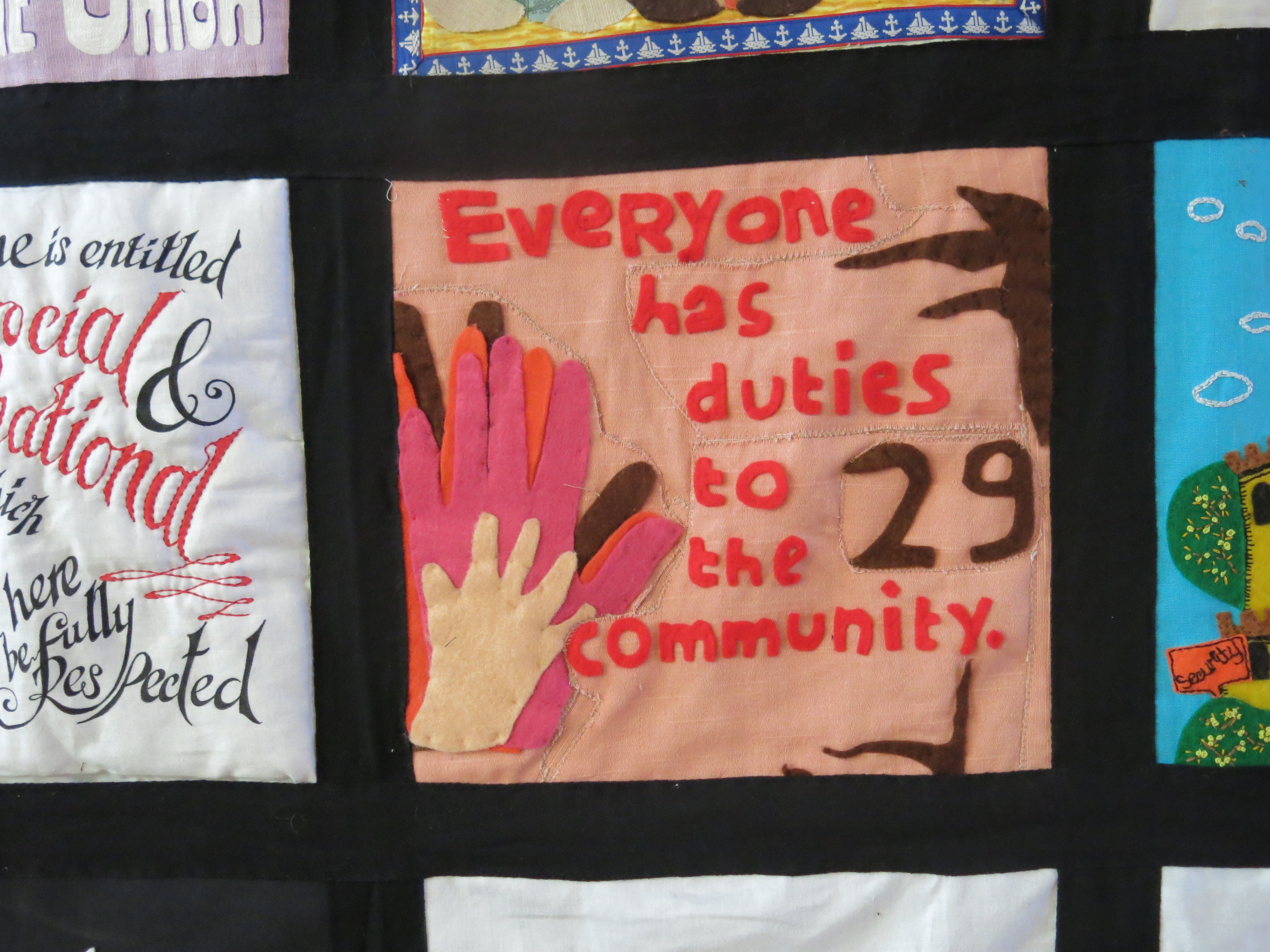
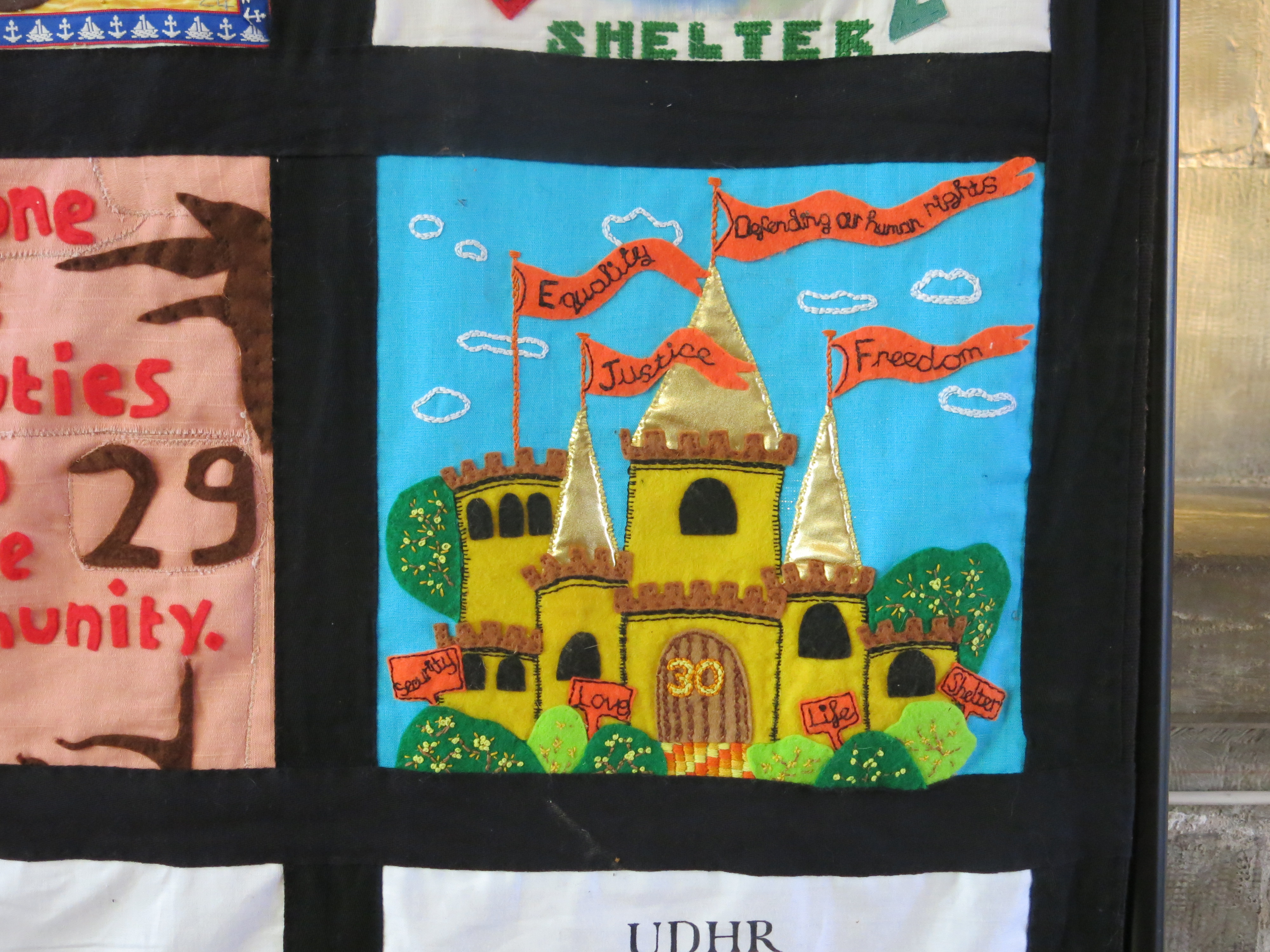
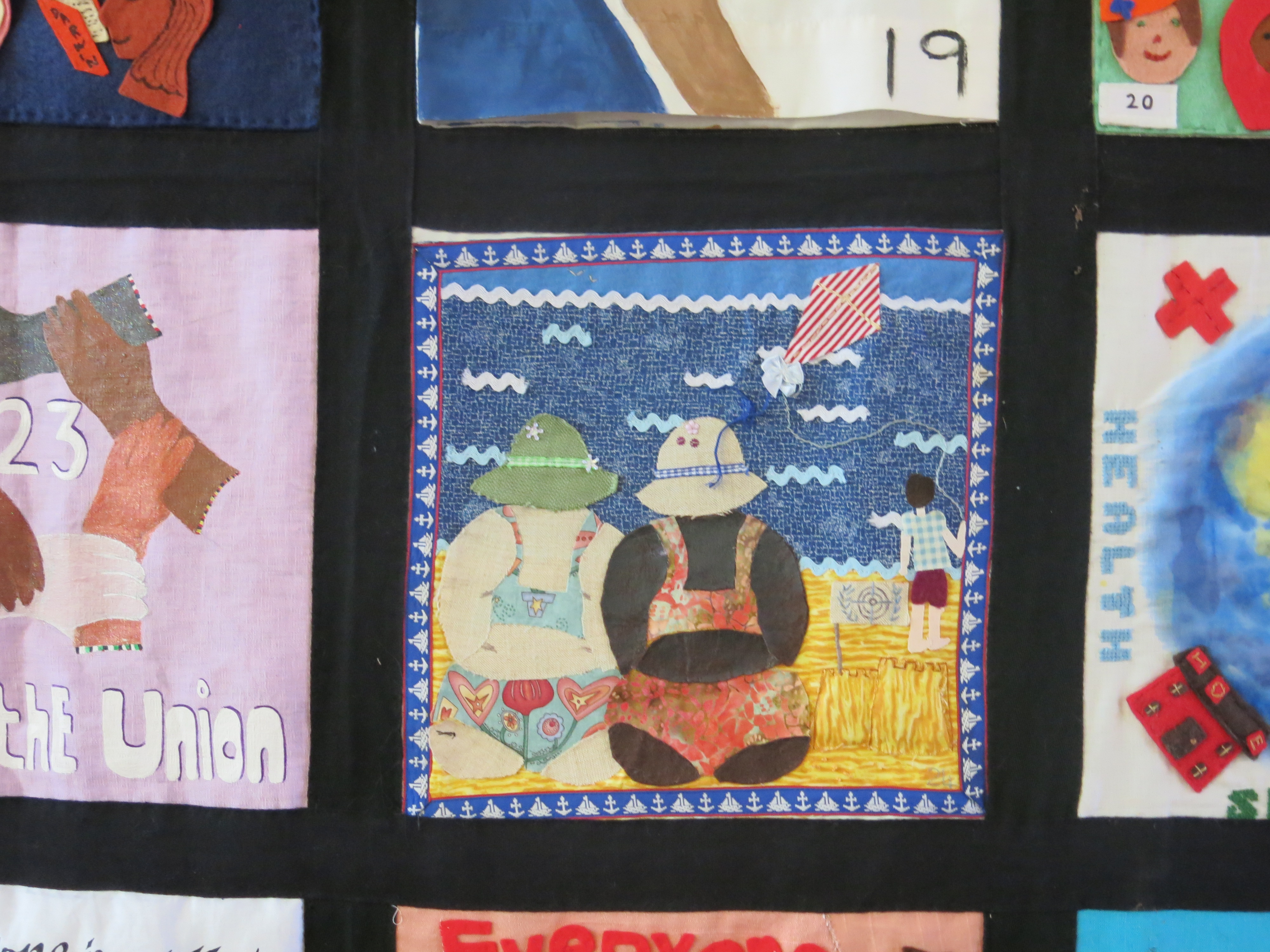
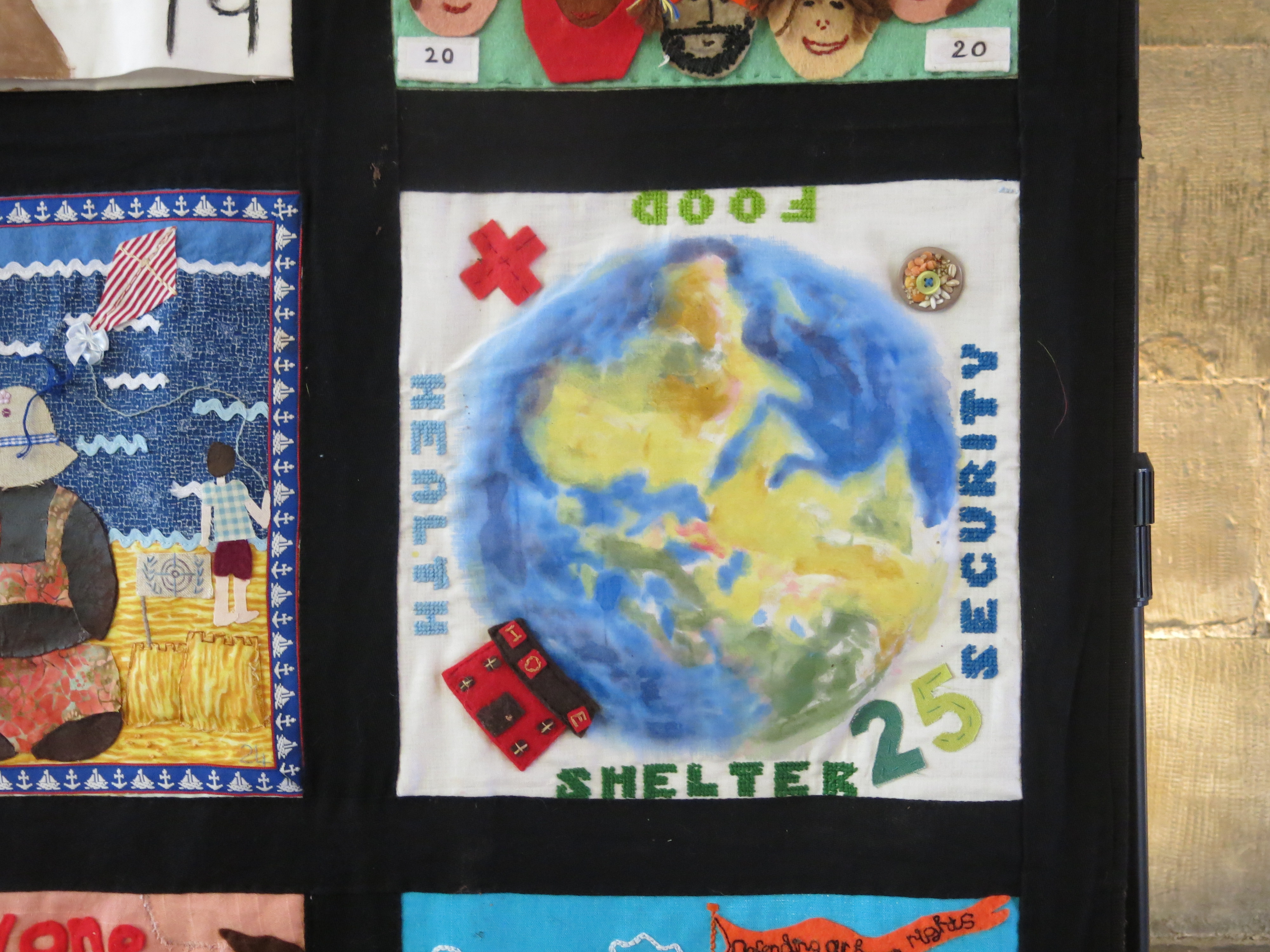
The last set of pictures of the panels on the tapestry currently in the entrance to the Chapter House at Salisbury Cathedral. Each panel represents an article from the Universal Declaration of Human Rights. Video
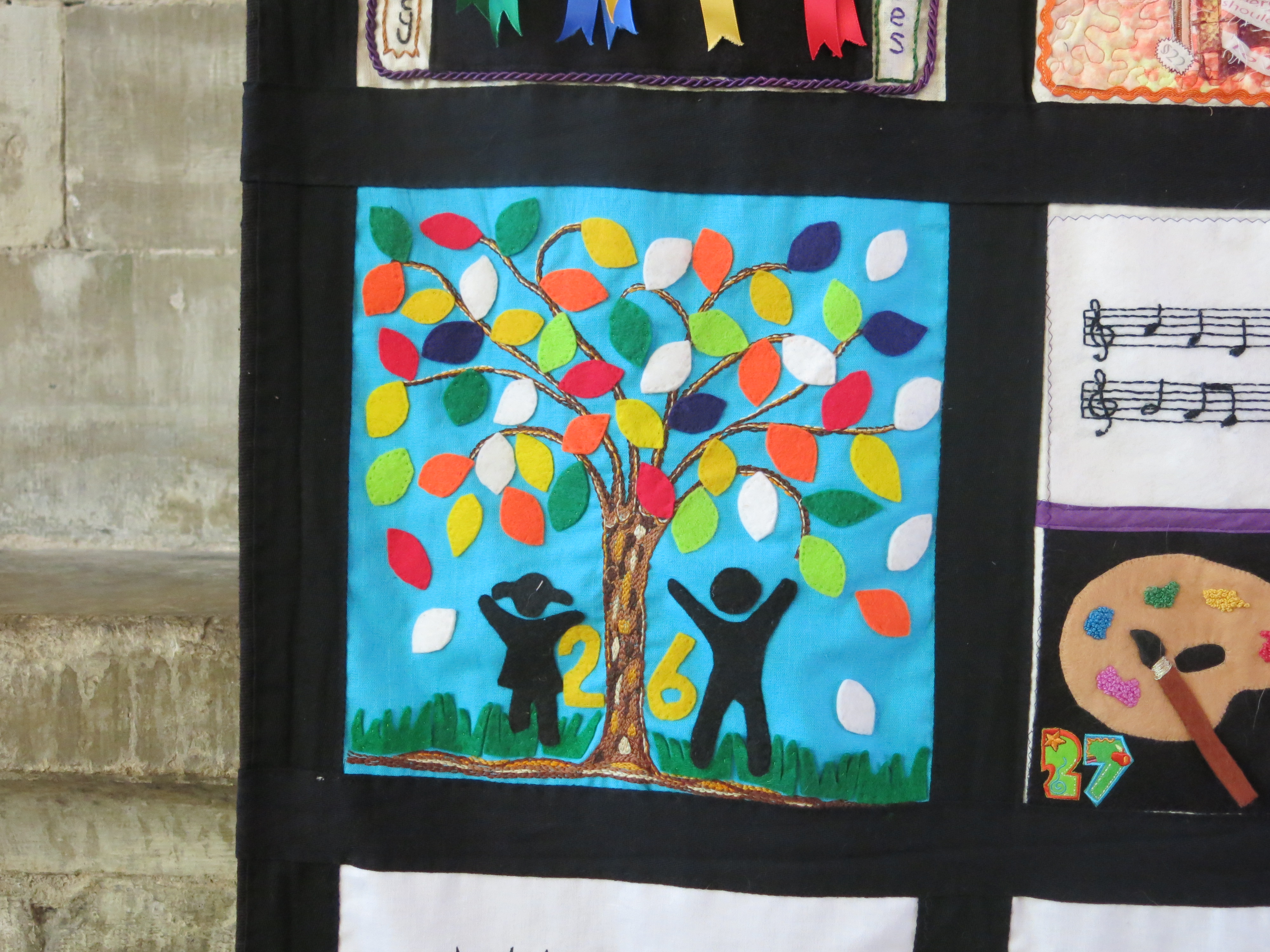
Article 26: Everyone has the right to an education, elementary schools should be free and compulsory. Contributed from the Southampton City group.
Article 27: Everyone has the right to freely participate in the cultural life of the community. Team effort this by Fay, Janet, Sharon, Sue and Gretel, members of the Romsey group.
Article 28: Everyone is entitled to a social and international order in which the rights and freedoms set out here can be fully respected. The third panel by our Regional Representative, Caroline Butler.
Article 29: Everyone has duties to the community. This is the second panel in the tapestry contributed by a refugee group, this time GARAS, the Gloucester Action for Refugees and Asylum Seekers. GARAS offers support to those seeking asylum in Gloucestershire; welcoming them when they arrive; advocating for them in their daily struggles; supporting them if they face being sent back, as well as helping them adjust to their long term future if they are recognised as refugees.
Article 30: No one has the right to act in such a way as to destroy the rights and freedoms set in in this declaration. The fourth panel from the Southampton City group.
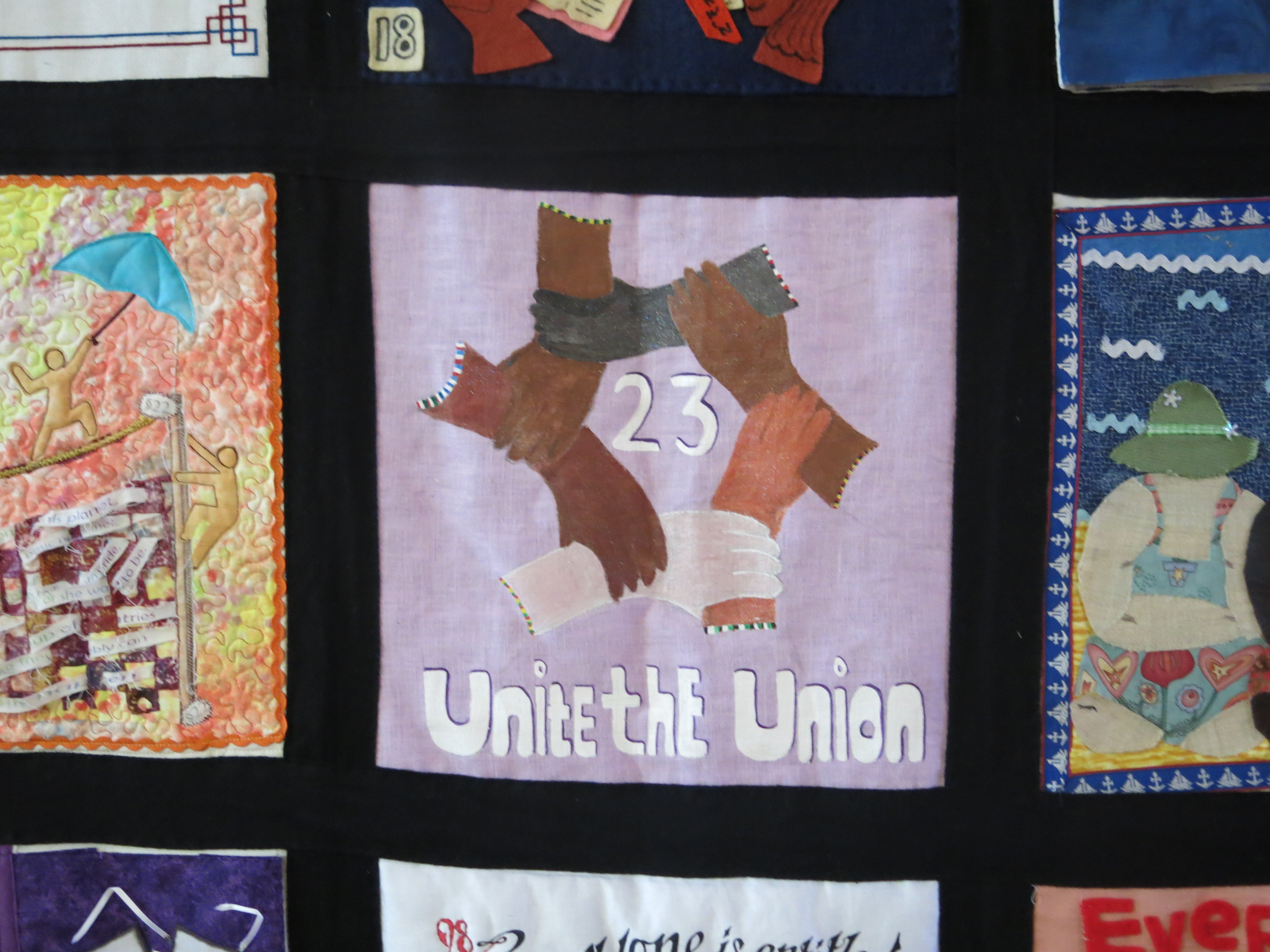
Nearly there: this is the fifth batch of detailed pictures of the tapestry now in the entrance to the Chapter House at Salisbury Cathedral. Previous blogs have shown the first twenty panels. Any errors of if you want to add some detail, please get in touch and we shall be happy to oblige.
Article 21: Everyonehas the right to take part in the government off their country. Voting should be regular and secret, and all votes should have equal value. Another panel from the Bournemouth, Poole and Christchurch group.
Article 22: Everyone as a member of society, has the right to social security and is entitled to realisation of economic, social and cultural rights. This panel made by the West Wilts group.
Article 23: Everyone has the right to work and those doing the same work should get equal pay. Everyone has the right to form and join a trade union. A second panel from the West Wilts group.
Article 24: Everyone has the right to rest and leisure including reasonable working hours and paid holiday. A third panel from the Frome group, this time by Fiona and Jeanne.
Article 25: Everyone has the right to a standard of living adequate for health and wellbeing. People should be helped if they cannot earn a living. A third panel from the Bristol group.















 Amnesty in Salisbury & South Wiltshire
