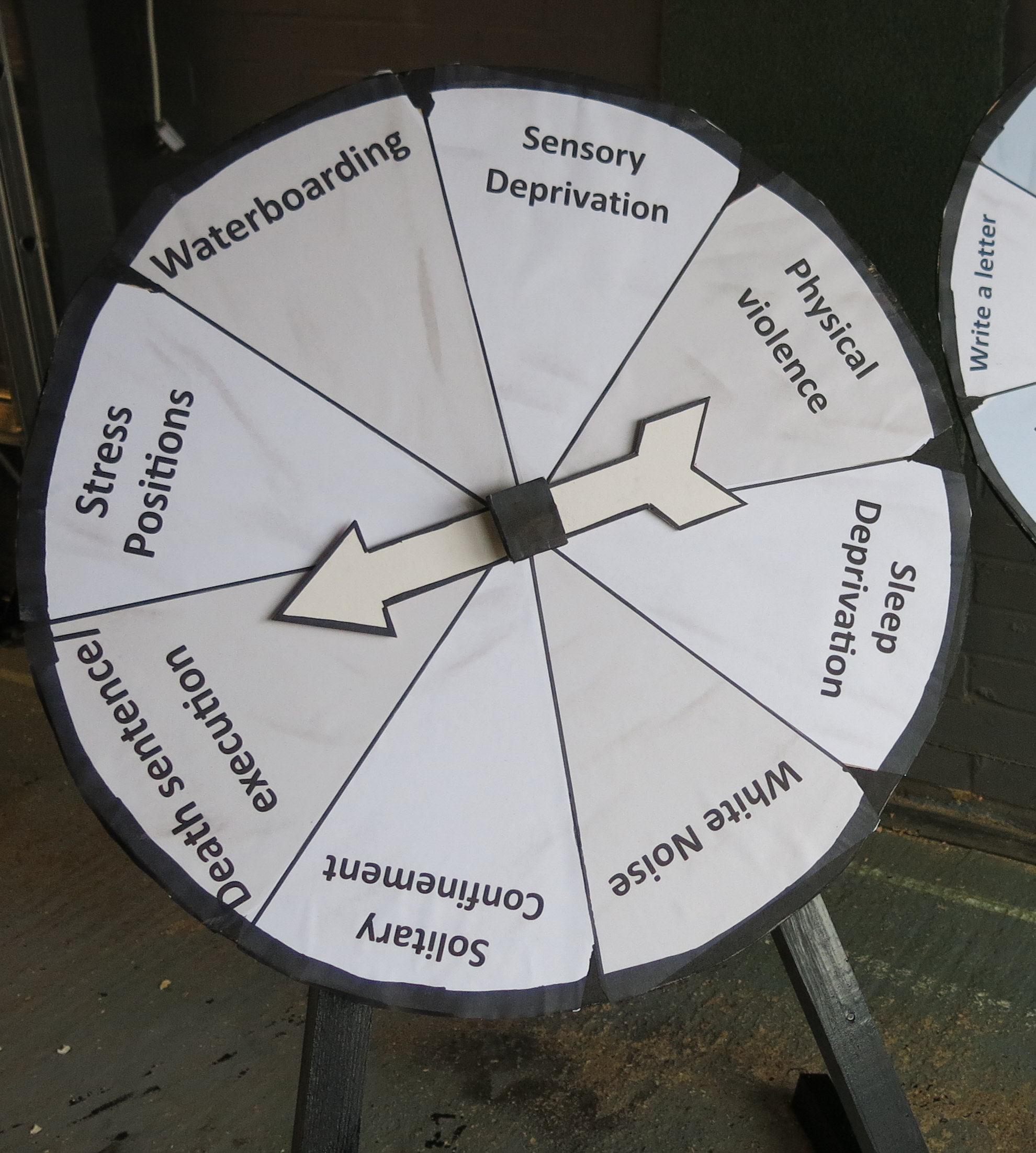
We today erected the display in the cloister at Salisbury Cathedral to celebrate the signing of Magna Carta and to illustrate the #StopTorture campaign.

It will remain in place for many weeks. There is also a panel on the Human Rights Act.
Amnesty in Salisbury & South Wiltshire
Promoting human rights from Salisbury UK

We today erected the display in the cloister at Salisbury Cathedral to celebrate the signing of Magna Carta and to illustrate the #StopTorture campaign.
It will remain in place for many weeks. There is also a panel on the Human Rights Act.

On Saturday 15 November the group carried out a signing for the #stoptorture campaign. Cards for five

individuals who have allegedly been tortured were available for people to sign and we secured the magnificent total of 267. It was the first time out for the torture wheel which is modelled on the infamous wheel used by the Philippine police. Various forms of abuse are put on a wheel which they spin to decide on what method to use on a victim.
Although we achieved a good response, many refuse to sign and one person ventured the opinion that ‘they must have deserved it.’ Torture is widely used around the world and is practised in 141 countries despite nearly every nation having signed the UN protocol against its use.
The cards will be posted over the net few days to the relevant authority where the victims are held.
Don’t forget the Salisbury Arts Centre film on 4 December.

October 2014
Update: See this Human Rights Watch blog: http://www.hrw.org/news/2014/10/31/dispatches-rare-victory-justice
A victory was achieved today in the long running battle by Abdul-Hakim Belhaj and Fatima Boudchar to get justice and redress for being tortured in Libya.
Belhaj was a Libyan politician who was allegedly abducted and secretly flown to Libya where he was tortured by General Gaddafi’s security forces. He has brought the case against the former foreign secretary, Jack Straw and Sir Mark Allen, the former head of counter terrorism at MI6. After the collapse of the Gaddafi regime, papers were discovered in Libya which implicated the British security services in the torture of Belhaj and his wife.
In December 2013, the High Court struck out the civil lawsuit brought by the claimants, holding that since the claim called into question activities of a foreign state on its own territory the act of state doctrine precluded the court from hearing the case. The Court rejected the UK Government’s argument that state immunity (a principle of international law by which a state is protected from being sued in the courts of other states) operated as a bar to the claim.
Judge Mr Justice Simon found “with hesitation” that the case could not go ahead and expressed his concern that “what appears to be a potentially well-founded claim that the UK authorities were directly implicated in the extraordinary rendition of the claimants, will not be determined in any domestic court; and that Parliamentary oversight and criminal investigations are not adequate substitutes for access to, and a decision by, the Court.”
In February 2014, the claimants were given permission to appeal the ruling on the act of state doctrine and the UK Government cross-appealed contesting that, in addition to the act of state doctrine, state immunity also precluded the claims from being heard.
On Monday 30 June, the NGOs Amnesty International, the International Commission of Jurists, JUSTICE and REDRESS filed written interventions jointly in this case, which may set an important precedent for future claims brought by torture victims.
In the Court of Appeal’s decision it noted, among other things, the changed nature of public international law which has expanded to include the regulation of human rights … It went on to observe that ‘unless the English Courts are able to exercise jurisdiction in this case, these very grave allegations against the executive will never be subjected to judicial investigation.’
Andrea Coomber of Justice said that the Government’s case would fundamentally undercut the international rule of law and undermine the global commitment to remedies for victims of human rights violations.
Part of the Government’s case was a fear of embarrassing the United States who had colluded with MI6 in the alleged abduction.
It is frequently stated that the British Government does not carry out torture and we have signed the relevant treaties to that effect. Rendering people to countries to, in effect, subcontract this evil process is unacceptable.
The government is considering whether to appeal.
Sources
Brick Court Chambers, http://www.brickcourt.co.uk
The Guardian http://www.guardian.co.uk
Redress (see link at bottom of this blog)
Reprieve (ditto)
Amnesty International (ditto)

An interesting decision was made by the courts this week that Prince Nassser bin Hammed Al-Khalifa (pictured) is liable for prosecution for his alleged role in the torture of FF a torture survivor from the kingdom. Up to now the prince has claimed immunity. The case is important because several of the gulf states regularly use torture yet prosecutions never happen because of claimed immunity.
This is an embarrassment to the UK government as it has welcomed members of the ruling family to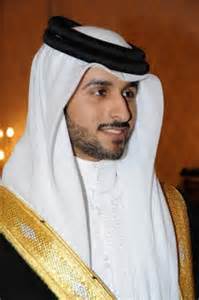 Downing St and is keen to promote greater ties with the kingdom. Indeed the New Statesman remarked that ‘the more desperate the situation in Bahrain becomes, the closer Britain ties itself to the ruling family.’
Behind it all is an arms deal of £1bn for the sale of Tornado jets.
The full story is on the Center for Constitutional and Human Rights (sic)
At a conference held by Amnesty in London, one of the speakers was Prof. Malcolm Evans of Bristol University. He spoke on the subject of #torture and its use around the world with the particular perspective of the UN Convention Against Torture [full title: Subcommittee on the Prevention of Torture and other Cruel, Inhuman or Degrading Treatments or Punishment, SPT].
One of the problems with the issue of torture and its use is that many countries have signed up to abolish its use but nevertheless continue to practise it. Another speaker pointed out that 155 countries have signed the protocol but as far as is known there are credible reports of its use in 141 countries around the world. It’s easy when reading statistics sometimes for one’s eyes to glide over such figures. But just ponder that figure -141 countries.
SPT gives the right of the UN to go to any country, which has signed the optional protocol, without prior warning. It is the only UN body able to do this. They are not there to investigate individual instances but to ‘get ahead’ of violations and to stop something from happening rather than holding individuals to account.
Their purpose is to get preventative safeguards established which include issues of legality, and knowing who is in detention. They work alongside authorities and discussions are held, sometimes with people one would rather not have discussions with.
He made the point that it wasn’t just dictatorial regimes who engaged in this activity but that it was more a matter of how it has always been done. There was a kind of routineness to it. It was as much to do with corruption as anything else. In trying to advance change, you have to work with what is practical to achieve and to establish relationships to achieve momentum.
He also raised the intriguing point that it was all very well writing to presidents and the like asking them to stop this practice, but since most of them had signed up not to do it anyway, how effective is that as a campaign method?


On Saturday 11 October we shall be manning a stall in Salisbury market to highlight the human rights situation in #Nigeria. In particular, the case of Moses Akatugba who was tortured by Nigerian police to secure a conviction. He was 16 when arrested, shot in the hand, beaten, and hung in an interrogation room for hours. Pliers were used to extract his finger and toe nails. His alleged crime was to steal three mobile phones. Unfortunately, this ill-treatment is now a commonplace in Nigeria and there are reported to be ‘torture officers’ in police stations.
Executions were resumed in June last year when four men were executed in Benin city. The bodies were not returned to the families for burial nor is the location of the graves known.
Amnesty has serious concerns about the increasing use of torture and other cruel, inhuman and degrading treatment or punishment in Nigeria. Recent research by Amnesty indicates that police and military personnel routinely use torture and other ill-treatment to extract confessions and to punish and exhaust detainees.
Nigeria fact sheet (pdf)
You can also read about corruption in Nigeria here: Human Rights Watch: Nigeria
We look forward to seeing you in the market place on 11th.

UPDATE: The full minutes are now available here
We held our monthly meeting on 11 September and a number of items were discussed some of which will be separately posted [P].

however and he will chase this up
Full minutes will be posted soon.

We are sad to record the death of Helen Bamber #helenbamber who set up Medical Foundation for the Care of Victims of Torture following many years as a member of Amnesty International and later the Helen Bamber Foundation. The foundation helped many people who had suffered torture in various countries from which they had managed to flee.

The local group was privileged to hear Helen speak at one of its meetings some years ago. She will be sadly missed.

 Amnesty in Salisbury & South Wiltshire