Is the situation with human rights around the world in terminal decline?
The title of this piece ‘What’s it got to do with us?’ was said at a signing in Salisbury by someone invited to sign a card for a prisoner of conscience. She did not sign. Of course, anyone involved in any kind of street signing will have come across this kind of response from people who are not persuaded there is any point in sending such cards and who do not think someone in prison in a foreign country has anything to do with us anyway.
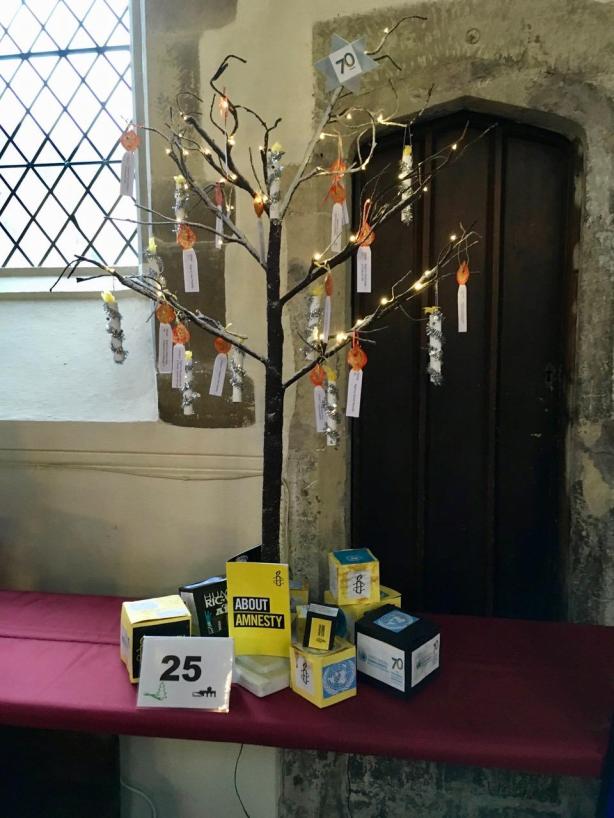
This year sees the 70th anniversary of the signing of the Universal Declaration of Human Rights. This was done following the second world war and with the formation of the United Nations itself was part of a belief that there had to be a better way for countries to organise their affairs. Although there was a desire for such a better way, it would be a mistake to overlook the difficulties in negotiations to get UNDHR agreed. The colonial powers – principally UK and France – had worries about what was happening in their colonies. They were reluctant to see rights being applied there especially in view of the brutal suppression of freedom movements. Nevertheless, it was signed and it did usher in a new world order.
Looking at the world today however, does not lead us to believe that we are on an improving trend. It is hard to select from a series of terrible events to illustrate the point. The suppression of free speech and the arrest of thousands of journalists and academics in Turkey is one example of many elements of the declaration being ignored. Syria, which has seen thousands die from bombing and the use of gas, is another example, this time by a member of the UN Security Council itself, namely Russia. In China, vast internment camps established in Xinjiang to detain hundreds of thousands of Uighurs, and the arrest of human rights lawyers has been detailed in a UN report. As Human Rights Watch expresses it:
The broad and sustained offensive on human rights that started after President Xi Jinping took power five years ago showed no sign of abating in 2017. The death of Nobel Peace Prize laureate Liu Xiaobo in a hospital under heavy guard in July highlighted the Chinese government’s deepening contempt for rights. The near future for human rights appears grim, especially as Xi is expected to remain in power at least until 2022. Foreign governments did little in 2017 to push back against China’s worsening rights record at home and abroad. World Report, 2018 [accessed 18 November 2018]
In Yemen, which this site has featured in a number of blogs, has seen a country taken to edge of viable existence by a campaign of bombing by Saudi Arabia and atrocities by the Houthis. The Saudis have been supported by arms from the UK, France and the USA. British RAF personnel are supposedly advising the Saudis. The point here is not just the misery inflicted on the country but that schools, hospitals, weddings and other community events have been targeted in the bombing campaign.
Seventy years after the signing of the Declaration, we should be celebrating steady improvements across the world. We are not. Rights and freedoms are routinely violated in many countries around the world. Torture is still widely practised by the majority of countries: countries that have signed up not to use it. Even countries like the UK have been found shamefully outsourcing its use of this abhorrent practice to Libya.
We could go on listing wars, the displacing of millions including the Rohingya from Burma, the continuing scourge of slavery which is probably at a higher level today than during the triangular trade, and the murder of journalists in countries like Russia.
Here in Salisbury we have seen the brazen Novichok attack on the Skripals by what seems, beyond doubt, to have been Russian GRU agents. In Turkey there has been the murder and probable dismemberment of Jamal Khashoggi. None of this kind of activity is new – the CIA have been involved in murders and coups especially in South America – but that we have become inured to it. To turn on the news is to witness war, misery, tides of refugees fleeing persecution or war, stricken cities and starving peoples. There is a distinct feeling that the international rules based order ushered in after the second world war, now seems to be crumbling. Famines in the ’80s and ’90s in Ethiopia and Somalia resulted in huge humanitarian efforts and the British public were moved by the scenes and reportage from the area. Considerable sums were collected to help. Today, we see the enormous damage and misery in Yemen but there is no sense of national outrage.
Causes
John Bew, in a New Statesman¹ article, argues that the events of 2007 and 2008 were an important factor. This is part of the theme of Adam Tooze’s recent book Crashed: how a decade of financial crises changed the world². Up until the crash, there was a feeling of ever increasing prosperity (for some at least) and that free market ideology had won the day. The crash destroyed that belief and importantly, ordinary people, not especially steeped in economic thought, began to realise that things were not right. There was also a shift in power eastwards towards China and away from the west. With it, the assumptions of democracy, free trade, and a rules based order had been weakened. With the increasing interconnectedness of the world order and global trade, the ability of societies to deal with the ‘left behinds’ diminished.
With this decline, countries like the UK needed to work harder to sell goods to pay their way in the world. That often meant looking the other way when we sold arms to unsavoury regimes. ‘If we do not sell them, the Chinese will’ was a common belief. Although the UK government often proclaims that we have a tough regime for arms control, the fact remains that brokers and dealers frequently and all too easily circumvent them.
The architects of the new world order after WW2 were the victorious powers: USA, China, Russia, UK and France. These are the biggest seller of arms today joined perhaps by Israel and Germany. The very countries wanting to achieve peace in the world are those busy selling the means to destroy it.
As the Amnesty annual report puts it:
In 2017, the world witnessed a rollback of human rights. Signs of a regression were everywhere. Across the world governments continued to clampdown on the rights to protest, and women’s rights took a nosedive in the USA, Russia and Poland.
From Venezuela to Tunisia, we witnessed the growth of a formidable social discontent, as people were denied access to their fundamental human rights to food, clean water, healthcare and shelter.
And from the US to the European Union and Australia, leaders of wealthy countries continued to approach the global refugee crisis with outright callousness, regarding refugees not as human beings with rights but as problems to be deflected.
In this climate, state-sponsored hate threatens to normalise discrimination against minority groups. Xenophobic slogans at a nationalist march in Warsaw, Poland and sweeping crackdowns on LGBTI communities from Chechnya to Egypt showed how the open advocacy of intolerance is increasing. Annual Report 2017/18 [extract]
Prospects
The prospects for human rights around the world look grim. The idea of a steady improvement around the world does not look promising. The belief in a new world order following the war also looks rather thin and forlorn. With the major countries, who should be setting an example but are not doing so, the chance of improvement in the future does not look great.
In the UK, the are some in government who would like to remove the Human Rights Act from the statute book to be replaced by a weakened bill yet to be published. If that ever sees the light of day we shall be campaigning against it.
There is also the problem of compassion fatigue. No sooner does one calamity – whether man made or natural – disappear from our screens, than another one appears. There seems no time to recover between them. It is perhaps not surprising that people feel a sense of hopelessness. The scale of some events is so huge, the quarter of a million Rohingya forcibly displaced for example, that any response seems puny by comparison.
But people who believe in human rights and their importance in the world continue the fight. We continue to highlight as many examples of wrong doing as we can. In the words of our founder ‘better to light a candle than curse the darkness’.
If you live in the Salisbury area we would welcoming you joining us. Events are posted here and on our Facebook and Twitter pages – salisburyai
- Revenge of the Nation State, 9-15 November 2018
- Adam Tooze, published by Alan Lane 2018