Arms sales and the revolving door


New report from the Campaign Against the Arms Trade reveals extent of this activity

November 2024

[ADDED: 16 December] If you want to see ministers squirm in front of a select committee when discussing arms sales to Israel (via USA) watch this YouTube video. Usual claims of ignorance and unable to answer basic questions. Even though the RAF is regularly flying over Gaza, it seems they are unaware of the destruction as the purpose they say is to look for hostages.

The question of arms sales has risen up the political agenda partly because of the question of whether we should continue to sell weapons to Israel. It also cropped up with the decision recently to award a GCVO to the King of Bahrain presented by King Charles. It was also an issue during the war in Yemen where British weapons and personnel were involved in helping Saudi in their ferocious bombing campaign in that country. All these and other examples revealed an industry with considerable political influence. They result in a distortion of our political process and an almost complete disregard for the effects of the arms on people at the end of them. The destruction being carried on in Gaza is facilitated by the continuing sale of F-35 aircraft elements of which are made in the UK. An ‘ethical dimension’ to our policy seems to be a thing of the past. There is little sign that arms sales are restricted to states which ignore human rights or International Humanitarian Law.

Not so much a revolving door as an ‘open plan office’

Campaign Against the Arms Trade CAAT has campaigned on these issues for many years and their current magazine, Issue 270, Autumn 2024 contains a number of articles on the topic of arms. One concerns what has been known as the ‘revolving door’. In an article ‘Government and Arms Industry Joined at the Hip’, they explore the deeply compromising nature of this relationship. They have published a report From Revolving Door to Open Plan Office: the Ever Closer Union Between the UK Government and the Arms Industry. They argue that the arms industry has become so deeply embedded in the government that the boundary has almost disappeared. It is now not so much a revolving door as an ‘open plan office’. 40% of top military staff and civilian personnel leaving the MOD hold positions in the arms and security industries. Transparency International research shows that one company, BAE, had more meetings with ministers and with Prime Ministers than any other company.

Private Eye carried out an extensive survey in 2016. This went into great detail and named names.

Why does it matter?

It matters for three main reasons:

  • Firstly, arms cause great misery for millions of people. The harrowing images on news programmes of property destruction, dead bodies, lines of people on the move or rows of tents housing displaced people are the result of the activities of this trade,
  • The lobbying power is such that government ministers seem to fall into line almost as soon as they assume power. Grand statements by Sir Keir Starmer and David Lammy for example are quickly forgotten as the next trade deal is signed. The arms trade seems to wield enormous power and influence over government policy,
  • Thirdly, the ‘open plan office’ means senior staff in the Civil Service and in the MOD and armed services are keeping an eye on prospects as they approach retirement. Lucrative board appointments and ‘consultancy’ contracts await them. Are they going to ask uncomfortable questions or raise difficulties with an arms contract and jeopardise these prospects?

As CAAT put it:

‘When these ‘revolvers’ leave public service for the arms trade, they take with them extensive contacts and privileged access. As current government decision-makers are willing to meet and listen to former Defence Ministers and ex-Generals, particularly if they used to work with them, this increases the arms trade’s already excessive influence over our government’s actions.

‘On top of this, there is the risk that government decision-makers will be reluctant to displease arms companies as this could ruin their chances of landing a lucrative arms industry job in the future. Beyond individual decisions, the traffic from government to the private sector, and vice versa, is part of a process where the public interest becoming conflated with corporate interest, so that it becomes normal to unquestioningly meet, collaborate and decide policy with the arms industry, then take work with it.’

Urgent action: Oklahoma


We attach an urgent action concerning the death penalty in Oklahoma

November 2024

DEATH PENALTY ACTION FOR NOVEMBER, 2024

This  action is part of our continuing campaign calling on the Governor of Oklahoma to issue a moratorium on all executions, and ultimately to move towards the permanent abolition of the death penalty in the state.  Letters (preferably) or emails should be sent to Governor Stitt, focusing in particular on the history of racial discrimination within the State and how this has impacted on Oklahoma’s application of the death penalty.

Contact details:

The Honorable J Kevin Stitt

Governor of the State of Oklahoma

Oklahoma State Capitol

2300 N. Lincoln Blvd; Suite212

Oklahoma City

OK 73105

USA.

Emails can be tried at:   https://oklahoma.gov/governor/contact/general-information/contact-the-governor.html which gives access to a form.

Please take this action before the end of November.

Racial Discrimination/Bias in the Application of the Death Penalty in the State of Oklahoma

In 2017 the Death Penalty Review Commission concluded the system in Oklahoma was ‘broken’ and unanimously recommended a moratorium on executions ‘until significant reforms were accomplished’.  They also questioned ‘whether the death penalty could be administered in a way that ensured no innocent person was put to death.  They made 47 recommendations but it is understood – over 6 years later – none have been implemented.

In 2022 the report Deeply Rooted: How Racial History informs Oklahoma’s Death Penalty’ by Dr Crutcher, Founder and Executive Director of the Terence Crutcher Foundation, was issued – and updated in  September 2024.

The report places Oklahoma’s death penalty in its historical context of lynchings and mass violence against Black Oklahomans and the forced migration of Native Americans. It documents the historical role that race has played in the State’s death penalty and details the pervasive impact that racial discrimination continues to have in the administration of capital punishment.

The report ties Oklahoma’s use of the death penalty to its troubled history of racial violence and segregation. It observed that Oklahoma was at an inflection point in its administration of the death penalty and argued that, if the State was to establish a fair and humane system of justice, it was crucial to acknowledge and redress the effects of the Jim Crow laws and racial violence that persist into the present day.

Racial discrimination, especially the race of the victim, continues to infect all aspects of the death penalty in Oklahoma.  A study of homicides in the state between 1990 and 2012 found that the odds a person charged with killing a white female victim would be sentenced to death were 10 times greater than if the victim was a minority male. Of the 25 executions scheduled between August 2022 and December 2024, 68% involve white victims. Data throughout the report suggest that valuing white victims more than others has resulted in disproportionate punishment for Black defendants who murder white people.

An examination of the age and race of the men scheduled for execution reflects the bias that Black youth are perceived as older and less innocent than white youth. Seven of the 10 Black men set for execution were 25 years old or younger at the time of the crime. By contrast, only one of the 13 white men set for execution was 25 or younger at the time of his crime. Three of the Black men were 20 or younger and one of them, Alfred Mitchell, was only two weeks past his 18th birthday.

Of the 142 people in the U.S. who have been removed from death row because of intellectual disability (following the U.S. Supreme Court’s ruling that their executions are barred), the majority (83%) have been people of colour. This suggests that people of colour, especially Black people, with intellectual disability are at a greater risk of being subjected to capital punishment. Oklahoma has limited the ability for people on death row to seek relief based on intellectual disability. As the report notes, Michael Smith, a Black man, had a documented, lifelong intellectual disability[i]. Despite his medical diagnosis, Oklahoma denied Mr. Smith a hearing on his intellectual disability.

At least five cases of those scheduled for execution in Oklahoma may have involved official misconduct, including Clarence Goode, a Black and Muscogee man set to be executed on August 8, 2024, (but see below) who was convicted after the testimony of a detective who later served time in federal prison for misconduct in other cases. Nationwide, nearly 80% of wrongful capital convictions of Black people involve official misconduct by police, prosecutors, or other government officials.

Native American Sovereignty

The report states that Oklahoma has a history of defying U.S. Supreme Court decisions that would provide some measure of racial justice. For example, the Oklahoma Court of Criminal Appeals refused to apply McGirt v. Oklahoma (holding that the State lacked jurisdiction to prosecute crimes committed by or against Native American people on tribal lands)

In 2020 the US Supreme Court recognised that Oklahoma has continually prosecuted criminal cases in violation of long-standing treaties with Native American tribes.  At least 3 Native Americans have been executed in violation of tribal sovereignty, and at least 4 people remain on death row despite these violations.

Thirty-seven Native American men and women have been sentenced to death in Oklahoma, more than in any other state. Two people currently scheduled for execution –  Clarence Goode, Jr[ii]  and Alfred Mitchell[iii] are Native American.

Sources:  Death Penalty Information Centre


[i] my update: executed on 4th April 2024 – despite a 4 to 1 recommendation for clemency from the Pardon and Parole Board

[ii] my update: execution stayed 8th August 2024 pending new date

[iii] my Update: execution stayed 3rd October 2024 pending new date

Fiftieth Vigil


Fiftieth Vigil held on Saturday 16 November

November 2024

[Video added, 17 November]

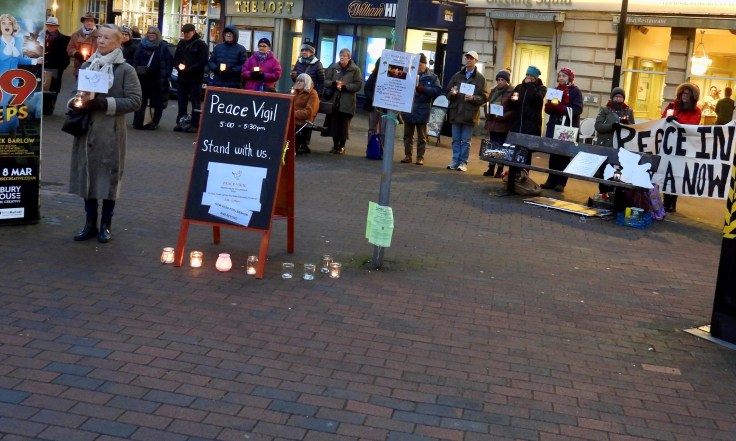
It is likely that holding a Vigil on Saturday in Salisbury Market Place was intended to be a short run affair. Most vigils are: people come together to show their support for a cause and it’s over. But on Saturday, we held our 50th Vigil in aid of peace in Gaza. Around 40 attended a number which has remained remarkably constant. New people came as well so it isn’t the same old faces week after week.

Part of the motivation is the continuing horror in Gaza and also, now, Lebanon with reports today of aid workers killed in a bombing. Over 43,000 are now dead in Gaza with 70% women and children the BBC reports.

Some of the attendees at the 50th Vigil.

Video of the Vigil

Visibility


November 2024

We have made some changes to how we promote the site. We are – in keeping with thousands of others – no longer on X as it is allowing some unpleasant material to remain unmoderated. You will see at the bottom of posts that we are now on Mastodon and Bluesky. Please let us know if there are problems with accessing either of these. We continue to post on Facebook.

Group minutes: November


November 2024

The minutes of our November meeting are here thanks to group member Lesley for producing them. The contain information about forthcoming events and brief reports on refugees and the death penalty.

Group news


Some events the group will be involved in

November 2024

From time time we list some of the events the group will be involved in. This is partly for those people who might be thinking of joining us. Coming along and making yourself known is the best way to introduce yourself. Membership of our group is free but if you join Amnesty International there is a fee.

We welcome new members especially in this, our 50th year since formation. We are, sadly, the only surviving group in Wiltshire and we hope people from outside Salisbury feel able to join.

Upcoming events:

  • Not an event as such but a tree will be planted in Victoria Park soon to commemorate out anniversary. We are not able to be at the planting itself (!) but we hope to convene a photo shoot at some future date,
  • Carol singing. [Completed – see post]. This has been an annual event and we kick of on 9 December in Victoria Road. We are delighted to welcome the Farrant Singers to do the singing and we cover 3 or 4 roads in the vicinity,
  • Vigil. Group members take part in the Vigil in the Butter market in Salisbury (by the Library) starting at 5pm for half an hour. This is to promote peace in the Middle East. See previous posts on this subject. This Saturday 16th, will be our 50th such Vigil,
  • We will be holding a schools event on 26th but this is not open to all,
  • Write for Rights in the Cathedral cloister on 1st December for around 2 hours in the morning, [Completed]
  • Further ahead, we will be at the People in the Park event in May. Details in due course,
  • We hope to arrange an Evensong with the Cathedral next year.

We look forward to seeing you at one of these events.

King Charles gives GCVO to King of Bahrain


Award of GCVO invites many critics because of poor human rights in Bahrain

November 2024

The award of the Grand Cross of the Victorian Order to King Hamad bin Isa al Khalifa of Bahrain by King Charles has brought criticism and controversy. The list of human rights failures in Bahrain is a long one. It includes the lack of a free press, no genuine political opposition, the use of torture, critics who are harassed and arrested and there are problems with an independent judiciary. Individuals are executed after confessions secured following the use of torture. There is little religious freedom. Freedom House has described the kingdom as one of the more repressive regimes in the region. Since violently crushing a popular prodemocracy protest movement in 2011, the Sunni-led monarchy has systematically eliminated a broad range of political rights and civil liberties, dismantled the political opposition, and cracked down harshly on persistent dissent concentrated among the Shiite population.

Of course it is unlikely that King Charles was directly responsible for this award and may even felt uncomfortable with it. It is almost certainly a political decision because Bahrain is a key defence ally. CAAT has described the range of contacts between the two kingdoms and the importance of Bahrain as a purchaser of arms.

This has become a feature of British foreign policy and ideas of an ‘ethical foreign policy’ seem a long time ago. The Royal family are frequently used to promote ties and friendly relations with the various monarchs who still rule most of the Gulf states. Arms sales and the supply of oil are crucial elements of the British economy and effectively means ethical and human rights issues have to take a back seat. The Secretary of State said in parliament on 21 October 2021 that ‘[t]he Government are clear that more trade will not come at the expense of human rights’. However, as CAAT notes, arms sales to Bahrain continue apace.

Human rights violations and violence continue in the Kingdom and arms sales continue seemingly unhindered. Awarding the King an award is just icing on the cake. The problem is that it represents a kind of seal of approval. Is the Kingdom ever going to improve if it feels that Britain will continue to supply arms, use the Royal family in this way and make these awards? Or will it feel it can carry on persecuting its people and continue to deny basic rights with impunity? After all, the Bahrain’s own web site proudly proclaims ‘Bahrain is committed to safeguarding human rights, actively engaging in impactful initiatives that underscore its dedication to ensuring the well-being and freedom of its citizens and residents.’

Charles was told in a letter by the exiles: “It is personally difficult for us to view this honour as anything other than a betrayal of victims who have suffered at the hands of King Hamad and his brutal regime.”

Sources: Amnesty International; Human Rights Watch; Hansard; the US State Department; the Guardian; CAAT; Freedom House; Government of Bahrain; Bahrain Institute for Rights and Democracy.

Refugee report


Europe still struggles to deal with refugees coming to its shores

November 2024

This month’s report is Eurocentric. Hopefully we can look at the wider aspects next time, as we become clearer about the new US President’s plans for widespread deportation (and also the Australian government’s battle with the courts).

The government’s proposals on the small boats crisis remain unclear at the moment. Apart from the Prime Minister’s curious assertion that the people smugglers constitute a threat to national security, things continue much as before. The total number of arrivals so far this year is over 32,000, 22% up on last year (but still below 2022). Worse overcrowding on the boats is partly responsible for 64 migrants dying at sea this year (5 times last year’s total). The government has agreed improved intelligence exchange with three Balkan countries and has pledged £150 million for the proposed Border Security Command.

Within the Home Office It is suggested that there is some doubt as to how the new Command will work. Lizzie Dearden in the i reports that the fear is that the more the authorities clamp down the more risky the methods used by migrants and that a new approach is the best solution. Nevertheless, the Home Office is recruiting a head for the proposed National Returns Progression Command, a body intended to take control of deporting unsuccessful applicants for asylum status.

There has been much concern about the use of the term “illegal arrival” as per the 2022 Nationality and Borders Act. Anyone guilty of “facilitation” (which includes steering a boat) is liable to up to life imprisonment, and cases have been reported of this happening. Since the Act came into force there have been 471 arrests, 233 of them for taking the tiller.

An aspect of the difficulties within the system is the lack of available legal aid. The Joint Council on the Welfare of Immigrants is urging a reform of the legal aid system, arguing that a functioning system would be much cheaper for the public purse than the present approach.

According to the French charity Utopia 56 there are still some 2,000 migrants on the Channel coast in France.

The Institute for Public Policy Research have observed the need to consider the demand side of the equation, to see why so many are fleeing their countries of origin: ”In order to have an effective response you need to go beyond enforcement.”

Elsewhere possible solutions to the problem are being considered. In Switzerland, since 2019 a new approach has been tried: the main aim is to target a total of 140 days for the complete processing of applications, while not cutting corners. The three critical issues are:

1. to have enough decision makers

2. fast streaming easier cases and moving more difficult ones to a different process and

3. ensuring access to lawyers.

Meanwhile in Spain a more friendly attitude to arrivals is being pursued, both for the economy and to allow family reunions. The Spanish government is opposed to what it terms “Melonisation”, the Italian plan to offload migrant processing to Albania.

Human Rights Watch have a piece noting that discerning the popular attitude towards refugees very much depends on the question asked. People are more sympathetic when it is phrased in terms of what would happen to deported asylum seekers rather than immigrant numbers arriving here.

Finally, a success story of an “illegal” migrant:

An immigration lawyer reviews Paddington in Peru: A very British bear – Free Movement

Andrew Hemming

Death penalty report – November


November 2024

We are pleased to attach the bi-monthly report on the death penalty around the world prepared by group member Lesley. A lot on the US this month as there is a lot of activity, certainly in the southern states, at present. In view of the recent presidential election, it is worth noting that although there is a lot of ‘noise’ about President elect Donald Trump’s desire to ramp up the use of the penalty, what frequently matters is what happens at state level. Who the governor is and his or her attitude to executions matters more than federal attitudes.

Note as ever that China does not feature although it is the world’s biggest executioner, details and statistics are a state secret.

Anniversary supper


November 2024

Some members of the Amnesty group met last evening to celebrate the 50th anniversary of its foundation. We are, sad to say, the last surviving group in Wiltshire. As we have noted before, the founders in 1974 may have thought that human rights were now a part of the political agenda and that it might naturally wither on the vine especially when the Human Rights Act became law in the UK. That has not been the case and the need for vigilance is ever present.

The world situation is dire for millions in countries like Burma where the minorities such as the Rohingya are persecuted; China where the Uyghurs and Tibetans suffer monstrous persecution; sub Saharan Africa where wars rage and millions flee or are driven from their homes; Syria – although quiet at present – has been a country where large numbers have been killed or driven from their homes and currently, the Middle East where a fearsome death toll and suggestions of ethnic cleansing are taking place in Gaza.

In the UK, hostility to the HRA is ever present and was a fixture of Conservative party policy for some years. Only yesterday we reported on a Daily Mail article which gave its readers only partial details of a report critical of the HRA produced by a secretive think tank. Several of the tabloids and the right wing press generally have maintained a steady stream of anti human rights stories suggesting the act is a get out of gaol card for criminals, terrorists and assorted ne’er-do-wells.

The They Work for You website reveals that both local MPs – John Glen and Danny Kruger – generally vote against human rights proposals. Kruger has written often on this subject and we have reviewed some of his activities on this site. The last Conservative government passed several pieces of legislation to limit protests and giving more powers to the police to arrest people taking part in protests. Indeed, the issue of arrests of journalists was part of the last Salisbury Democracy Café debate on Saturday 9th.

Both internationally and in the UK, the continuing need for a spotlight on human rights issues is vital and the group hopes to carry on with this work in the years to come. We always welcome new members and the best thing is to follow this site or Facebook (salisburyai) to see what we are doing and come along and make yourself known. Oh, and we had a very enjoyable meal!

Pic: Jane Miller

Blog at WordPress.com.

Up ↑