Reading a Uyghur book can lead to serious punishment
August 2026
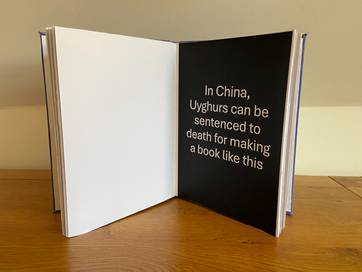
This is not the Middle Ages. This is the 21st Century. But the desire of the Chinese to extinguish Uyghur culture can lead to draconian consequences. This short piece and the book, were created by the Amnesty Death Penalty project.
So often, we take our books for granted. But if you are Uyghur, reading, promoting or writing books in the Uyghur language – even children’s text books – can land you in serious trouble. In fact it can and has on a number of occasions, resulted in a death sentence. This is all part of the Chinese government’s attempts to suppress the Uyghur language, culture and identity. Too many governments around the world use the death penalty as a means of intimidating ordinary people into compliance. Books, things that we take for granted in the West, can be very dangerous for Uyghurs which is why the Anti-Death Penalty Project has created a book (كىتاب) to show our solidarity. ‘Thank you so much Death Penalty Network for such a beautiful and thoughtful project!
The Salisbury group publishes a report each month on the use of the penalty around the world. It does not include China as executions are a state secret. The country is believed to execute more of its citizens than the rest of the world put together.
A love story illustrates the tragedy of the Uyghur people
August 2026
This is a love story which appeared in today’s Guardian (5th August) which highlights the effects on innocent lives arising from the repression and cultural genocide being committed in Xinjiang by the Chinese. The relationship blossomed around a discovered novel entitled Leyighan Bulaq (The Muddy Spring) written by the Uyghur novelist Jalalidin Băhram. It is a book about the brutalities of the Cultural Revolution.
The boy who uncovered the book wanted to share it with a female friend which in a Moslem environment was difficult to do. He smuggled a copy of the book to her. He left to study abroad. She was unable to sit a university entrance exam as she wore a headscarf. She was unable to obtain a passport either which the Chinese are reluctant to permit Uyghurs to have. She eventually made it out and they married in Istanbul. No family members were present. Messages from abroad can result in punishment which meant they could not convey messages to their families back home including the sad death of their 2 year old daughter.
The story illustrates very well the effects on ordinary lives by the campaign of repression. How people cannot leave the area, how messages from abroad can result in punishment. How indignities are heaped on the people for wearing a scarf. Unspoken in the story is the use of CCTV cameras which control lives not just in Xinjiang but throughout China. They make ordinary contact and movement almost impossible.
A message …
“To all Amnesty activists and supporters,
Thank you for standing with the Uyghur people at a time when our language, culture, faith, and very identity are under systematic attack. The recent testimony of former Chinese police officer Zhang Yabo has once again confirmed what Uyghurs have long tried to tell the world: in today’s Uyghur homeland, almost anyone can become a target — writers, poets, musicians, artists, intellectuals, religious figures, and ordinary people simply trying to preserve who they are. Songs are banned, the Uyghur language is criminalised, faith is weaponised against believers, and even memory itself is treated as a threat.
Beyond the camps and prisons, the repression follows Uyghurs across borders through intimidation, surveillance, disinformation, and relentless transnational repression designed to silence us and isolate us from the world. Many Uyghurs are afraid even to speak publicly, fearing consequences for loved ones back home.
That is why your solidarity matters so deeply. Every voice raised, every campaign organised, every act of compassion tells Uyghurs that we have not been abandoned or forgotten. In the face of fear and erasure, solidarity becomes a form of protection, dignity, and hope.
Please continue to stand with us, support the work of Stop Uyghur Genocide, and help amplify Uyghur voices by following and sharing our work on social media. Your support truly makes a difference.
With heartfelt gratitude,
Rahima Mahmut Executive Director Stop Uyghur Genocide”
Responses
We are delighted to report that the response to our earlier posts on the Uyghur Solidarity Month have been good. Our post made top ranking on Startpage’s search engine today. Most pleasing is the number of views from China and Hong Kong which together were second and third in the rankings. Amnesty is banned in China so this is encouraging.
Short podcast of our last two posts on this campaign
Pip: August 2026, and a cultural genocide that’s largely dropped out of the news — which is exactly when a local Amnesty group decides to make some noise.
Mara: The Salisbury has been writing about Uyghur Solidarity Month, and that’s the territory we’re covering today — the scale of what’s happening in Xinjiang, and what people in Salisbury can actually do about it.
Pip: Let’s start with the oppression itself, and who’s trying to break through the silence.
Uyghur Solidarity Month: Oppression and the Fight for Awareness
Mara: The framing here is stark: this is described as “the largest campaign of cultural genocide in the modern era,” and Amnesty’s declaration of August as Uyghur Solidarity Month is a direct response to the crisis slipping from public view.
Pip: The post points to one outlet trying to hold that ground — Kashgar Times, founded in April 2025. Here’s how they describe their mission: “At Kashgar Times, our mission is to break through that silence. We aim to bridge the information gap. We provide a platform where Uyghur voices can be heard, and their stories told — free from propaganda.”
Mara: What that means in practice is that independent, on-the-ground reporting from Xinjiang is nearly impossible to obtain. China’s censorship has closed off the region to journalists and foreign observers entirely, so an outlet run by Uyghurs, for a global audience, is filling a gap that mainstream media simply cannot.
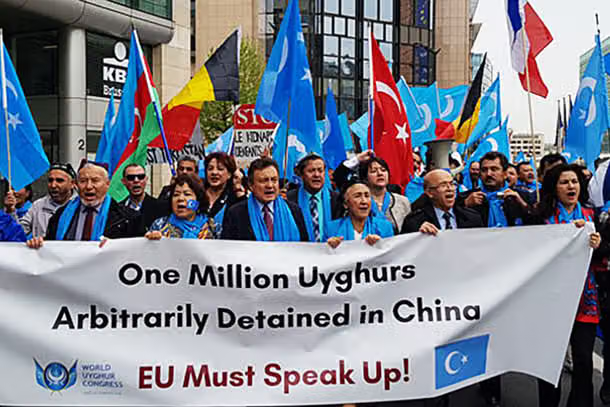
Pip: The scale is worth sitting with. Around a million individuals detained. Children separated from parents. Arbitrary detention, torture, forced labour, persecution on grounds of religion and ethnicity. And a proposed Chinese embassy in London — potentially the largest in Europe — raising fears about expanded surveillance of dissidents on British soil.
Mara: The second post, “Uyghur solidarity month,” pulls the crisis closer to home in a way that’s hard to dismiss. It includes a draft letter to local newspapers, drawing on findings from the UN High Commissioner for Human Rights and the 2021 Uyghur Tribunal, chaired by Sir Geoffrey Nice KC, which concluded the Chinese government had committed genocide.
Pip: And then there’s the wardrobe argument — which is either uncomfortable or very effective, depending on your tolerance for being implicated personally. A quarter of the world’s cotton comes from Xinjiang.
Mara: The post puts it directly: “You will have in your wardrobe, or be wearing, many items made of cotton. It is highly likely that some of them have been made with cotton from this region using virtual slave labour.” The ask is simple — write to your local paper.
Pip: Silence, as the post notes, makes it easier to ignore. And writing a letter is not nothing.
Mara: A genocide that’s fallen out of the news cycle, and a local group working to put it back — that’s the thread running through everything here.
Pip: More to come through the month, apparently. We’ll be watching.
Bringing the plight of Uyghurs to a wider audience
August 2026
We noted in our last post on the Uyghurs that their plight had slipped out of the news in the last year or so. With war in Iran and the closure of the Straight of Hormuz, and continuing conflict in the Middle East including Gaza, giving attention to a far off land where contact with its people is almost impossible is not altogether surprising.
But we need to do our best to bring people’s attention to what is going on there. We should always remember desperate governments do desperate things. The UK is up against it politically and economically. This leads it to pursue arrangements with overseas powers with highly dubious human rights records such as Saudi and UAE, to promote arms sales with almost any country while claiming to have a ‘robust policy’ not to, supporting Israel overtly and covertly despite its destruction of Gaza and mounting violence in the West Bank. Economic needs trump concerns about human rights. Jobs in the UK count for more than rights half way across the world.
Write a letter
We are asking that people write to their local newspaper to highlight the dreadful way the Chinese are treating these people. The campaign organisers have provided a sample letter which unfortunately exceeds the word limit of local papers. We have amended the letter which could be the basis of your own contribution:
I want to draw the attention to people in Salisbury of the dire human rights situation facing the Uyghur people in Xinxiang province, China.
the UN High Commissioner for Human Rights concluded there were credible allegations that the Chinese government had carried out arbitrary detention, torture, forced labour, family separation, and severe restrictions on religious and cultural freedoms on a vast scale on the Uyghur people. They stated that these violations may constitute crimes against humanity. In 2021, the independent Uyghur Tribunal, chaired by Sir Geoffrey Nice KC in London, concluded that the Chinese government had committed genocide against the Uyghurs through measures intended to prevent births, and had also committed crimes against humanity.
Despite these findings, the suffering of the Uyghur people continues while the world looks away. More than a million Uyghurs are reported to have been detained, and countless families have been torn apart. Survivors have described detention camps, torture, rape, forced labour, coercive birth-control measures, and the removal of children from their families. Behind every statistic are innocent individuals whose lives have been destroyed for ever.
This month, Amnesty International’s Uyghur Solidarity Month is trying to raise awareness of the continuing crisis but also to celebrate the rich culture, language, and heritage now under such severe threat.
Whether one views this issue through the lens of international law, freedom of religion, cultural preservation, or basic human dignity, the plight of the Uyghur people deserves continued public attention and informed discussion. Uyghur Solidarity Month reminds us that protecting a people’s culture is inseparable from protecting their human rights.
Public awareness alone will not end this crisis, but silence only makes it easier to ignore. We all have a responsibility to ensure that the voices of the Uyghur people continue to be heard.
[NAME]
Provide name and address.
You might be tempted to think that what has this to do with me? It’s sad that a people are being persecuted in a far off land but there are so many other problems nearer to hand, why there? But you are involved. You will have in your wardrobe, or be wearing, many items made of cotton. It is highly likely that some of them have been made with cotton from this region using virtual slave labour – the Uyghurs. A quarter of cotton comes from there. You may have bought these garments from a well known and reputable store in the high street or online. Despite their fine words and protestations about the integrity of their supply chains, they still use this cotton. So you are wearing the evidence. You are involved.
The oppression and cultural genocide of the Uyghurs continues and has largely dropped out of the news. Such news as there is concerns the desire for China to establish the largest embassy in London and possibly Europe which is still being considered. The fears, the very real fears, is that it will become an espionage hub and also enable the Chinese Communist Party to expand its intimidation of Chines ‘dissidents’ i.e. anyone who disagrees with the CCP. It will be an interesting test of the government’s wil to see if it agrees with this proposal.
Amnesty has declared this month to be Uyghur Solidarity Month and you can sign up using this link. The treatment of Uyghurs and Kazakhs is deplorable and consists of arbitrary detention, torture, forced cultural intimidation and persecution based on religion and ethnicity. Children are separated from their parents. Around 1 million individuals are involved. There is evidence of forced labour that Uyghurs are used to pick cotton which finds its way into clothes sold in high street stores in the UK. No journalists or foreign observers are allowed into the region.
It represents the largest campaign of cultural genocide in the modern era.
One beacon of light is the Kashgar Times which tries to bring news from the area. We include an extract from them below.
“Kashgar Times is an independent news media outlet dedicated to reporting on the Uyghur people and the injustices they face under the oppressive regime of the People’s Republic of China. Kashgar Times was founded on April 30, 2025, by prominent Uyghur advocate Arslan Hidayat and seasoned journalist Nuriman Abdureshid. The outlet aims to serve as a vital source of accurate, on-the-ground news from East Turkistan, also known as the Xinjiang Uyghur Autonomous Region.
“The Uyghur people have long suffered under systemic oppression. They face cultural erasure and widespread human rights violations—amounting to genocide—by the Chinese government. Yet, despite the urgency of these issues, getting unfiltered news from this region is increasingly difficult. China’s strict censorship and crackdown on free journalism have silenced many voices.
“At Kashgar Times, our mission is to break through that silence. We aim to bridge the information gap. We provide a platform where Uyghur voices can be heard, and their stories told—free from propaganda.
“Kashgar Times fills an urgent gap in today’s media landscape. Our founders bring with them a wealth of experience and passion. Arslan has tirelessly advocated for Uyghur rights on international platforms. Nuriman has sharpened her journalistic skills while reporting for the Uyghur Service at Radio Free Asia. Together, they embody the spirit of resilience and commitment that Kashgar Times stands for.
“At Kashgar Times, we are dedicated to upholding the highest journalistic standards. We aim to present stories that highlight the struggles and triumphs of the Uyghur community, offering insights that are often overlooked or misrepresented in mainstream narratives and especially on Chinese state-run media. By sharing first hand accounts, investigative reports, and expert analyses, we hope to shed light on the reality of life in Chinese-occupied East Turkistan, pushing back against the extensive campaign of disinformation funded by the Chinese Communist Party.
“As a Uyghur-run media outlet, we are committed to reporting on Uyghurs, by Uyghurs, for a global audience. We believe in the power of storytelling to awaken empathy and understanding—allowing the world to grasp the gravity of the situation faced by the Uyghur people.
“We invite you to support our mission by subscribing to Kashgar Times. Your contributions will enable us to continue our crucial work and help us expand our reach and resources. Together, we can create a robust platform that not only informs readers but also amplifies the voices of those fighting for justice and preservation of our people.
“For U.S. Donors Zelle to “kashgartimes.news@gmail.com” (if you don’t use Zelle then donate via DonorBox)”
Ruth Ellis was hanged in Holloway Prison in 1955 and was the last woman to receive this punishment. Hanging was abolished in 1969 but the execution of Ruth Ellis was one of the events which led to its abolition. The last execution was in 1964, that is 70 years ago. This week Ellis was given a conditional pardon by the government. The application was brought by four of Ellis’s grandchildren who said her action was profoundly shaped by domestic abuse, trauma and circumstances that were never properly recognised at her trial. It is likely that if her life of abuse was made known to the jury it is likely she would have been convicted of manslaughter.
The desire to restore the penalty emerges from time to time and ‘bring back hanging’ appears in some interviews especially after a terrible murder or a terrorist attack. A minor British political party, Restore, is campaigning for its return but it is not a policy of the major parties. The Daily Telegraph does not agree that she has been pardoned reflecting perhaps its older readership’s views about the penalty.
Amnesty believes it is wrong in all circumstances and campaigns for its abolition around the world. The US is the only country in the Americas to retain it in some states at least and in Florida, there has been an increase under Governor De Santis, it is suggested as part of his campaign to be President. Support in the States is slowly diminishing reflecting the views of younger Americans. China is the world leader in executions carrying out more than the rest of the world combined although exact figures are not known as they are a state secret.
There are many problems with the penalty the most obvious being that mistakes cannot be rectified once the execution has happened. And there are mistakes often because exculpatory evidence is sometimes withheld by police. Frequently, the defence is poor or because a key witness can lie to save their own skin. There is considerable racial bias. It does not deter crime as is often claimed: there are no significant differences in crime between states with the penalty and those without. It is very expensive especially in the US where prisoners live for years on death row waiting results of appeals. It is a barbaric practice and simply perpetuates the cycle of violence.
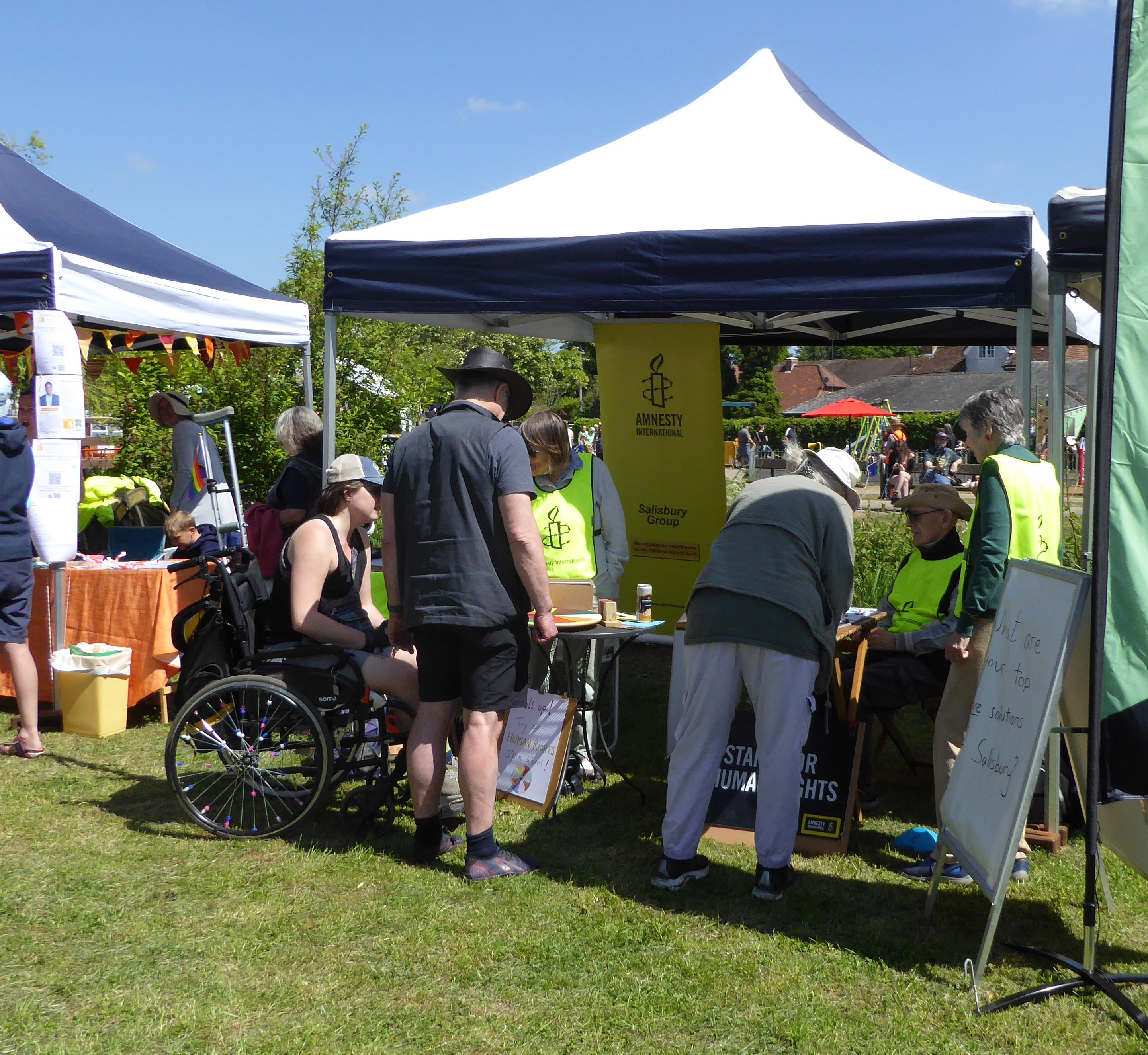
We will be at the People in the Park event this Saturday to highlight this issue
Past event – report soon 16/05
At this event in Salisbury on Saturday 16th May, we shall be focusing on the human rights abuses involved in the manufacture of a pair of jeans. An everyday item of clothing, no less than 5 billion pairs are made every year mostly in factories in Far East countries. From the production of the cotton to the manufacture of the jeans themselves, millions of – mostly women – are subject to massive levels of abuse. Amnesty has produced a report called Stitched Up which provides background to this industry.
The numbers involved are quite staggering. There are something like 100 million garment workers worldwide the vast majority of whom suffer various kinds of abuse to enable us to buy cheap clothes (not just jeans).
The abuses
The abuses take place at every stage in the manufacture:
Around a quarter of the cotton comes from the Xinjiang region of China where the abuse of the Uyghurs is a massive issue. The treatment by the Chinese of these people is a story of itself and involves mass arbitrary detention and so-called ‘re-education’, unjust imprisonment, intrusive surveillance and forced labour. The treatment of the Uyghurs has been described as genocide.
To produce the faded look a dangerous process is used and the workers are in danger of contracting silicosis. Numbers die of this each year.
Low wages and levels below even minimum wage levels in their own country. This is linked to ‘wage theft‘. Workers are allegedly paid the minimum wage but do not if fact receive them. So inspectors carrying out cursory checks for the retailers see appropriate wages being paid.
Overwork. Overtime is compulsory if a big order arrives and workers may work very long shifts with no choice.
No collective bargaining and trade unions largely banned. It can involve working 99 hour weeks. Only 5 unions exist among Marks and Spencer’s 172 suppliers for example.
Abuses, physical and sexual, is widespread. With a mostly female workforce this is a serious problem.
The brands
The major brands on our high streets and on line are complicit in these abuses. It is important to stress the massive scale of the abuse involving millions of people. Virtually all the major brands are complicit in whole or in part, in these abuses largely due to inaction. If you read the Amnesty Stitched Up report linked above, you will see nearly all the familiar high street names mentioned. The supply chains are long so factories may be largely invisible to any inspection activity.
This post is to raise your awareness. It is almost certain that among the clothes you are wearing are garments produced which are the product of abuse, violence, forced labour about which the retailer you bought them from has likely done little to tackle. Cheap clothing comes at a cost. It is not costless because making clothes in the UK is extremely difficult if retailers are freely able to source from countries where regulations are ignored, wages are not always paid in full and there are no trade unions.
We are pleased to attach the latest report for mid-April to mid-May thanks to group member Lesley for the work in compiling it. It contains details of the penalty around the world including a massive number of executions in Iran and how Saudi has executed large numbers in recent years. Singapore is mentioned with its policy of executing individuals involved in the drugs trade. Florida continues to feature with the Governor signing warrants for executions.
Israel’s proposals to re-introduce the penalty and to hold public trials for those held following the 7th October massacre is discussed and the responses to the change from countries around the world. Israel seems to be sliding ever backwards with its genocide, apartheid, violence and now the reintroduction of the death penalty last used on Adolph Eichmann.
As ever, we have to note that China is thought to be the world’s largest executioner but details are a state secret. There is a disturbing report from Australia however with some details but there is a warning about its content.
We are pleased to attach this month’s report thanks to group member Lesley for the work in compiling it. Featured this month are Florida with Governor De Santis’ spate of executions – the highest in the State’s history – the disturbing number of executions in Iran to add to the slaughter of its citizens in the streets, and the discriminatory bill passed by the Knesset in Israel for the execution of Palestinians in the West Bank.
As ever we note that China does not feature despite executing more of its citizens than the rest of the world combined.
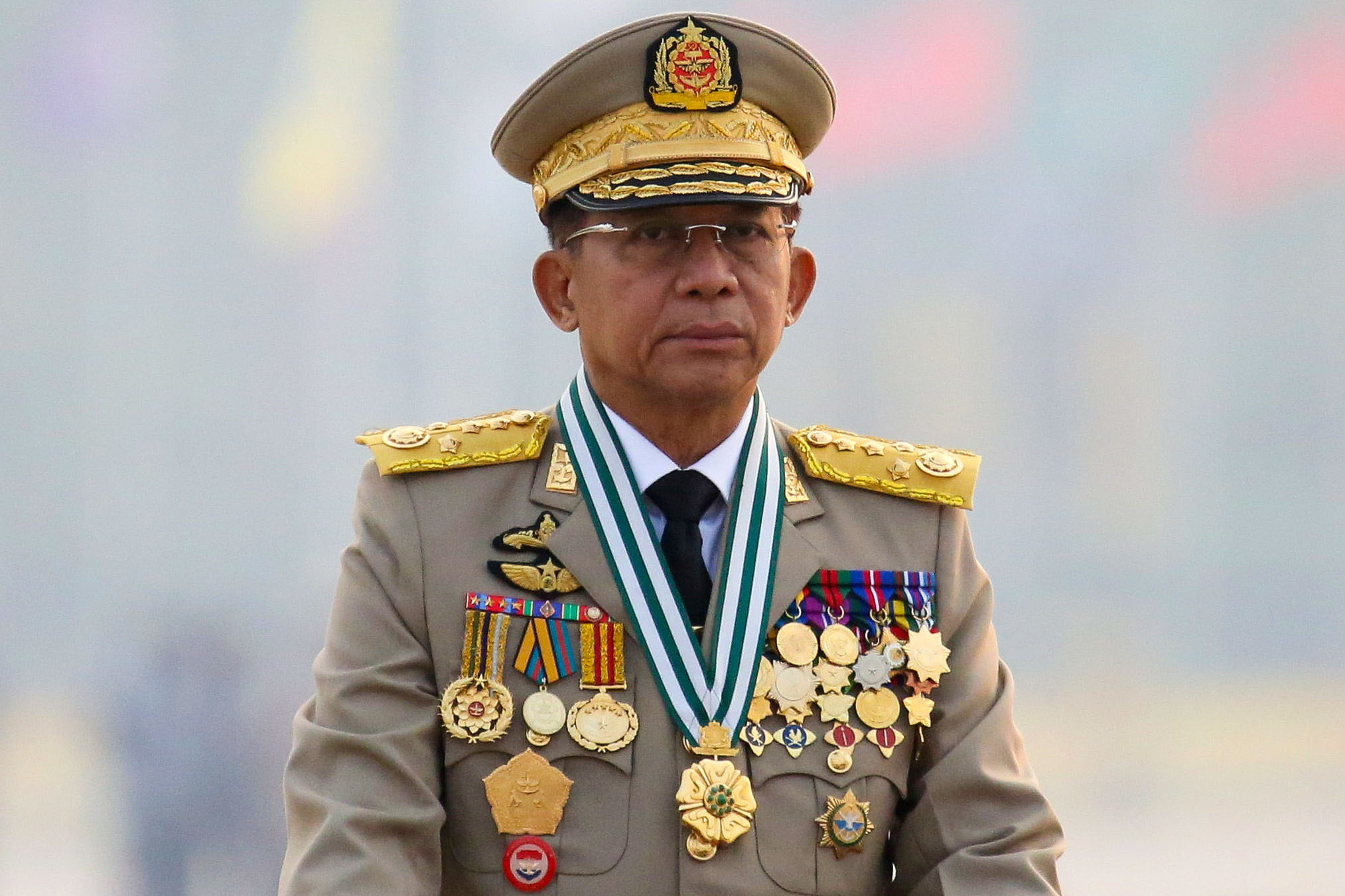
Burma, or Myanmar, has slipped out of the news in recent months but the brutal activities of the military Junta continue. Violence has lasted for 6 decades now during which massacres have been carried out and around 800,000 have been forced to flee. Elections are promised which will be sham. There is considerable resistance, both peaceful and armed to the regime. As part of the election process some of the 20,000 political prisoners will be released according to the latest edition of the Burma Campaign News (Issue 49, 2026). Political prisoners are subject to horrific treatment, held in appalling conditions, subjected to torture and denied medical care. Children as young as 2 years old are held as proxies for their parents.
Amnesty reports that the military Junta has committed widespread repression and abuse in every facet of life in the country since seizing power on February 1, 2021, Amnesty International, Fortify Rights, and Human Rights Watch said last month. The military’s atrocities since the coup, which include war crimes and crimes against humanity, escalated over the past year as the Junta sought to entrench its rule through abusive military operations and stage-managed elections.
The UN Special Rapporteur said in London in December:
“The people of Myanmar have shown extraordinary courage. They deserve an international response that matches their determination the United Kingdom can play a decisive role and now is the moment to act”.
Following a submission by Gambia, the International Court of Justice has in January, commenced hearing evidence of genocide against the Rohingya people many of whom fled the country. The ICJ issued provisional measures to protect the Rohingya which have been ignored by the Junta.
The UK government is criticized for not having made any new, targeted sanctions since 2024 and there is also a concern that the Junta is allowed to host a military attaché in London.
China’s role
The role of the Chinese is significant in the future of the country. Currently, it is reported by Foreign Affairs that China is ‘supporting both sides but with the hope that the Junta will win through in the end’ despite its appalling record of human rights abuses. It can tolerate a divided Myanmar as long the the main power holders remain dependant on China for trade and energy. It is also reported that China has provided $3bn of aid to the Junta.
Although it is true that the UK can play a role, the resource rich country is attractive to China which exhibits little interest in human rights within its borders or in foreign countries. It is their role which is probably crucial and as long as it continues to support the military then the current path of violence will likely continue.
As well as the Burma Campaign, another organisation of note is Advance Myanmar.