Group meeting Thursday 12th at 7:30 as usual in Victoria Road. Supporters welcome.
Torture report
Select committee issues two damning reports on UK’s role in torture
The Intelligence and Security Committee released its report in the UK’s role in torture on 28 June 2018 and this revealed the shocking extent of MI6’s involvement. It is government policy, and the legal position, that the UK does not use torture nor does it outsource the practice to other agencies or governments. It is counterproductive since under torture, victims are likely to say anything to get it to stop. The evidence thus gleaned is of doubtful value as was dramatically shown in Iraq and our decision to invade. It is also a key part of the Human Rights Act. Article 3 protects you from:
– torture (mental or physical)
– inhuman or degrading treatment or punishment, and
– deportation or extradition (being sent to another country to face criminal charges) if there is a real risk you will face torture or inhuman or degrading treatment or punishment in the country concerned.
As you would expect, public authorities must not inflict this sort of treatment on you. They must also protect you if someone else is treating you in this way. If they know this right is being breached, they must intervene to stop it. The state must also investigate credible allegations of such treatment. Equality and Human Rights Commission
That we were involved in this activity has been known for some time although often the details were not available. So were the denials and here is Jack Straw – the Home Secretary for much of the time when this was happening – claiming in an interview:
Unless we all start to believe in conspiracy theories and that the officials are lying, that I am lying, that behind this there is some kind of secret state which is in league with some dark forces in the United States, and also let me say, we believe that Secretary Rice is lying, there simply is no truth in the claims that the United Kingdom has been involved in rendition full stop. Quoted by Peter Oborne in the Daily Telegraph, 11 April 2012 [accessed 3 July 2018]
Peter Oborne continued: After Mr Straw spoke out, further denials followed. Tony Blair insisted that Britain had never engaged in the practice. Mr Straw’s successor, David Miliband, was equally adamant. Sir John Scarlett, until recently head of the Secret Intelligence Service (and the official responsible for the notorious dossier of September 2002 which asserted that Saddam Hussein was capable of deploying weapons of mass destruction within 45 minutes) was forthright. “Our officers are as committed to the values and the human rights values of liberal democracy as anybody else,” he said, adding that there was “no complicity in torture. (ibid)
The scale of the activity revealed by this report was a surprise. Up until the report was published it was known that the activity had taken place on a modest scale but the facts show otherwise:
• On 232 occasions UK intelligence officers were found to have continued supplying questions to foreign agencies between 2001 and 2010, despite knowing or suspecting a prisoner was being tortured or mistreated.
• There were 198 occasions when UK intelligence officers received information from a prisoner whom they knew was being mistreated.
• In a further 128 cases, foreign intelligence bodies told UK intelligence agencies prisoners were being mistreated.
• MI5 or MI6 offered to help fund at least three rendition operations.
• The agencies planned or agreed to a further 28 rendition operations.
• They provided intelligence to assist with a further 22 rendition operations.
• Two MI6 officers consented to mistreatment meted out by others. Only one of these incidents has been investigated by police.
• In a further 13 cases, UK intelligence officers witnessed an individual being tortured or mistreated.
• MI5, MI6 and the military conducted up to 3,000 interviews of prisoners held at Guantanamo.
• No attempt is being made to find out whether guidelines introduced by the coalition government in 2010 are helping to prevent the UK’s intelligence agencies from continuing to be involved in human rights abuses.
• The UK breached its commitment to the international prohibition of torture, cruel, inhuman and degrading treatment.
• On at least two occasions ministers took “inappropriate” decisions.
• Jack Straw authorised payment of “a large share of the costs” of the rendition of two people in October 2004. The Guardian 2 July 2018
Not that this is the full story. The government prevented individual officers from giving evidence so there may well be more to come out in future. On this matter, Kate Allen, the director of Amnesty said:
It is obvious that the ISC was prevented by the Government from producing a thorough report about what really happened – it says so itself. The ISC had no powers to summon witnesses or demand full evidence, and its findings were always subject to redaction and veto from the Prime Minister herself. Instead of the independent, judge-led torture inquiry promised by David Cameron, we’ve had an under-powered, over-controlled review by a committee that was never empowered to get the job done. While the Committee’s report represents a helpful step forwards, it is not the definitive account of what really happened. It was always the wrong tool for the job.
With the President of the United States personally praising waterboarding and the CIA led by someone closely linked to torture, now is not the time to brush this issue under the carpet. We need a full judge-led inquiry now. Amnesty statement
The Response
In the face of damning evidence and a considerable amount of research carried out by the committee over many years, one might have thought that a contrite response from the head of MI6 at the time, Sir Richard Dearlove, would be appropriate, if not a full apology. Not a bit of it. Here he is quoted in the Sun* newspaper:
As far as my former service is concerned, the mistreatment issue has been blown out of proportion by pressure from certain interest groups [one assumes Amnesty is among them]. There never was a systemic problem, and there are no skeletons in the cupboard from my time. The staff served the nation magnificently and with due care for our respect for the law. In extreme circumstances, there will always be incidents that one regrets. But nothing illegal was perpetrated – which is as achievement given the extent of the provocation. Warning of the chilling effect that the MPs’ withering criticism could have, the ex-spymaster added: It’s time to move on and not allow our willingness to take risks to be diminished. The Sun 29 June 2018
No mea culpa there. Quite what the ‘provocation’ is not explained. Torture seems to be part of a need to ‘take risks’. This quotation – if it is an accurate statement of his position – is disgraceful. That the former head of the service brushes aside a comprehensive and detailed description of our – and his service’s role – in water boarding, stress positions and other forms of degrading treatment is utterly reprehensible. His defence seems to rest on the fact that MI6 officers did not actually do the torturing themselves.
But he is not alone. This is the Sun’s editorial position:
WHAT did we gain by MPs blowing five years probing what MI5 and MI6 knew of the US torture of terror suspects back in 2001? Their report admits our spooks were directly involved only twice. And if it extracted vital intelligence preventing further atrocities after 9/11, so what if we turned a blind eye? Yes, torture is barbaric. But the CIA firmly believes it saved lives. Would those people wringing their hands over it prefer to have risked thousands more being massacred by al-Qaeda?
Still perpetuating the myth that torture is necessary and saves lives.
As a nation we pride ourselves on civilised behaviour. We promote such behaviour around the world and in the UN. We are signatories to key treaties and it is government policy that we do not torture people. We have the Human Rights Act which prohibits it. Government ministers constantly claim that such practices are alien to our culture and way of doing things. We have a fundamental sense of decency it is claimed. However, Peter Beaumont, a journalist with the Observer, says over the years he has ‘been lied to a lot’.
British intelligence officers, despite all the denials, were aware of the mistreatment, they benefited from it and even supplied their own questions for the victims of mistreatment despite knowing those being interrogated were being brutalized. 1 July 2018
Even now, people like Sir Richard Dearlove are in denial. The government has done all it can to frustrate the enquiry and to prevent it getting to the truth. Jack Straw and others have many questions to answer.
Joint statement by human rights organisations
*a tabloid newspaper part of the Murdoch group in the UK.
UK role in destruction of Yemen
The Court of Appeal has granted permission for Campaign Against the Arms Trade to appeal the legality of arms sales to Saudi Arabia
The destruction of Yemen continues and our role in that destruction becomes ever more clear as time passes. The case brought by CAAT failed and it is welcome news that the Appeal Court has allowed an appeal. The decision was profoundly flawed and needs to be challenged. It raised disturbing questions, not just about our role in the bombing of Yemen, but how our supposedly independent legal system operates in cases like this.
An analysis of the decision by Oxford Human Rights hub and others revealed profound flaws in the Appeal judges ruling and handling of the case. These are:
- statements by the government were taken at face value despite claims that the case would be looked at objectively
- the judges regarded evidence from NGOs as necessarily being of lesser value than the government’s arguments. They said they were ‘second hand’ despite the fact that the NGOs had representatives on the ground and had collected considerable first hand evidence of what was happening
- the close relations the government has with the Saudi government (to which we could add many members of the Royal family) puts them in a good position, it was claimed, to take statements by the Saudis at face value namely that they were compliant with International Human Rights standards
- the court took no account of the stake the government has in the trade namely that 46% of our arms exports are going to this country. That this might bias their case was not something that the judges seemed to consider. Indeed, they went further pointing to the ‘highly sophisticated, structured and multi-faceted process’ of government decision taking in comparison with that of the press and NGOs. Altogether, the judges exhibited an unduly deferential approach to the government
- But perhaps the most disgraceful aspect of their judgement was the issue of ‘inference’. This argument centred on the idea that it was not necessary or practical for the government to infer that civilian causalities and breaches of IHL arose from the supply of weaponry to the Saudis. Because this destruction was taking place in another country, it was not practical for the Secretary of State to have access to all the relevant information. So on the one hand, the judges say that the government has a superior and sophisticated decision making process compared to that of the NGOs and media, but on the other hand, when civilians are killed, suddenly they are not in a position to know it was our weapons which were involved.
There are other criticisms of the judgment and the dubious logic on which it was based. Overall, they seemed to adopt a unduly deferential approach to the government’s position.
In another development the Committee on Arms Export Controls criticized many aspects of the government’s dealings with arms supplies to the region. One key aspect is the question of brokerage. This is where a company, registered in the UK, uses a broker to circumvent the controls on the sale of arms. The Committee concluded:
The Committees conclude that it is a significant loophole in UK arms export controls that a UK company can circumvent those controls by exporting military and dual–use goods using an overseas subsidiary. The Committees recommend that the Government states whether it will close this loophole, and, if so, by what means and in what timescale.
The Committees continue to conclude that it is most regrettable that the Government have still to take any action against “Brass Plate” arms exporting companies who have the benefit of UK company registration but carry out arms exporting and arms brokering activities overseas in contravention of UK Government policies. 35 The Committees’ Recommendation: The Committees again recommend that the Government sets out in its Response to this Report what steps it will take to discontinue the UK registration of such companies [Extracts from the Select Committee Report]
The government does not accept the committee’s conclusions on this matter.
In yet another aspect, the government is alleged to use opaque licensing procedures to conceal hundreds of millions of pounds worth of British-made missiles and bombs sold to Saudi Arabia for use in Yemen under a licensing system that makes tracking arms sales more difficult.
Currently, the sale of arms is governed by the Arms Trade Treaty and the Consolidated EU and National Arms Export Licensing Criteria. It is clear from the opinion of the sub committee, CAAT and other NGOs that the government is using every stratagem to sell arms to Saudi and to keep on doing so. Royalty and ministers are pressed into service to keep the Saudi regime sweet. The effects of our arms – and those of other arms suppliers such as the USA – on the people of Yemen has been devastating. With 10,000 deaths and many more thousands injured and displaced, it is a calamity on a massive scale. We must hope that the higher court will overturn the highly dubious and flawed decision.
In the future, post Brexit, there will be a reduction in the degree of control over this trade in the opinion of Stockholm International Peace Research Institute. In a commentary they say:
Either way, it is likely that Brexit will lead to a reduction in the EU’s ability to promote its standards in the field of export controls internationally. […] If Brexit means the UK starts to water down its export controls in order to facilitate transfers to Saudi Arabia, or otherwise boost its arms exports, the implications may be more severe. Such a move could trigger a ‘race to the bottom’ among EU member states, many of which are seeking to boost their own arms exports in order to help domestic producers offset the impact of post-2008 national defence cuts.
Let us hope they are wrong. It is likely however that post Brexit, there will be a keen desire to secure trade deals – to include arms sales – with any foreign nation including those with poor human rights records.
Sources:
Oxford Human Rights Hub; Ibid (part 2); Opinio Juris; CAAT; The Guardian; Amnesty International; European Journal of International Law
Trump protest
Local protest planned
The local group is planning a short demonstration against the visit by Donald Trump to the UK. It will take place in the market square on 13 July starting at 11am for an hour. The purpose is to highlight his attitude towards immigrants and the decision to withdraw the USA from the Human Rights Council.
Readers are welcome to join us.
Amnesty stall

We held our stall on Saturday and it was extremely successful. Since the move from the side of the Guildhall, we have found the new location to be less than satisfactory but Saturday was different. It started almost as soon as we arrived and we continued on until noon with a few stragglers still buying as we packed up.
Thanks to all members who volunteered for the morning.


Belarus


Death penalty suspended in Belarus
Belarus is the last country in Europe that maintains the death penalty. Good news is rare so when it happens it is to be welcomed. News broke yesterday that the Supreme Court of Belarus, in an unprecedented move, has decided to suspend and review the death sentences of Ihar Hershankou and Siamion Berazhnoy while their appeals are under consideration. Marie Struthers, Director of Amnesty’s Eastern Europe and Central Asia Regional Office, said:
This is a hugely significant and unprecedented decision for the only country in the region that has continued to execute people all these years. We are not aware of other cases where the Supreme Court of Belarus has suspended an execution. We continue to monitor the case closely, but it gives us hope that after years of discussion on the death penalty Belarus is ready to ‘walk the talk’ and has urged the authorities to establish an immediate moratorium on executions and to commute all death sentences as a first step towards abolition
Hooligan Sparrow film

Film reveals terrible state of Chinese justice system
UPDATE: if you have arrived here having picked up a leaflet at the Poetika event in Salisbury this evening – welcome!
A small audience at the Arts Centre watched a documentary film hosted by the Salisbury group called Hooligan Sparrow set in China. The story concerns the attempts by a lawyer Ye Haiyan to get a college principal and his assistant prosecuted for spending the night in a hotel with 6 underage girls. They were likely to have escaped punishment because of the endemic corruption of the Chinese police and communist party. Subsequently they gave $2000 dollars to the girls which made them prostitutes and thus made them the criminals under the Chinese system.
Ye was determined to bring them to justice and started with a simple protest outside the school. The film then charts the subsequent events of harassment, violence and intimidation by the police, secret police and hired thugs. Remarkably, much of this is filmed and we can see and hear the activities of the police engaged in the intimidation. Ye ends up homeless having been evicted from flats and hotels. Finally, she returns to her home village to live in some quite basic accommodation. A most telling and sad scene shows her and her daughter sat on the roadside with all their possessions piled up unable to find anywhere to live. This exact scene is recreated in an exhibition in Brooklyn Museum in New York.
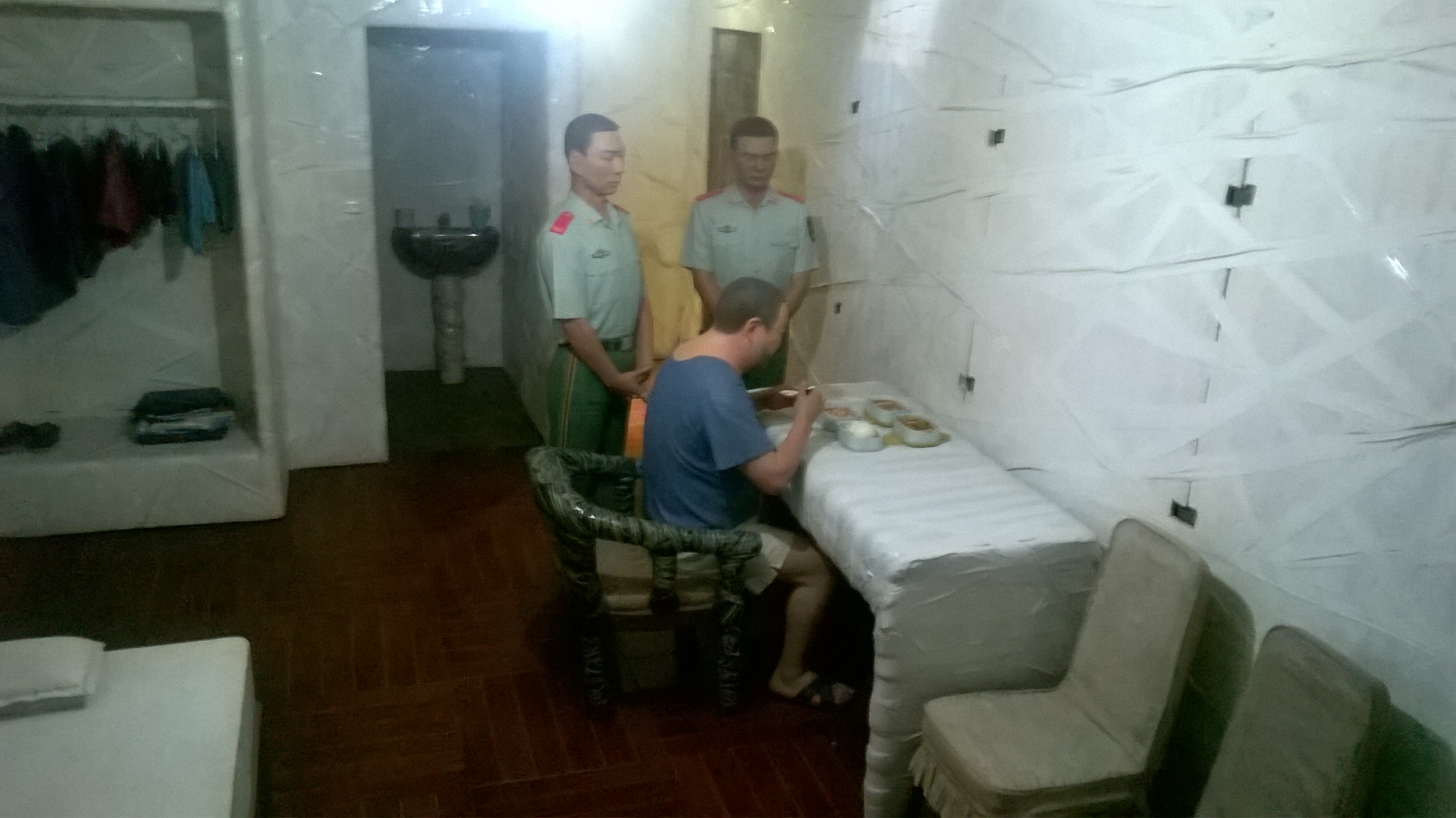
The exhibition was of work by Ai WeiWei, an artist who has also been intimidated, arrested and interrogated by the police on more than one occasion. He has a degree of fame outside China which gives him a modest level of protection. During one of his imprisonments, he was subject to close surveillance 24 hours a day, every day, including when going to the toilet. This was recreated in an exhibition at the Royal Academy three years ago (pictured)
Ye certainly lived a colourful life and at one time worked in a brothel which is where she acquired the nickname ‘sparrow’. In order to raise awareness for HIV prevention, Ye lived the illegal life of a sex worker, distributing free condoms while claiming that they were government subsidies.
Much of the footage was shaky as the filming took place under extreme duress. We hear threats to kill her or break her legs. It is nonetheless riveting work and vividly brings to life the dire state of human rights in China. The list of infringements of human rights in the country are too many to list here as this report from Amnesty shows:
The government continued to draft and enact new laws under the guise of “national security” that presented serious threats to human rights. Nobel Peace Prize laureate Liu Xiaobo died in custody. Activists and human rights defenders were detained, prosecuted and sentenced on the basis of vague and overbroad charges such as “subverting state power” and “picking quarrels and provoking trouble”. Police detained human rights defenders outside formal detention facilities, sometimes incommunicado, for long periods, which posed additional risk of torture and other ill-treatment to the detainees. Controls on the internet were strengthened. Repression of religious activities outside state-sanctioned churches increased. Repression conducted under “anti-separatism” or “counter-terrorism” campaigns remained particularly severe in the Xinjiang Uighur Autonomous Region and Tibetan-populated areas. Freedom of expression in Hong Kong came under attack as the government used vague and overbroad charges to prosecute pro-democracy activists. [extract] Amnesty Report 2017/18
Much western coverage of China speaks of its economic progress and remarkable growth. It is the world’s second most powerful nation and its activities in the South China Sea is causing real concern. Western politicians fawn over President Xi Jing Ping in the hope of business. But this film shows a lonely woman seeking justice on behalf of six young girls, being subjected to violence, intimidation and threats by a range of state agents. China does its best to shield its citizens from outside influence shutting out foreign web sites behind the ‘Great Firewall of China‘. One is reminded of other countries which behaved like this notably, Soviet Russia, East Germany and Rumania. Each crumbled and it was the activity of a single person which often started the collapse – the priest in Rumania for example. It can be like a stone chipping a windscreen.
The question is therefore, quite how powerful is the communist party in China that it feels the need to intimidate and mistreat any who question it?
The film was made by Nanfu Wang. Our thanks to group member Fiona for organising this event.
If you would like to join the local group you would be very welcome. We are holding a stall in the market place on 23 June so come along and make yourself known.
Executions in Saudi
Executions and torture still continuing in Saudi Arabia
The number of executions in Saudi Arabia is rising and we are gravely concerned for the people on death row there. The authorities have executed 52 people this year already, and nearly 600 since 2014.
Right now, eighteen young people could be beheaded at any time for the ‘crime’ of protesting against the Saudi government. Some were sentenced to death for attending protests when they were children. All were brutally tortured.
The UK government continues to prioritize the sale of arms despite the manifest human rights abuses and the bombing of civilians in Yemen.
Reprieve currently have a petition and if you have time to sign it, every little helps.
June Minutes
[if you have come to this page from a ticket site, details of the film can be found here]
Minutes of the June meeting are available thanks to group member Lesley for compiling them.
Joint Committee on Human Rights
House of Commons Committee taking evidence on human rights issues
A recent post by RightsInfo discussed the evidence given to the House of Common’s Joint Committee on human rights. The committee’s investigation is to be welcomed. It consists of 12 members drawn from both houses and its work includes scrutinising government bills for their compatibility with human rights legislation. It is chaired by Ms Harriet Harman.
On 9 May it took evidence from three witnesses: Prof. David Mead from the school of law at UEA; Ms Martha Spurrier a director at Liberty; Dr Alice Donald a senior lecturer at Middlesex University and Adam Wagner of RightsInfo. They were asked a range of questions on the issue of human rights, how they are perceived and how they work in the UK today.
Those of us who are concerned about human rights and campaign on the subject are often dispirited by the fairly constant stream of negative press coverage about human rights generally and the Human Rights Act itself. The most vociferous critic and publisher of tendentious or misleading stories has been the Daily Mail under its editor Paul Dacre and the paper was frequently mentioned by witnesses during this session. Coincidentally, this week it was announced the Dacre is to retire as editor of the Mail which is welcome news. As the Guardian put it:
His sheer bully-power often frames the national debate by warping broadcasters’ news agendas, because they know the Mail makes politicians quake. Theresa May – his candidate – caves in to him every time, as paralysed on paying for social care as on Brexit. Polly Toynbee 7 June 2018
Criticism of the act is of course acceptable, likewise pointing out flawed or questionable decisions. We have a free press which is important. But along with the Sun and the Express, the right wing media has carried on a campaign of ‘monstering’ human rights painting them as a threat to the safety and wellbeing of ordinary people. Why this should be is difficult to understand. Perhaps it is because the act shifts a degree of power to ordinary people and minorities in society – some of whom are unpopular – and this shift is in some ways distasteful to the elites (or the establishment as they used to be known). Many readers of these papers will have benefited from the working of the act. Indeed, Hampshire was mentioned where the authority has incorporated its principles into all its policies.
[Update, 11 June 18] For those interested in this subject, you may like to read an earlier post ‘Why do they hate the Human Rights Act?
The Committee
The committee discussion focused on several main themes:
- the role of the press and in particular the right wing press
- education both of the populace as a whole and in schools
- the role of judges
- legal aid and
- politicians
The Press
Prof. David Mead said he had done research specifically on the Daily Mail because
it sticks out like a sore thumb in its reporting across a whole range of topics. I have done research exclusively on that newspaper and on other across the board. The findings I have reached are that it misportrays human rights law quite significantly.
He then went on to admit that he did not know of any causative effects of these stories on people’s attitudes to human rights. As with Brexit, was it a case of the media picking up on reader’s misgivings and supplying the stories to suit or was it the media setting the tone and persuading people to their point of view? Martha Spurrier said that sections of the press like the Daily Mail, ‘will fan the flames of attitudes and values which are pretty contrary to human rights project’. She noted that the paper will cover stories about soldiers’ rights ‘sympathetically and accurately whereas with migrants there was a different approach’. Part of the reason she thought was because these kinds of stories had traction not only in society but in ‘upper echelons of power.’
So if senior leaders are saying they want to create ‘a hostile environment for migrants’ is it any wonder that newspapers will then peddle stories about migrants being a pernicious group of people to sell those papers. We cannot divorce rhetoric in one part of the system from rhetoric in another. Martha Spurrier
This argument seems a little weak since there are newspapers and weeklies which do divorce the two.
Adam Wagner from Rights Info was a little more robust and said:
… however, I do think that certain right wing newspapers have ‘monstered’ human rights. They have created a monster out of human rights in a deliberate and specific campaign. […] when you talk to people, you find that they are generally influenced by the way that human rights are framed in the Daily Mail, the Sun and the Daily Express. They talk about human rights being for other people not for us. They refer to them fundamentally as being about stopping people being deported or crazy European Judges.
Education
There was discussion about the role of education – or rather the lack of it – in generating better understanding of human rights and their importance to us. Wagner thought that human rights was removed by the Coalition government. There was a lot of talk about the rule of law but he thought that they have been removed because they were seen as ‘a kind of leftie political thing.’
Going out to schools they thought was important which in fact is something the Salisbury Amnesty group does every year.
Significant budget cuts to the Equality and Human Rights Commission (EHRC) made the issue of educating the public at large more difficult. They now had around a quarter of the funds they had when they were formed.
Judges
The role of judges is important and Adam Wagner noted that a new generation of High Court judges have grown up in their careers with the Human Rights Act. He said you cannot underestimate how important this is and how it has marked a fundamental change in our entire legal system.
He went on to describe how politicians and ministers in particular, use or rather misuse the judicial system. They frequently, he claimed, passed difficult or contentious cases to the courts to decide so that the ‘judges can take the blame for this.’ When there was a furore following the decision, the Home Office would say that they are considering appealing the case which in fact they never did because the judge got it right.
Legal Aid
Another topic discussed was legal aid the severe cuts to its funding. There were now ‘advice deserts’ all over the country where you will not be able to seek advice.
We have seen legal aid being decimated across areas of fundament importance to ordinary people’s lives: debt, welfare and benefits, housing, employment, clinical negligence, and immigration. Martha Spurrier
Conclusion
This is just part of this committee’s deliberations on this important topic. A consistent theme of the evidence given was the malign role played by the right wing media. Although no one wanted to limit press freedom, the ‘monstering,’ as Adam Wagner put it, of all things to do with human rights was clearly regretted by the witnesses. It was not clear however what the ‘direction of travel’ was. The tabloids have been successful by giving the readers what they want. If the public do not like migrants for example, then providing stories of their misdoings are going to sell papers. Are the papers stirring things up or are they reflecting what their readers already think? After all, the right wing papers sell in great numbers and the online version of the Daily Mail was the most read paper in the world.
The role of politicians and in particular ministers, was another theme running through the evidence. A failure to give a lead and using judges to get out of receiving bad press for themselves showed them up in a poor light.
No doubt we will be hearing more as time goes by.
If you want to join the local group – which is free – you are very welcome to do so. We suggest coming along to one of our events and making yourself known. We have a stall in the market place on the morning of Saturday 23rd of June and we are hosting a film on Thursday 14 June at the Arts Centre starting at 7;30 pm.


