Harmful effects of the death penalty


The effects on those responsible for carrying out executions is often overlooked

February 2025

In discussions about executions the focus is, naturally enough, on the individual who is about to be put to death. We forget that there are many prison officers who are closely involved with those on death row, sometimes for many years, even decades. This post draws on material produced by the Death Penalty Information Center in the US for which we are grateful. The Salisbury group is focusing on the state of Oklahoma. We are grateful to group member Lesley for the work in compiling this.

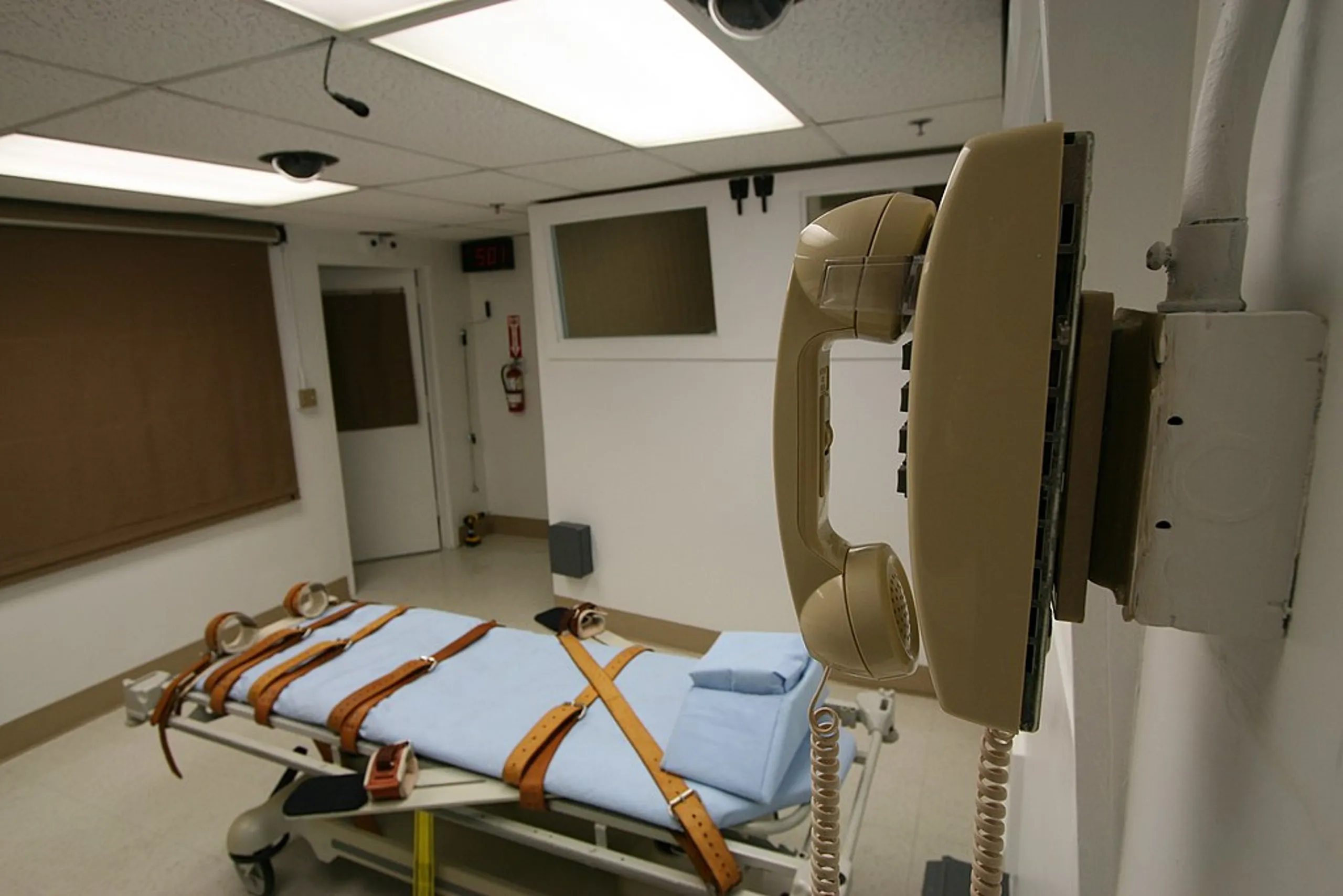
Executions can cause prison staff to suf­fer psy­cho­log­i­cal dis­tress sim­i­lar to what vet­er­ans expe­ri­ence

after war. A 2022 NPR inves­ti­ga­tion found that cor­rec­tions offi­cers faced symp­toms such as insom­nia, night­mares, pan­ic attacks, sui­ci­dal thoughts, per­son­al­i­ty changes, and sub­stance abuse – all hall­marks or comor­bidi­ties of post-trau­mat­ic stress dis­or­der. Of the 16 peo­ple NPR inter­viewed who par­tic­i­pat­ed in exe­cu­tions, none sup­port­ed the death penal­ty in their wake. Psychologists use the term ​“moral injury” to describe how com­mit­ting an act that con­tra­dicts one’s deeply held beliefs, such as caus­ing anoth­er person’s death, cre­ates a severe psy­cho­log­i­cal dis­rup­tion. Robert Jay Lifton and Greg Mitchell coined the term ​“executioner stress” to describe the spe­cif­ic men­tal impact of car­ry­ing out the death penalty. 

The stress may also extend to guards who do not par­tic­i­pate in the exe­cu­tion itself, but devel­op close rela­tion­ships with death-sen­tenced pris­on­ers over the course of decades work­ing on death row. Some cor­rec­tions offi­cers have remarked that they spend more time with the peo­ple on death row than their own fam­i­lies. They may come to see the con­demned pris­on­ers as friends, or wit­ness the pris­on­ers’ men­tal or phys­i­cal vul­ner­a­bil­i­ties. In stud­ies, offi­cers have expressed con­cerns about the arbi­trari­ness of the death penal­ty, not­ing that they had worked with many peo­ple with life sen­tences who com­mit­ted equiv­a­lent or worse crimes than the peo­ple the offi­cers helped put to death. 

There is a part of the war­den that dies with his pris­on­er,”

The psy­cho­log­i­cal toll of per­form­ing exe­cu­tions is not a new phe­nom­e­non. Donald Cabana and Jerry Givens both con­duct­ed exe­cu­tions in the begin­ning of the mod­ern era, in the late 1970s and ear­ly 1980s, and went on to pub­licly oppose the death penal­ty. ​“There is a part of the war­den that dies with his pris­on­er,” Mr. Cabana often said.

Journalist Jennifer Gonnerman researched New York’s last four exe­cu­tion­ers, who over­saw the use of the elec­tric chair from 1913 through 1963, a peri­od dur­ing which hun­dreds of peo­ple were put to death. Several of the men expe­ri­enced med­ical issues around the time of exe­cu­tions, such as migraines or faint­ing spells. One, Robert Elliot, lat­er became a promi­nent death penal­ty abo­li­tion­ist. Two of the men, John Hulbert and Dow Hover, died by suicide. 

Yet prison staff have long faced a cul­ture of silence about exe­cu­tion-relat­ed trau­ma. ​“We don’t talk about it,” said Justin Jones, direc­tor of the Oklahoma Department of Corrections from 2005 to 2013, who joined the effort to increase the time between exe­cu­tions (see Oklahoma below.)  ​“Correctional offi­cers are pub­lic ser­vants on the low­est salaries in state gov­ern­ment, and they get home at the end of the day and just absorb it.” NPR’s inves­ti­ga­tion revealed that some exe­cu­tion team mem­bers had nev­er even told their fam­i­lies they par­tic­i­pat­ed. ​“We all knew to keep it silent,” said Catarino Escobar, who worked on the exe­cu­tion squad in Nevada. Mr. Escobar was strapped to the gur­ney when he played the pris­on­er dur­ing a prac­tice ses­sion, and he grew pan­icked and became con­vinced he was going to die. NPR found that only one of the offi­cers they inter­viewed had ever received men­tal health care relat­ed to their posi­tion, and even when care was offered, it was ​“over­whelm­ing­ly option­al” and ​“many of them avoid­ed ask­ing for it so as not to seem weak.” 

Oklahoma

In this con­text, uni­fied efforts by cor­rec­tions staff to address the psy­cho­log­i­cal effects of exe­cu­tions rep­re­sented a mile­stone. In March 2024 a group of nine for­mer Oklahoma cor­rec­tions offi­cials wrote a let­ter to Attorney General Gentner Drummond and, based on the detri­men­tal impact of the job and the lack of men­tal health sup­port, asked for an increase from a time of 60 to 90 days between executions. They not­ed that exe­cu­tion team mem­bers expe­ri­ence an increased risk of PTSD, sui­cide, and sub­stance abuse, and the gruelling prepa­ra­tion sched­ule puts staff mem­bers through­out the prison on edge due to ​“near-con­stant mock exe­cu­tions being con­duct­ed with­in earshot of pris­on­ers’ cells, staff offices, and vis­it­ing rooms.” With few state resources at their dis­pos­al, some employ­ees even resort­ed to talk­ing with defence men­tal health experts vis­it­ing the prison ​“about the dis­tress they are expe­ri­enc­ing due to the non­stop executions.” 

This com­pressed exe­cu­tion sched­ule also increas­es the risk of some­thing going wrong dur­ing the exe­cu­tion process because the stress cre­at­ed by each exe­cu­tion com­pounds the dif­fi­cul­ty of an already com­plex pro­ce­dure. If even a rou­tine exe­cu­tion can inflict last­ing harm on cor­rec­tions staff, the trau­mat­ic impact of a botched exe­cu­tion is expo­nen­tial­ly worse. Oklahoma has expe­ri­enced this harm on mul­ti­ple occa­sions and should not need­less­ly place its hard­work­ing cor­rec­tion­al staff at risk of anoth­er such mistake.

“Prison staff need to ‘man up'” Judge says

Judge Gary Lumpkin dismissed these concerns, telling officials that prison staff needed ‘to suck it up’ and ‘man up’.  Prison staff were report­ed­ly angered by Judge Lumpkin’s com­ments that they need­ed to ​“man up” and the sug­ges­tion that their con­cerns were not valid. ​“Anybody that thinks that exe­cut­ing some­body is no prob­lem has not been a part of the process,” said Justin ​“JJ” Humphrey, the state assem­bly chair of a crim­i­nal jus­tice and cor­rec­tions com­mit­tee and 20-year vet­er­an of the cor­rec­tions depart­ment. The Oklahoma Court of Criminal Appeals even­tu­al­ly grant­ed the exten­sion request in May. 

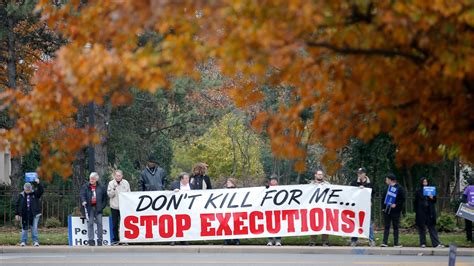
(Source: Death Penalty Information Centre – December 2024). Image: USA Today.

Follow us on Bluesky

Death penalty rage in US


A spate of executions in US prompts rage and frustration

December 2024

The authoritative Death Penalty Information Center in the US has published its 2024 report on executions in the USA. The num­ber of new death sen­tences in 2024 increased from 2023, with 26. The num­ber of peo­ple on death row across the United States has con­tin­ued to decline from a peak pop­u­la­tion in the year 2000. Support for the penalty in the US has continued to decline.

Three of the cases it highlights are those which the Salisbury group has campaigned on: Marcellus Williams, Robert Roberson and Richard Glossip.

It has mainly been the Southern states that stick to this penalty. Indeed, it is just four states that conducted 76% of executions: Alabama, Oklahoma, Texas and Missouri. Concern has been expressed that too many people are executed who have a credible defence of innocence. Many of those who await execution or who were executed demonstrate classic vulnerabilities, including intellectual disability or brain damage, serious mental illness, or a history of severe childhood trauma or abuse.

The US joins a motley crew of countries which execute significant numbers of its citizens. China leads the way with large numbers executed but the numbers are a state secret. Others include North Korea, Iran, Saudi Arabia and Iraq.

Why should it be banned? There are five good reasons:

  • It is not a deterrent. If it was, one would expect to see a fall in violent crime in the states using the penalty. There is no such correlation.
  • It is irreversible. Mistakes cannot be put right. There is no comeback from an execution. We can quote Andy Malkinson who was released after 17 years in prison for a crime he did not commit. Had he been executed …
  • It is often used as a political tool especially in countries such as Iran, Saudi and China. There are elements of this in the Southern states of the US with disproportionate numbers of Black people on death row.
  • It is often used after unfair justice. Readers of Clive Stafford-Smith’s work, for example, Injustice, will know that the process of criminal trials in the US is far from perfect or fair. There is no obligation on police to produce evidence that proves a plaintiff’s innocence. Plea bargains are frequently used to enable one participant to escape justice at the expense of another. Juries are often biased.
  • It is discriminatory with a preponderance of black people or those with mental impairment who find themselves on death row.

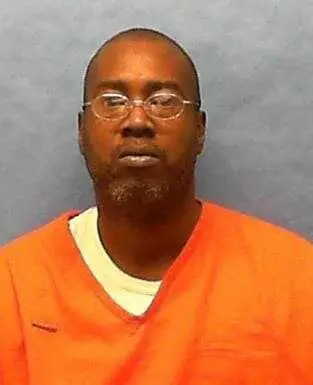
In Oklahoma, Richard Glossip (pictured) is one of the cases the group has pursued which illustrates several of the

above points. Doubts around the death sentence of Glossip also provoked intense soul-searching. Glossip was convicted of the 1997 murder of Barry Van Treese, the owner of a motel in Oklahoma City which Glossip managed.

He was convicted based on the testimony of a co-worker who later admitted he was the actual murderer. It was also recently revealed that prosecutors destroyed evidence before trial that could have cleared Glossip.

The Report notes that the Supreme Court has largely abandoned its role of critical appraisal of cases which come before it. When Donald Trump assumes the role of President a month from now, he is committed to accelerating the pace of Federal executions. It is likely that a number of death row inmates will die who have credible doubts about their convictions.

Recent Posts:

Alabama’s third execution this year


Many troubling aspects to this case. Urgent action with full details available here

July 2024

Keith Gavin is scheduled to be executed in Alabama next week on 18 July 2024. He was convicted in 1999 of a murder committed in 1998 and sentenced to death on a jury vote of 10-2 for the death penalty. In 2020, a federal judge found that his legal representation at the sentencing phase had been constitutionally inadequate, but in 2022 the Court of Appeals reversed this decision. International legal standards require that anyone facing the death penalty be provided effective legal assistance at all stages of the case. This standard was not met. We urge the Governor to commute this death sentence.

There are a number of troubling aspects to this case not least the poor and ill-prepared defence (defense) he received. After the trial, appeal lawyers discovered much mitigation evidence not heard by the jury, including multiple psychological risk factors from Keith Gavin’s childhood and adolescence, including his exposure to violence at home and in the community. He was one of 12 siblings growing up in a dilapidated apartment in Chicago’s notorious public housing projects; his closest siblings all had histories of incarceration and drug dependencies. He was subjected to more paternal beatings than the others because he “accepted responsibilities for things he had not done because he felt he was strong enough to accept the whippings”. Outside the home, the exposure to violence took the form of pervasive gang activity. Seven of the 12 children ultimately joined gangs, and several became victims of gang violence.

The Governor of Alabama said “Although I have no current plans to grant clemency in this case, I retain my authority under the Constitution of the State of Alabama to grant a reprieve or commutation, if necessary, at any time before the execution is carried out,” Ivey said in her letter to Alabama Department of Corrections Commissioner John Hamm. (Source: Montgomery Advertiser)

Full details of this case can be accessed here and we urge those reading this to write to the Governor (model letter available) as soon as you can. The US is the only country in the Americas to retain the death penalty.

1721170800

  days

  hours  minutes  seconds

until

Execution

"Amnesty International" "Human rights" Amnesty Arms arms sales Arms trade Bahrain Belarus Cathedral China conservatives Death penalty death row ECHR Egypt FCO film Gaza Group news HRA Human rights Human Rights Act immigration India Indonesia Iran Israel Japan John Glen MP minutes North Korea Oklahoma Pakistan Palestine refugees Reggie Clemons Salisbury Saudi Saudi Arabia Texas UK urgent action USA vigil Yemen

Richard Glossip’s execution stayed


The execution of Richard Glossip in Oklahoma has been stayed by the Supreme Court

May 2023

Richard Glossip has been on death row in Oklahoma, USA, for 25 years for a murder it seems likely he did not commit. He was accused of the murder of motel owner Barry van Treese in 1997. The conviction was largely based on the plea bargain struck by Justin Sneed, who has a history of mental illness, in a deal which saved his own life.

Two independent investigations have cast doubt on the veracity of the trial. First the only evidence seemed to be the plea bargain by Sneed who in fact admitted committing the murder. Further testimony by prison inmates was not given to the jury. The State withheld evidence and other evidence was either lost or destroyed by the DA’s office.

As Mr Glossip’s execution date of May 18th draws near, there has been a flurry of activity to get it delayed or vacated. On April 7th, the Oklahoma Attorney General Gentner Drummond – a pro death penalty Republican – asked the state Court of Criminal Appeals to vacate the conviction. He said “the only witness to allege Mr Glossip was involved in this case cannot be believed, it is unconscionable for the State to move forward with his execution“.

On April 20th, the Oklahoma Court upholds the conviction. On 26th April the Board of Pardons and Paroles declined to recommend clemency on 2-2 vote which meant the Governor, Kevin Stitt, was unable to do so either.

On May 5th, the Supreme Court of the United States stays the execution pending the disposition of two writs of certiorari. Should they be denied this stay will terminate automatically.

So that is the current position. The case reveals some troubling aspects of the legal system in this instance. Relying on plea bargain evidence should not be the sole justification for a conviction let alone an execution. The failure to present all the evidence to court is also questionable and the loss or destruction of other evidence is also to be deplored. The fundamental problem with the death penalty is that mistakes cannot ever be rectified once the deed is done.

We must hope that the intervention of the Supreme Court will lead to the state authorities to think again.

Sources: Death Penalty Information Centre; Wikipedia; New York Times, Save Richard Glossip Campaign

Death penalty report: July


We are pleased to attach our latest monthly death penalty report with thanks to group member Lesley for preparing it. Note that it does not contain any details from China which is the world’s largest executioner of its citizens because details are a state secret. However, a report of the Chinese execution practices was printed in the Sun newspaper in the UK (warning – contains disturbing images).

The death penalty in USA


Eloquent piece by Clive Stafford Smith of Reprieve concerning the death penalty in the USA

Stafford Smith has represented many individuals on death row in the USA so his experience of a dysfunctional and unfair system is considerable. Many more black people are convicted than white people. There is no obligation on the police to make exculpatory evidence available. Prisoners spend decades on death row going through seemingly endless appeals. One case – Kris Maharaj – which we have highlighted on this site, is a case of miscarriage gone badly wrong. Despite copious evidence that he had nothing to do with the murder, he still languishes in prison in Florida. New evidence cannot be introduced at the appeal stage. The level of mistakes is high at around 10% and one of the problems with executions is that they cannot be put right.

Judges may have little criminal experience. Defendants are usually poor and cannot afford experienced or capable lawyers.

This account is of the USA but we should remember that the system is much worse in some other countries of the world: Egypt, Saudi Arabia, Iran for example and that thousands are executed in China where details are a state secret.

Death penalty in USA

Source: Al Jazeera

Reprieve

The US execution spree


The US rushed to execute 13 before Jo Biden became president

January 2021

Shock was widely expressed following the execution of 13 people in the final days of the Trump presidency and just days before president elect Jo Biden takes office on 20th.  President Trump has been the most prolific executioner in more than a century.  There has been a gradual drift away from this use of the penalty in the USA – the only American nation still to have the penalty – and the executions are out of step with trends and attitudes among the US public.  These executions took place in federal prisons. It has been criticised as vindictive.

The Attorney General, William Barr said:

[…] We owe it to the victims and their families to carry forward the sentence imposed by our justice system.  US Department of Justice statement when federal executions were resumed after two decades.  July 2019 [accessed 16 January 2021]

Lisa Montgomery executed


Lisa Montgomery was executed in the Federal prison of Terre Haute, Indiana today (Wednesday, 13 January 2021) after a long legal struggle to save her from this punishment. The case has caused a major debate in the US partly because Lisa was the first woman to be executed in nearly seven decades. She was executed in a federal prison, not a state one.

There is no doubt that her crime was horrific. But there seems little doubt also that her upbringing, which included being gang raped more than once, contributed to her lack of mental wellbeing and borderline personality disorder. It is unlikely she was aware of what was happening to her. She was the 11th person to be executed at Terre Haute since President Trump resumed federal executions.

The US is the only country in the Americas to retain the death penalty and not all states in the union practise it.

There is no evidence to support the maintenance of this penalty. It does not deter and it brutalises those involved in it. It can make securing convictions harder if juries are unwilling to agree a guilty verdict if there is a risk of execution. It is extremely expensive as we noted in a previous post and it has cost California for example, around $12bn to administer since 1978.  For poor people, unable to employ expensive lawyers, the system is stacked against them.  Mistakes – and there are many – cannot afterwards be rectified.  

Death penalty in America: CNN interview


This is an interview on CNN of Helen Prejean who is an active campaigner against the death penalty in the USA.  Helen is a Roman Catholic, born in Baton Rouge Louisiana, and was chair of the National Coalition to Abolish the Death Penalty up to 1995.  She is the author of a book, Dead Man Walking.

The interview was made because of President Trump’s programme of carrying out a string of Federal executions in the lame duck period before President elect Joe Biden takes over in January.  The number of these is unprecedented.

CNN interview

President-elect Joe Biden and human rights


President-elect Joe Biden has declared that human rights will be an important part of his agenda when he becomes president in January.  Following a period when President Trump rowed back on a lot of US commitments in this area, this is clearly welcome.  So how is this likely to look?

Trump pulled the US out of the UN Human Rights Council in 2018 and this year designated the International Criminal Court a “security threat.”  It is expected that a Biden administration will reverse these decisions as well as re-staffing the depleted Human Rights Department of the US Department of Justice and returning to various arms control agreements.  It is also clear that Biden will take a multilateral approach to international issues, unlike his predecessor.

The US-based organisation Human Rights Watch have urged the new administration to reverse course:

On November 9, countries at the UN Human Rights Council reviewed the human rights record of the United States and offered recommendations on guaranteeing the right to health, including sexual and reproductive health, non-discrimination, voting rights, policing, and gender equality, among others.  The Biden administration should re-engage with the Human Rights Council, including by accepting Universal Periodic Review recommendations aligned with international human rights law, and realizing the human rights obligations identified by the council

They also urge the incoming regime also to repudiate the Department of State’s Commission on Unalienable Rights, which Trump set up to make a hierarchy of countries and abandon the universality of international human rights law.

Kate Allen, Director of Amnesty UK, has also urged the Biden administration to take a new approach to international law and has indicated 3 areas where the new administration needs to change its human rights policy internally – gun control, asylum seekers and police reform (AIUK, 9 November 2020).

In the run up to the election, Biden made a number of statements in defence of human rights, notably in the Middle East, which he may well struggle to carry out.  In the last week or two, Egypt and Turkey have both made a large number of arrests of dissidents (maybe hoping to do so before Trump leaves), and Saudi Arabia is sending feminist activists to a terrorism court.

As Kareem Fahim writes in the Washington Post (27 November 2020):

The moves in recent days, by a trio of authoritarian governments that are close allies or partners of the United States, have put human rights issues front and center weeks before President-elect Joe Biden takes office, in a pre-emptive challenge to his pledge to vigorously defend such rights.


Blog at WordPress.com.

Up ↑